
Evaluating Golf Instructors for Beginners: What to Expect
Learn how beginners can evaluate golf instructors, understand lesson costs, and what to expect from effective beginner golf lessons.
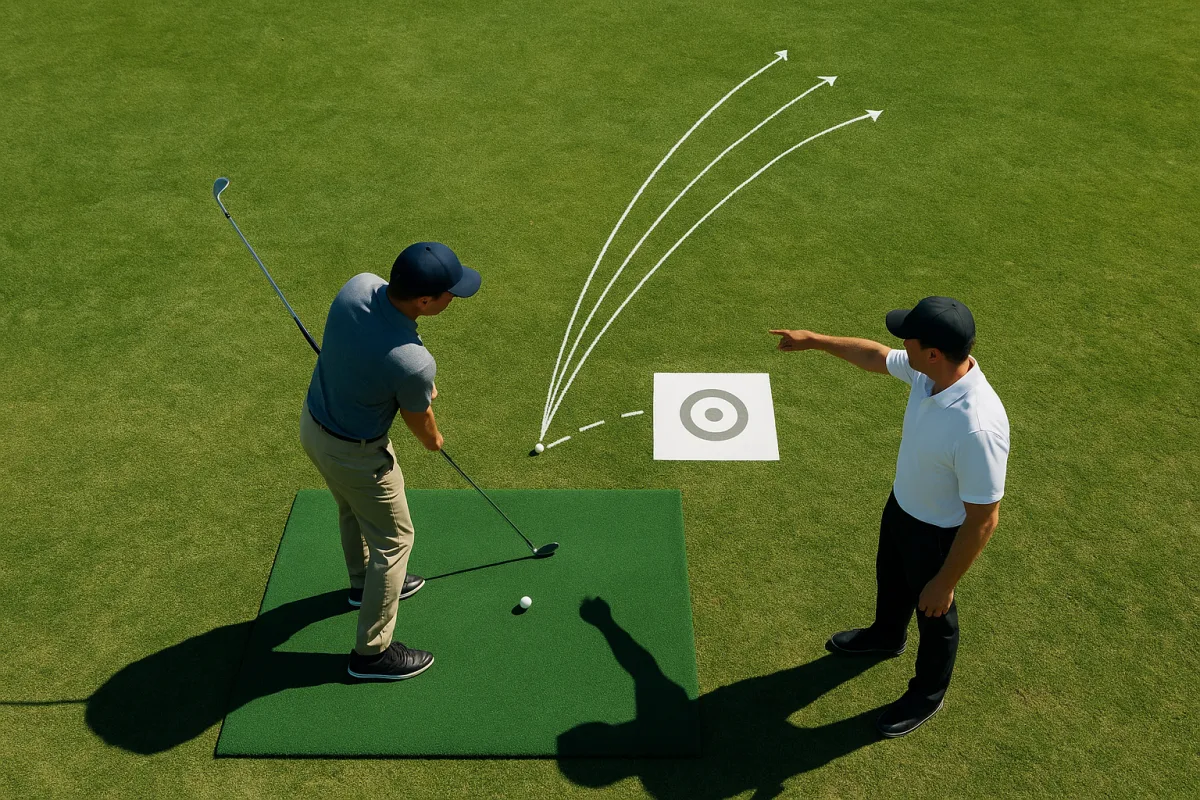
The ball that starts right, curves farther right, and lands in the next stall
A beginner’s first range session often produces the same confusing pattern: one shot flies straight, the next slices, then a third barely gets airborne. An instructor’s job is to sort that messy evidence into one change you can actually make.
That is the central test for choosing a teacher. Good instruction is a translation system: the instructor observes your swing, identifies the highest-priority pattern, explains it in language you understand, gives you a task, then checks whether the task changed the ball flight.
A PGA credential, a launch monitor, and a polished social-media swing video can all be useful signals. None guarantees that the teacher can stand beside your mat and explain why your 7-iron is topping the ball without burying you in six new positions.
The coaching loop: observe, explain, assign, verify
The best first lesson does not need to rebuild your entire swing. It needs to create a loop you can repeat after the instructor leaves: see the shot, understand the likely issue, rehearse one response, hit another shot, and judge the result.
For a new player, the visible outcome usually comes first. You may tell the instructor that your driver slices, your irons hit the ground behind the ball, or you cannot get a chip onto the green consistently.
The instructor then gathers information. That can include watching the swing, checking setup and grip, asking about your athletic background, and looking at the ball’s starting direction, curve, height, and strike location.
A launch monitor can add club speed, launch angle, and spin rate to that picture. Video can show positions that happen too quickly to see in real time. Those numbers and images are observations, not instructions by themselves. [26]
A 2,800-rpm driver spin rate, for example, does not come with a built-in correction. The number belongs to the club, ball, impact, and swing that produced it, so the instructor must explain whether it relates to your goal and what you should change next.
That translation is where instruction earns its fee. An instructor who says, “Your spin is high,” has given you a reading. An instructor who connects the reading to impact, gives you one feel, and shows how the next few shots changed has started coaching.
Why one priority beats a complete swing overhaul
Beginners can absorb only so much in a 30- to 60-minute lesson, which is the common range for introductory instruction. The format is meant to introduce fundamentals without overwhelming you. [13]
A poor lesson can leave you thinking about grip pressure, shoulder turn, hip rotation, wrist angles, head movement, club path, face angle, and tempo before you have hit ten balls. That is a recipe for paralysis on the range.
A good instructor may notice several issues but choose one that has the greatest effect on your next shot. For a player who swings across the ball with an open clubface, the immediate assignment might focus on setup or clubface control, not a full-body swing model.
This does not mean every slice has the same solution. A slice can involve face position, swing path, strike location, setup, or a mixture of those factors. A drill that helped one player can make another player worse if it addresses the wrong cause.
Ask the instructor directly: “What is the one thing you want me to work on before our next lesson?” If the answer is clear enough to write on your phone in one sentence, you have a usable practice plan.
Also ask what success should look like. It may be a tighter starting line, cleaner contact, fewer severe curves, or a repeatable pre-shot setup. It does not need to be an extra 20 yards by the end of one session.
Immediate improvement is an unrealistic expectation for many beginners, particularly when a change feels unfamiliar at first. Clear goals, focused instruction, and realistic expectations are recurring recommendations for avoiding a bad instructor-student fit. [20]
Credentials are a starting screen, not the final answer
Recognized certification tells you that an instructor has completed some structured preparation. It is worth checking, especially when you have no personal referral, but certifications do not supply a universal ranking of teachers for every beginner.
PGA of America membership requires a multi-year process and includes a Player Ability Test, where candidates must demonstrate the equivalent of a 15 handicap across 36 holes. [1] That makes it a meaningful signal of playing ability and professional training.
The United States Golf Teachers Federation, or USGTF, offers certification through online material and a four-day on-site course. Its next listed on-site course is in Fort Pierce, Florida, in November 2026. [2]
The Professional Golf Teachers Association of America, or PGTAA, centers its program on teaching skills and player development, awarding graduates the designation Class A Master Teaching Professional. [3] That emphasis can appeal if you want a teacher focused on building a player over time.
Titleist Performance Institute, commonly called TPI, certification focuses on the relationship between the body and the golf swing. It can be relevant if mobility, prior injuries, strength, or physical limitations affect how comfortably you can move. [1]
LPGA Teaching and Club Professional certification is another recognized pathway, with particular relevance to women’s and junior instruction. Golf Digest also offers a certification program built around video curriculum from established instructors and a directory listing. [1][6]
We would use credentials to make a shortlist, then judge the actual lesson. There is no published evidence here that one certification produces a guaranteed improvement rate or that one credential is universally better for a beginner.
Communication is the skill you are buying
A teacher can know plenty about swing mechanics and still be wrong for you if the explanation never lands. Beginners need plain language, a chance to ask questions, and feedback that tells them what to keep doing as well as what to change.
Pay attention to the first conversation. A compatible instructor asks what brought you to golf, how often you expect to play, whether you have any physical concerns, and what type of shot frustrates you most. [7]
Your answer might be modest: make enough contact to enjoy a scramble, get the ball in play off the tee, or stop fearing bunkers. That goal should shape the lesson plan more than an instructor’s preferred swing theory.
Ask how the instructor handles a player who is not improving after two or three sessions. The answer should involve reassessing the task, checking the practice method, and adjusting the explanation, not simply repeating the same cue louder.
Communication also includes restraint. A teacher who gives you one priority, then watches you attempt it, is generally serving a beginner better than one delivering a long technical speech while you hold a club.
Technology helps only when it changes the next shot
TrackMan, FlightScope, video analysis, swing analyzers, and putting systems can make lessons more specific. They can report metrics such as club speed, launch angle, and spin rate, while video gives visual learners a way to connect a feeling with a movement. [26]
Studies of golf-swing learning have found that video feedback can improve performance compared with self-guided practice. [25] Still, the screen should support the lesson, not become the lesson.
For a beginner, ask the instructor to show you one number and explain why it matters to your current goal. If your driver launches too low, for example, the instructor should connect the displayed result to a setup, strike, or delivery change you can rehearse.
The same standard applies to video. You do not need a frame-by-frame diagnosis of every body segment. You need a before-and-after image or a single checkpoint that helps you understand the assigned drill.
We would skip the instructor who uses technology as a sales display but cannot turn it into an actionable task. A launch monitor produces precise measurements, yet its value depends on the teacher’s ability to interpret them for your swing. [26]
What the lesson plan costs
Private beginner lessons commonly run $50 to $75 per hour at the entry level, $75 to $125 per hour with an experienced instructor, and $125 to $200 or more with top-tier teachers. Metropolitan areas and high-end facilities generally charge more than rural locations. [8]
Those rates normally cover the instructor’s time. They may not cover range balls, simulator bay fees, course access, rental clubs, or a facility charge, so ask what is included before booking.
Group clinics usually cost $20 to $50 per person for each session. [8] They are a lower-cost way to learn grip, stance, and basic shots, although you will receive less individual diagnosis and less time hitting under direct observation.
Five-lesson packages commonly run $200 to $500. [8] We would not buy one immediately unless the first lesson establishes clear communication, a focused plan, and a practice assignment you understand.
A package works when each session checks the previous assignment and adds the next layer. It wastes money when every appointment restarts with a new tip because neither you nor the instructor can describe what happened between lessons.
Set the schedule around practice, not urgency
Weekly lessons for the first one or two months are commonly recommended to establish fundamentals and limit the time spent rehearsing poor habits. After that, every-other-week sessions can give you more time to practice and consolidate changes. [12]
A 30-minute session may suit a player who needs a quick check on one priority. A 60-minute session gives more room for explanation, drills, and feedback, but only if you can remain focused and physically comfortable. [13]
Frequency depends on your available practice time. If you cannot hit balls or rehearse setup between weekly lessons, you may arrive each time needing a refresher. If you practice regularly, an instructor can use the next appointment to refine what you learned.
Weather can shape the plan as well. Northern states often have limited outdoor instruction from roughly April through November, with offseason lessons shifting toward indoor simulators and tools such as FlightScope or SAM PuttLab. [15][17]
Southern facilities can offer outdoor teaching and on-course strategy throughout the year. [17] If winter indoor lessons are your reality, ask how the instructor will carry simulator work back onto grass, uneven lies, bunkers, and the shots you face on an actual course.
The first lesson should leave you with a map
Bring your own club if you have one, wear clothes you can swing in, and arrive with one or two goals. Then listen for the coaching loop: what the instructor saw, why it affects your shots, what you will work on, and how you will measure progress.
Before you leave, write down the drill, the intended ball-flight change, and how often to practice. Ask whether you should use full swings, half swings, slow rehearsals, or short-game shots to build the pattern.
We would choose the instructor who makes your next range session clear. The right guidance does not promise a finished swing in an afternoon. It gives you one understandable task, a reason for doing it, and a way to know whether it is helping.
Frequently Asked Questions
How can beginners evaluate if a golf instructor is right for them?
Beginners should look for an instructor who can clearly identify one manageable priority to work on rather than overwhelming them with multiple swing changes. A good instructor translates swing observations into simple language, assigns a focused drill, and verifies if it improves the shot. Asking the instructor to explain one swing number, one video image, and one drill in plain terms before committing helps assess communication and teaching style.
What should beginners expect during their first golf lesson?
The first lesson typically lasts 30 to 60 minutes and focuses on fundamentals without overwhelming the student. The instructor observes the swing and ball flight, identifies the highest-priority issue, explains it clearly, assigns one drill or adjustment, and checks the results. Beginners should expect to work on one specific change rather than a complete swing overhaul.
How much do beginner golf lessons typically cost?
Private beginner lessons generally cost between $50 and $125 per hour depending on the instructor’s experience. Package deals of five lessons usually run from about $200 to $500. Group clinics may be less expensive, ranging from $20 to $50 per session per person.
What questions should beginners ask a golf instructor before committing?
Beginners should ask the instructor to explain one swing metric, one video image, and one drill in plain language to gauge clarity and communication. It is also helpful to ask what the one key thing to work on before the next lesson is and what success should look like. This ensures the practice plan is focused and the goals are realistic.
How important is communication in golf instruction for beginners?
Clear communication is critical for beginners to understand what to work on and why. An instructor who can translate technical data and observations into simple, actionable advice helps avoid confusion and frustration. Good communication supports a coaching loop where the student observes results, understands the issue, practices a response, and evaluates improvement.
How we researched this
This article was assembled from 28 cited references.
Nothing here is based on hands-on testing. Where a figure or finding appears, it belongs to the source cited beside it, and the writing says so rather than implying otherwise. Every source is listed below so you can check it.
Sources
- How to Become a Golf Instructor in 2026
- USGTF - Learn To Teach Golf - Become a Certified Golf Teacher, Certified Golf Coach, Golf Instructor - United States Golf Teachers Federation
- PGTAA - Learn To Teach Golf - Become a Certified Golf Teacher
- Golf Coach Qualifications: What to Look For | Beyond Golf Performance
- Golf Instructor Hiring Guide: Find Top Talent Fast
- Subscribe to Golf Digest Certification | GolfDigest.com
- How to Choose a Golf Instructor: Key Tips and Qualifications
- How Much Do Golf Lessons Cost in 2026? (Real Pricing Data)
- How Much Are Golf Lessons? (Real 2026 Pricing) | The Other Golf Channel
- 2026 Golf Lessons Prices (with Local Costs) // Lessons.com
- Golf Lessons Cost and Beginner Guide: What to Expect and How to Budget | DrivingRangeAtlas
- How Often Should You Take Golf Lessons? | Fulcria Labs
- How Long Should a Golf Lesson Be to Actually Improve Your Game? - Azgolflessons
- Golf Lesson Frequency Guide for Faster Improvement
- Northeast Golf Weather: When the Season Opens and Where to Play | PinWeather Golf
- When Does Golf Season End? Regional Dates & Guide
- Seasons Change, and so Does the Golf Instruction - Golf Range Association
- Back to Golf School - for Adults and Retirees
- Golf School Enrollment Demand in the US: 2025-2026 Trends
- Mistakes Beginners Make When Choosing a Golf Schools | Differ
- Women's Golf Lessons: How to Find the Right First Instructor
- First Golf Lesson: What to Expect & How to Prepare | TeachMe.To
- Golf Instructor Warning Signs Every Student Should Know
- OPTIMOTION: Why 3D Data Beats 2D Video for Golf Lessons
- The efficacy of video feedback for learning the golf swing
- How technology transforms golf instruction: What really works - Golf Blab
- The Ghost in the Machine: Why AI Can't Fix Your Golf Swing (And Why Coaches Aren't Going Anywhere) | SwingMatch Blog
- How Often Should You Take Golf Lessons? A Full Guide
Related Articles
How to Start Playing Golf
Learn how to start playing golf with beginner equipment advice, practice routines, swing basics, and etiquette tips for new golfers.
Best Golf Training Aids for Beginners
Discover the best golf training aids for beginners, comparing alignment sticks and the Orange Whip to improve your swing and setup effectively.
How to Choose a Golf Instructor: Key Tips and Qualifications
Learn how to choose a golf instructor with the right qualifications, teaching style, and lesson plan to improve your game effectively.
Golf Course Features for Beginners: What to Look For
Learn key golf course features for beginners, including fairway width, landing zones, course length, and green design to improve your game.