
Best Golf Training Aids for Beginners
Discover the best golf training aids for beginners, comparing alignment sticks and the Orange Whip to improve your swing and setup effectively.
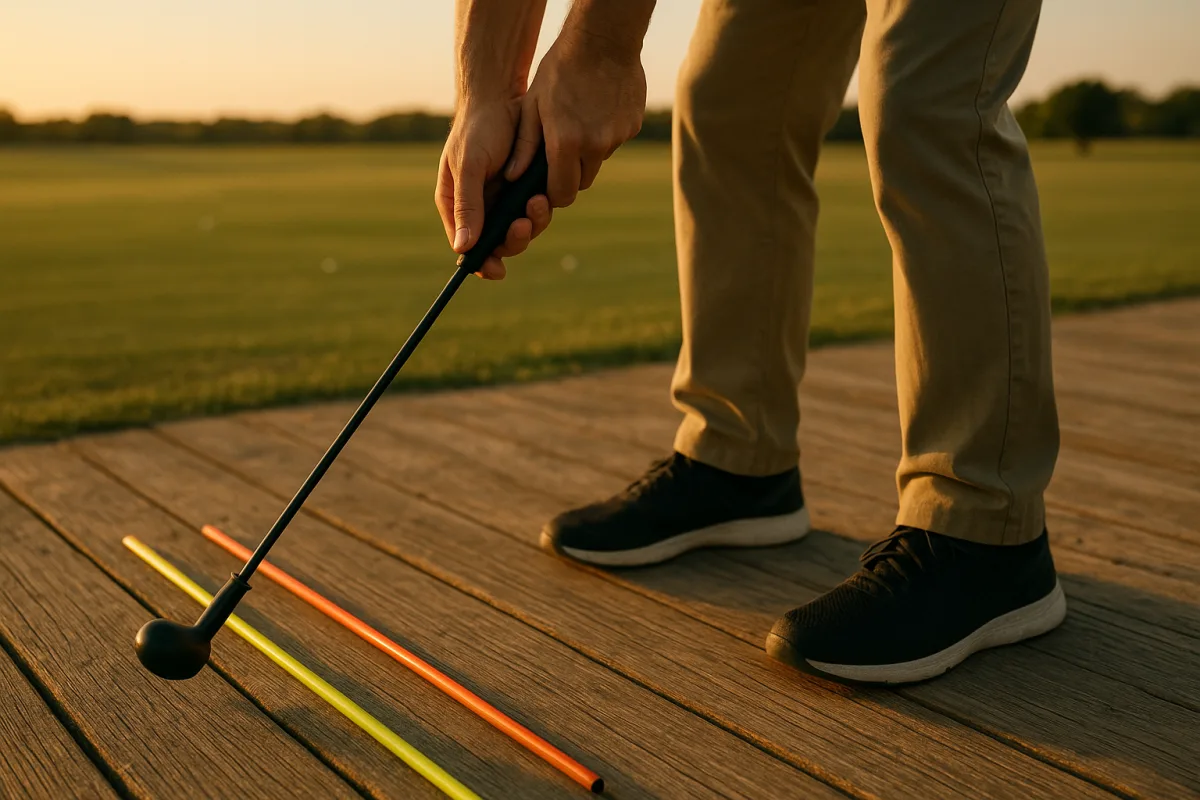
The first training aid should solve a problem you can see
You are standing on the range, trying to stop a slice, hit the middle of the clubface, and make contact before the bucket runs out. Buying a training aid will not organize that practice for you.
For a beginner, the best aid is usually the one that gives clear feedback on a fundamental movement or setup position. It should help you notice what changed, then let you hit normal shots without becoming dependent on it. [20][21]
Our pick is the Callaway Alignment Sticks. They are an entry-level tool for improving alignment and swing path, and they can also give you reference points for stance, ball position, posture, and takeaway direction. [4][12]
The Orange Whip Compact Swing Trainer is a close second, and it may be your better purchase if tempo and balance are the obvious weak links. It is an entry-level swing trainer aimed at building rhythm and tempo from day one. [1]
Neither tool can diagnose every miss. A slice caused by an open clubface, poor alignment, a steep path, or a grip problem can look similar in ball flight, but it needs a different fix.
Callaway Alignment Sticks vs. Orange Whip Compact Swing Trainer
| Criteria | Callaway Alignment Sticks | Orange Whip Compact Swing Trainer |
|---|---|---|
| Main job | Improves alignment and swing-path awareness | Develops swing rhythm, tempo, balance, and sequencing |
| Feedback type | Visual, using ground and body-position reference lines | Tactile, through the trainer’s movement and weight |
| Best beginner problem | Aiming poorly, inconsistent setup, uncertain ball position, or an unclear path | Rushing the downswing, losing balance, or struggling to feel a connected rhythm |
| How it fits ball practice | Can stay in place while you hit shots, if positioned safely | Usually used for rehearsal swings before returning to a normal club |
| Short-game value | Can help organize putting alignment and setup drills | Primarily a full-swing rhythm tool |
| Learning curve | Very low, but you need a specific drill | Very low, with feedback that is immediate and easy to feel |
| Risk of misuse | Can become visual clutter or encourage you to chase a line instead of hitting shots | Can create a rehearsed motion that does not transfer if you never return to your own club |
| Space required | Small practice area, range bay, or putting surface | Enough room to swing safely, indoors or outdoors |
| Cost position | Entry-level | Entry-level, but typically a step up from basic alignment sticks |
| Our verdict | Best first aid for most beginners | Best first aid for the beginner whose setup is stable but tempo is not |
1. What each one teaches
Callaway Alignment Sticks teach external references. Place one along your toe line and another to establish ball position or swing-path guidance, and you can see whether your feet, shoulders, and club are aimed where you think they are.
That is valuable because poor alignment can make you alter your swing to compensate. If you aim right and then throw the club over the top to pull the ball back toward the target, you may blame the swing when setup started it.
The Orange Whip Compact teaches feel. Its purpose is to promote rhythm, balance, flexibility, and a better sense of sequencing through the swing. Orange Whip trainers are widely used by amateurs and professionals, and Golf Digest has recognized the line as a leading swing trainer. [1][12]
For a newcomer, that feel can be helpful because many early swings are all arms and urgency. The trainer gives immediate tactile feedback when you snatch it back, rush from the top, or lose balance through the finish.
The limitation is clear. A smoother rehearsal does not automatically fix an open clubface, poor grip, or misaligned stance once you put a regular club behind a ball.
2. Feedback and practice effectiveness
Alignment sticks give visual feedback before and during the shot. You can check whether your feet and shoulders are parallel to the target line, then use the same reference for several balls without guessing at your setup.
That makes them unusually versatile. Basic alignment sticks are commonly used by skilled players because they can support setup, posture, takeaway, swing-path, and putting drills without prescribing one permanent motion. [12]
The Orange Whip Compact gives tactile feedback, which can be easier for a beginner who cannot yet recognize a rushed transition on video. You feel the trainer’s momentum, then try to reproduce a calmer sequence with your normal club.
We would use it in short blocks, not for every swing. Make several rehearsals, hit a few balls with your own club, and judge the result by strike, start line, and balance, not by whether the rehearsal felt elegant.
Both options satisfy the basic beginner requirement of immediate feedback. The difference is where that feedback appears: alignment sticks show you the framework, while Orange Whip asks you to feel the motion inside it.
3. Transfer to the course
Callaway Alignment Sticks win this category because every shot begins with an aim line, ball position, and body alignment. You will not bring the sticks onto the course, but you can build a repeatable pre-shot routine around the positions they taught you.
Use them at the range, then remove them for the final portion of practice. If your shots fall apart without the reference, slow down and check your setup between balls instead of reinstalling a guide for every swing.
The Orange Whip Compact transfers best when you struggle with tempo under pressure. Its intended lesson is not a particular ball-flight pattern, but a smoother rhythm and a balanced finish you can recall on the first tee.
It falls down if you use it as a warm-up substitute for actual ball practice. Your driver, iron, and wedge do not have the same length, weight, or turf interaction, so you still need to hit real shots with your own clubs.
4. Space, season, and convenience
Callaway Alignment Sticks work in the smallest area of the two. A carpet, putting mat, garage bay, or range stall can be enough, provided you are not making full swings in a confined space.
The Orange Whip Compact needs safe swinging room. Indoor full-swing practice requires adequate ceiling height, roughly nine feet, plus consideration for noise, protective mats, and nearby objects. [15]
Outdoor practice gives both aids more room, although wind can move lightweight equipment and change what you feel during a rehearsal. Cold-weather golfers may get more value from compact indoor setup drills during winter, then take full-swing work outside in spring and fall. [16][17]
Neither aid replaces warming up. Start with easy movement and controlled swings, especially if you are new to repeated practice, because forcing fast repetitions can reinforce poor movement or create unnecessary strain. [19]
5. The value question
Both are entry-level products, but Callaway Alignment Sticks are the cheaper route to a broad set of drills. That matters when you do not yet know whether your biggest issue is aim, posture, ball position, path, or contact.
The Orange Whip Compact costs more than basic sticks, but it has a clearer purpose. Buy it if you already know that your setup is workable and your swing loses rhythm when you try to create speed.
We would skip the urge to move immediately into premium technology. A launch monitor can produce ball-speed, launch-angle, and carry-distance numbers, but a number belongs to the swing that produced it, and beginners often need clearer movement priorities first. [3][4]
More data can become another distraction if you do not know which number connects to your strike pattern. Most early improvement comes from repeatable setup, centered contact, and enough practice to recognize your usual miss.
Where the other beginner aids fit
The Orange Whip Compact Swing Trainer, SKLZ Golf Grip Trainer, PuttOut Pressure Putt Trainer, and Callaway Alignment Sticks sit in the entry-level group. Each addresses a distinct beginner need, so buying all four at once is rarely the answer.
The SKLZ Golf Grip Trainer suits a player who needs help developing proper grip pressure and hand placement. Grip is central to clubface control and consistent ball striking, but a molded guide can become a crutch if you never hit shots without it.
The PuttOut Pressure Putt Trainer suits the beginner who wants to improve putting accuracy, pace control, and stroke consistency. It gives putting practice a target, which is often a better use of home time than making full swings in a tight room. [14]
The SKLZ Accelerator Pro Putting Mat is a mid-range option for developing a more consistent putting stroke. Its ball-return format can make repetition convenient, but use it for specific start-line and pace drills instead of rolling putts mindlessly. [13]
The Me And My Golf True Grip Glove is another mid-range grip-focused option, aimed at consistent hand placement. It suits golfers who repeatedly rebuild their grip between shots, though you still need to learn to place your hands correctly without the glove.
The Eyeline Speed Trap 2.0 is a mid-range path and strike aid. It suits a player with a defined issue, such as a path that repeatedly approaches the ball from the wrong direction, but it is less forgiving of vague practice goals.
The GFORCE Golf Swing Trainer is a mid-range option for sequencing and speed. It suits the beginner who has progressed beyond basic setup work and can practice a sequence calmly, without chasing speed before contact becomes reliable.
The Hackmotion Sensor 4 is a premium tool for monitoring wrist action and clubface control. It suits a player who can interpret wrist data with a clear coaching plan, not a newcomer who is still trying to establish grip and alignment.
The SuperSpeed Golf Training System is another premium option, designed for swing-speed and distance work. It suits golfers who have a stable movement pattern and want to pursue speed training, not beginners whose strike and balance vary widely.
The Lag Shot 7 Iron Swing Trainer is premium and targets lag and swing mechanics. It suits the player who benefits from a flexible-club feel, but it should not be your first purchase if you have not yet organized your setup and tempo.
Build a practice plan around one aid
Use two or three focused sessions each week, each lasting 45 to 60 minutes, for roughly two-and-a-half to three hours of weekly practice. Add short 10-to-15-minute home sessions for grip, setup, or putting work when possible. [10][11]
With alignment sticks, spend the opening part of a session checking aim, ball position, and posture. Then remove the sticks and hit normal shots, checking whether the same setup still produces a better start line and more centered contact.
With the Orange Whip Compact, make a small number of controlled rehearsal swings before hitting balls with your own club. Alternate between trainer swings and normal shots so the lesson becomes a playable motion, not a separate warm-up routine.
Avoid practicing too fast, using one device for every problem, or ignoring your short game. Common mistakes include relying on gadgets without a plan, expecting instant results, choosing an aid above your skill level, and reinforcing an incorrect movement through repetition. [19]
Track one outcome at a time. For sticks, that may be whether your ball starts closer to the intended line. For Orange Whip, it may be whether you finish in balance and strike more shots from the center of the face.
Who each option suits
Choose Callaway Alignment Sticks if: you are new enough that setup feels inconsistent, your shots start in unpredictable directions, or you want one entry-level aid for full swing, wedges, and putting. We would choose them first for most beginners.
Choose the Orange Whip Compact Swing Trainer if: you generally know where to stand and aim, but your swing feels hurried, unbalanced, or dominated by your arms. It is the better buy for rhythm, but not the broadest first tool.
Choose both only if: you can state two separate goals, one for setup and one for tempo, and give each tool part of a planned session. They are close because they solve two common beginner problems, but they should not compete for every swing.
Frequently Asked Questions
What are the best golf training aids for beginners?
The Callaway Alignment Sticks and the Orange Whip Compact Swing Trainer are top beginner aids. Alignment sticks help with setup, ball position, alignment, and swing path, while the Orange Whip focuses on rhythm, tempo, balance, and sequencing. Both provide immediate feedback and suit different beginner needs.
Which golf training aid should a beginner use first?
Most beginners benefit from starting with the Callaway Alignment Sticks because they address multiple fundamental setup and swing path issues without locking you into one swing thought. The Orange Whip is a better first aid if your setup is stable but your swing feels rushed or off-balance.
How do alignment sticks help beginner golfers?
Alignment sticks provide visual feedback by creating reference lines for feet, shoulders, ball position, and swing path. This helps beginners check and improve their aim and posture, reducing compensations caused by poor alignment. They are versatile and can be used for various drills including putting.
What does the Orange Whip Compact Swing Trainer teach beginners?
The Orange Whip Compact teaches feel by promoting rhythm, balance, flexibility, and proper sequencing in the swing. It provides immediate tactile feedback to help beginners avoid rushing the downswing or losing balance, encouraging a smoother, more connected swing motion.
How can beginners practice effectively with golf training aids?
Beginners should focus on one training aid with a specific drill for two or three sessions per week, each lasting 45 to 60 minutes, supplemented by short at-home practice. Consistent, focused practice with immediate feedback is more effective than rotating among several gadgets or hitting balls quickly without a plan.
How we researched this
This article was assembled from 21 cited references.
Nothing here is based on hands-on testing. Where a figure or finding appears, it belongs to the source cited beside it, and the writing says so rather than implying otherwise. Every source is listed below so you can check it.
Sources
- Orange Whip Trainer - Just Say Golf
- Best Golf Training Aids in 2026: 12 Tools That Actually Work | Fulcria Labs
- Garmin Approach R10 Portable Golf Launch Monitor | Best Buy Canada
- Best Golf Training Aids 2026: What Actually Improves Play - GolfSource
- Expert review: Top 7 golf training aids that help you in 2026
- Callaway Golf Swing-Easy Training Aid - Walmart.com
- TRS Slider - Golf Swing Tool
- TRS Slider Review: Is This The Best Training Aid On The Market?
- Best Golf Training Aids (2026): Instructor-Approved & Scored | LearnGolf
- Golf training routine: the complete program
- How Often Should Beginners Practice Golf? (A Coach's Simple Weekly Plan) | ATX Golf Performance
- Best Training Aids For Golf | Golf Equipment: Clubs, Balls, Bags | Golf Digest
- SKLZ Golf Accelerator Pro Putting Mat with Ball Return - Green, Forza Sports
- PuttOUT Pressure Putt Trainer Orca - Carl's Golfland
- Indoor vs Outdoor Golf Nets (Pros & Cons)
- Seasonal Golf Training: Adjusting Your Interval Routine Year-Round - Intervals.Golf Blog
- How to Build an Outdoor Golf Simulator Setup
- Top Golf Training Aids to Reduce Handicap | Best Golf Practice Tools 2026, My Store
- Common Mistakes to Avoid When Using a Golf Trainer for Swing Improvement -
- Golf Training Aids That Actually Work | The Smarter Play
- Do Golf Training Aids Work? An Honest Answer | Divot & Draw
Related Articles
How to Start Playing Golf
Learn how to start playing golf with beginner equipment advice, practice routines, swing basics, and etiquette tips for new golfers.
Starter Golf Equipment List: What You Need to Begin
Discover the starter golf equipment list for beginners, including essential clubs and gear to get you ready for your first round.
How to Play Golf in Cold Weather
Learn how to play golf in cold weather with tips on swing, clothing, equipment, and course strategy for optimal cold-weather golf performance.
Golf Course Features for Beginners: What to Look For
Learn key golf course features for beginners, including fairway width, landing zones, course length, and green design to improve your game.