
How to Start Playing Golf
Learn how to start playing golf with beginner equipment advice, practice routines, swing basics, and etiquette tips for new golfers.
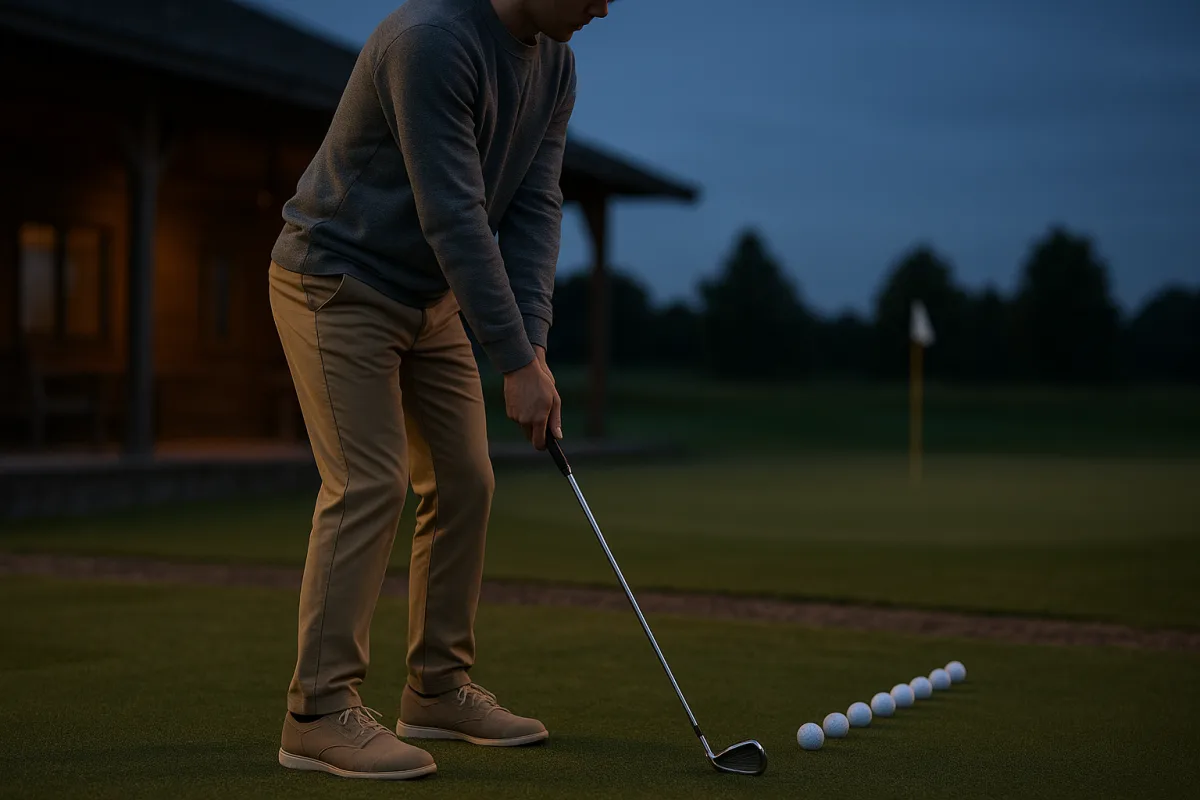
Start with a practice system, not a swing thought
The most useful thing a new golfer can build is not a perfect swing. It is a repeatable weekly system: practice often enough to remember what happened last time, but not so often that every session becomes a random repair job.
A sensible starting schedule is two 45-minute sessions each week for three months. One session is for the full swing, the other for short game and putting. A third, optional session is actual course play. [5][6][8][22]
That structure matters because golf contains different skills that merely share a club in your hands. A seven-iron shot from a mat, a bunker shot and a four-foot putt do not respond to the same practice method.
Most beginners make the range their entire golf life because hitting balls feels like practice. It is practice, but only for one part of scoring. The full swing creates opportunities, while the short game determines how many strokes those opportunities cost.
The point of the first three months is not to chase a particular handicap or carry number. It is to make contact predictable enough that you can play nine holes, keep score honestly and know why a shot went wrong.
Session one: 45 minutes for the full swing
Use the first weekly session for the motion that gets the ball from tee or fairway toward the green. The objective is not maximum distance. A beginner who can start the ball roughly on line has something to build on.
Begin with five to ten minutes of movement and a few easy half-swings. Hit short shots with a wedge or a short iron before reaching for driver. This reduces the temptation to begin every session by trying to hit the hardest club.
Spend the middle of the session on one observable task. That might be maintaining balance through the finish, making centre-face contact, or starting the ball at a target. It should not be three technical changes at once.
A common early error is gripping the club too tightly. Another is trying to lift the ball into the air, which often causes the hands to scoop and the clubhead to strike the ground poorly. [18][19][20]
With an iron, the loft on the clubface is designed to launch the ball. You do not need to help it upward. A useful beginner intention is to brush the turf after the ball, rather than trying to flip the ball into the sky.
For a driver, the ball is played forward in the stance and the club is intended to sweep it from a tee. That difference in turf interaction is why a driver swing and a wedge swing may look related but are not identical.
Do not make launch-monitor targets your first project. Launch angle, ball speed, spin rate and carry distance are outputs of a particular strike, loft, shaft and swing. They are not grades you can simply copy from another golfer.
A player with a slower swing may launch a seven-iron differently from a stronger player, even when both make good contact. The same applies to driver spin. More spin is not automatically bad, and less spin is not automatically better.
Distance claims should also be treated with restraint. A few extra yards from one model, one shaft or one session can sit comfortably within normal strike variation, wind, range-ball condition and monitor setup. Fitting beats buying on headlines.
Finish the full-swing session by writing down a simple result. Record the club, the intended target and a rough count of solid strikes. You are looking for patterns over weeks, not pretending that one good shot proves a change worked.
Equipment is the input to the system
A practice plan works better when the clubs are not fighting the player. Typical beginner sets include a driver, fairway wood, hybrid, irons from six through nine, pitching wedge, sand wedge and putter. [1][2][4]
Current beginner-set guidance places credible complete packages at roughly $290 to $500. [1][2][3][4] That price is for the clubs, not for lessons, range balls, shoes, golf balls, bags beyond those included, green fees or transport.
Avoid the ultra-cheap package under $150 if you can. The research brief’s consensus is that these sets often compromise too heavily on quality, and poor clubs can make it harder to distinguish a swing problem from an equipment problem. [1][2][3]
The Wilson Profile SGI is worth noting because it offers height-based fitting options rather than treating every adult beginner as the same size. [1][2] It suits a player whose height makes standard-length clubs uncomfortable, not someone shopping solely for a logo.
Height is only one part of fit. Shaft weight, flex, grip size, lie angle and driver loft can all influence what the player feels and what the ball does. A club fitting does not manufacture a swing, but it can remove obvious mismatches.
For example, a 120-gram steel shaft can be overly demanding for a beginner who would manage a lighter 95-gram graphite option more easily. [18][20] That does not make graphite universally better, because weight and feel are player-dependent.
Driver loft deserves similar caution. Too little loft can encourage a beginner to swing upward aggressively or manipulate the face in search of height. [18][20] The resulting fault may be blamed on technique when the club’s setup is part of the problem.
A basic fitting at a golf shop, range or teaching facility is often more valuable than spending the difference on a premium driver. Bring your normal swing, tell the fitter your budget and accept that your needs may change as you improve.
Session two: 45 minutes where scores actually settle
The second 45-minute session should happen on a practice green and short-game area, where available. Start with putting from short distances, then move to longer putts, chips and simple pitch shots. [5][6][22]
A straightforward split is 15 minutes on short putts, 15 minutes on longer putts and 15 minutes chipping. The exact division is less important than separating the tasks and giving each one a target.
For short putts, use a narrow starting-line target rather than simply rolling balls toward a hole. A tee or coin placed a few feet away gives immediate feedback. If the ball misses the line, you know whether direction was the problem.
For longer putts, judge success by distance control. Leave yourself a manageable second putt. Making every 25-footer is not a realistic standard, while repeatedly finishing six feet past the hole creates strokes and frustration.
Chipping teaches a beginner how little swing is sometimes required. Use a landing spot on the green, then observe how the ball releases. A pitching wedge and sand wedge will usually react differently because their lofts and soles differ.
This is also where turf interaction becomes real. A club that digs deeply can produce a heavy strike, while one that bounces into the ball can thin it. The answer is not always to change technique immediately, especially from inconsistent practice lies.
Use one ball when possible, rather than hitting a pile from the same spot. Golf demands adjustment after every shot. Changing lies, targets and distances prevents the practice area from becoming easier than the game you intend to play.
Session three: take the system to a course
The optional third session is nine holes, a par-three course or a practice round from forward tees. It is where you learn decisions, uneven lies, pace and the fact that a decent swing can still leave an awkward next shot.
Choose tees based on how far you actually hit the ball, not on ego or age. The forward tee is not a concession. It is a way to encounter more reachable greens, fewer forced carries and more shots that resemble the golf you practiced.
Beginner-friendly options cited in the research include Smock Golf Course in Indiana, Vails Grove Golf Course in New York and Mud Run Golf Course in Ohio. Each is identified as offering multiple tee choices or a relaxed setting. [11][12][13][14]
Before playing, learn the pieces of etiquette that protect other golfers. Be ready when it is your turn, select the club while others are hitting and keep pre-shot routines brief. Guidance commonly suggests about 40 seconds per stroke. [9][10]
A four-player group should generally aim to complete 18 holes in no more than about four hours. [9][10] If the group behind is waiting and there is space ahead, let them play through rather than treating the round as a personal test.
Safety is simple and non-negotiable. Do not hit until the group ahead is safely out of range. If a ball heads toward another person, shout “Fore!” loudly and immediately, even if you are unsure it will reach them. [9][10]
Repair divots, rake bunkers and fix ball marks on greens. Avoid stepping directly on another player’s putting line when practical, stay quiet during shots and count every stroke honestly. [9][10] Those habits matter as much as knowing the rules.
Lessons, bodies and realistic expectations
Professional instruction is recommended but not mandatory. A coach can spot an over-the-top move, a poor setup or excessive grip pressure before a beginner spends months building a workaround. [18][19][21]
Private lessons in 2026 range from roughly $50 to $75 an hour with entry-level instructors to $200 to $400 or more with elite coaches. Group instruction commonly costs $25 to $100 per person per hour. [17]
Price reflects location, facility and coach experience, with urban markets often costing more. [17] For a newcomer, one or two lessons focused on grip, posture, alignment and a practice plan may provide better value than buying a more expensive club set.
The fundamental job remains consistent across ages: make a balanced motion, return the club to the ball and control the face. But older beginners, or those with reduced mobility, may need a more relaxed posture and realistic speed expectations. [15][16]
The 2022 research in the Journal of Strength and Conditioning Research links physical qualities with golf-swing performance. [15] That does not mean every beginner needs a gym programme, but strength and flexibility work can support comfort, balance and swing speed.
There is less specific evidence on how mechanics should change for every fitness level, so avoid rigid prescriptions. A tip that fixed one player’s slice may not fix yours. Start with a qualified look at your own setup and ball flight.
Spring and autumn are broadly the easiest seasons for beginners in much of the United States, while summer heat and winter cold can limit outdoor play. [7][8] In cold regions, indoor practice can keep the weekly system intact through winter.
After three months, judge progress by better contact, fewer lost balls, more completed holes and a clearer understanding of your misses. Those are sturdier measures than a single longest drive, and they give the next lesson or fitting something useful to work with.
Frequently Asked Questions
What is the best practice schedule for beginner golfers?
A good starting schedule is two 45-minute sessions each week for the first three months. One session should focus on full-swing mechanics, while the other targets putting and shots around the green. Adding on-course play is recommended only when you can maintain a steady pace of play.
How much should I spend on beginner golf clubs?
Beginner golf club sets typically range from about $290 to $500 for usable quality sets. It is advisable to avoid sets priced below $150, as they often represent poor value. Money saved on clubs is better spent on lessons, range balls, and green fees.
What should a beginner focus on in their golf swing?
Beginners should prioritize making predictable contact and starting the ball roughly on line rather than maximizing distance. Common early swing issues include gripping the club too tightly and trying to lift the ball into the air. A useful approach is to let the club’s loft do the work and brush the turf after the ball rather than flipping it upward.
How can I improve my golf short game as a beginner?
Dedicate one of your weekly practice sessions specifically to putting and shots around the green. Developing these skills separately from full-swing practice helps reduce the number of strokes lost once on the course. Consistent, focused practice on short game shots is essential for lowering scores.
Do I need private lessons to start playing golf?
Private lessons are not mandatory but can be helpful. One lesson can establish fundamentals like grip, posture, and basic motion. Entry-level private instruction typically costs between $50 and $75 per hour, which is sufficient for most new players without requiring elite coaching.
How we researched this
This article was assembled from 22 cited references.
Nothing here is based on hands-on testing. Where a figure or finding appears, it belongs to the source cited beside it, and the writing says so rather than implying otherwise. Every source is listed below so you can check it.
Sources
- Best Golf Clubs for Beginners 2026 – Top Sets Reviewed | SportDeal | SportDeal.com
- Best Golf Club Sets for Beginners 2026: Every Budget - The Golfer's Yard
- Best Cheap Golf Club Sets 2026 - Our 5 favorite budget sets from testing
- Best Beginner Golf Sets Under $500
- Golf Practice Schedule: 2, 3, and 5-Day Weekly Templates (Free PDF) | PracticeCaddie
- golf practice routine for beginners: A Simple Weekly Plan to Actually Improve | Beckley Golf Guide
- golf again – tofumocha.com
- How Often Should You Practice Golf? (Simple Weekly Plan) — Alba
- Golf Etiquette: Pace of Play & Course Conduct
- Golf Etiquette Cheat Sheet - Navigating the Golf Course
- Smock Golf Course — MyGolfIndex
- Smock Golf | Come and Play!
- Vails Grove Golf Course
- Mud Run Golf Course Tee Times
- Physical Determinants of Golf Swing Performance:... : Journal of Strength & Conditioning Research
- Use these 5 simple tips to swing your best at any age | GOLF.com
- How Much Do Golf Lessons Cost in 2026? A Complete Guide | TeachMe.To
- The 5 most common beginner mistakes in golf and how to avoid them - Golf El Rompido
- Golf Swing Basics for Beginners: A Complete Guide | Fulcria Labs
- What Are the Most Common Mistakes Beginners Make in Golf?
- The 10 Most Common Golf Swing Mistakes (And How To Fix Them) | MyGolfSpy
- Beginner Golf Practice Plan: How to Improve Quickly | Outtabounds
Related Articles
Golf Rain Gear and Strategy: What to Do If It Rains
Learn essential golf rain gear and strategies to stay dry, adjust your swing, and play safely when it rains on the course.

Starter Golf Equipment List: What You Need to Begin
Discover the starter golf equipment list for beginners, including essential clubs and gear to get you ready for your first round.
How to Play Golf in the Rain: Gear, Swing & Strategy Tips
Learn how to play golf in the rain with expert tips on gear, swing adjustments, and course strategy to improve your wet-weather game.
Golf Course Features for Beginners: What to Look For
Learn key golf course features for beginners, including fairway width, landing zones, course length, and green design to improve your game.