
Golf Course Features for Beginners: What to Look For
Learn key golf course features for beginners, including fairway width, landing zones, course length, and green design to improve your game.
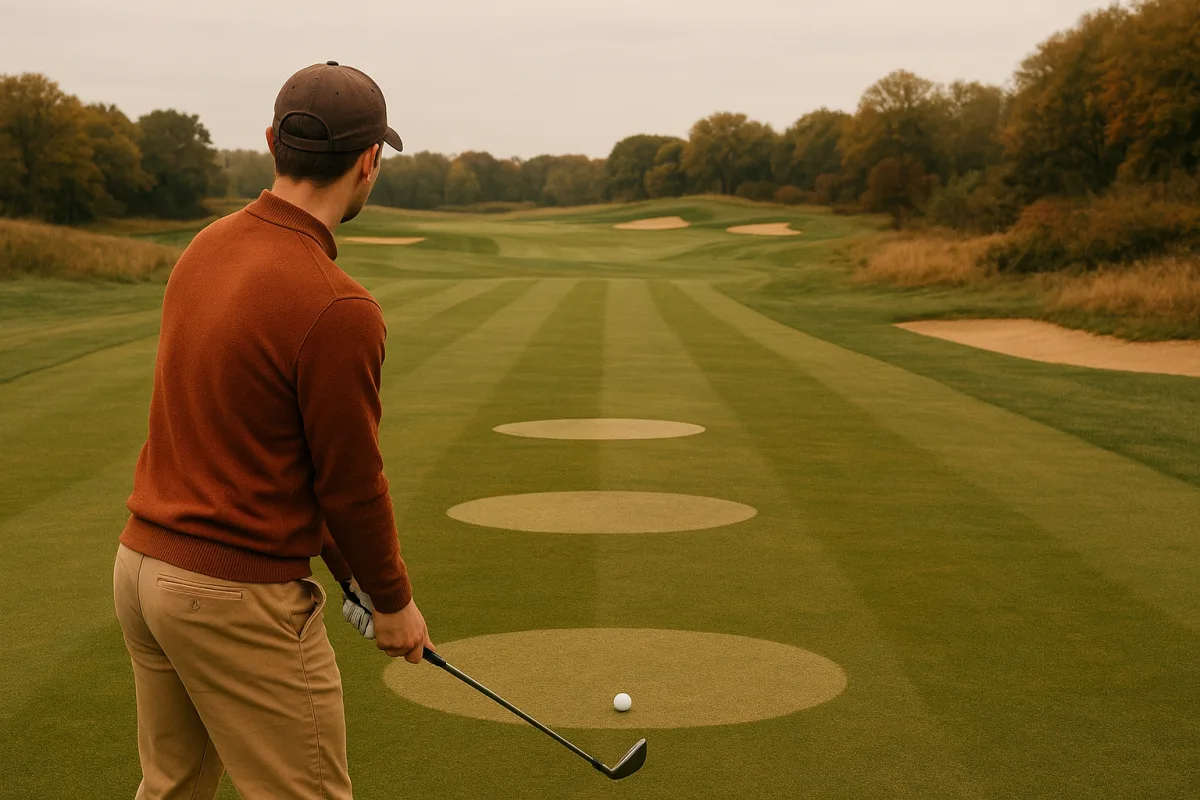
The useful idea: judge a course by its landing zones
Beginners are often told to find an “easy course,” which is true but not especially useful. A better test is to ask one practical question: where is the ball likely to finish after an ordinary, imperfect full swing?
That area is the landing zone. On a tee shot, it is not the centre of the fairway shown in a glossy course photo. It is the spread of shots you actually produce, including the push, pull, thin strike and heavy strike.
Golfers with more experience can choose lines around bunkers, carry a corner, or deliberately leave themselves a preferred yardage. A new player is usually trying to get the ball forward, find it, and hit the next one without a penalty.
That is why course selection should start with the first shot rather than the total yardage. Yardage matters, but it is only useful when it changes the demands placed on your normal shot pattern.
A 4,500-yard course is commonly suggested as a suitable upper range for beginners, especially one built from par 3s and short par 4s. [1] That is a sensible filter, not a universal law written into the Rules of Golf.
A golfer who carries a driver 200 yards and hits it reasonably straight may find one 4,500-yard course comfortable. Another golfer who carries it 140 yards with a 40-yard rightward spread may find the same number demanding.
Launch-monitor numbers work the same way. A carry distance, launch angle or spin rate belongs to the swing that produced it. Course length is only meaningful when matched to the shots you can reliably put in play.
Why fairway width matters more than a famous course rating
The research brief points to fairways around 50 to 70 yards wide as forgiving for newer golfers, while fairways in the 25 to 35-yard range are much more demanding. [9] That 20-yard difference is not cosmetic.
Imagine a player whose tee shots can finish 20 yards left or 20 yards right of the intended line. On a 60-yard fairway, that player has room to miss and still be in short grass or light rough.
Put the same shot pattern on a 30-yard fairway and the maths changes quickly. A ball that was merely imperfect is now in trees, long rough, a lateral hazard or out of bounds.
That is the important distinction. A beginner-friendly course does not need to reward perfect shots constantly. It should allow a playable next shot after a merely serviceable one.
A fairway can look broad from the tee and still play narrow if bunkers, water or thick rough occupy the places where a beginner’s ball tends to finish. The relevant width is usable width, not the strip of mown grass measured at its widest point.
Before booking, look at the scorecard and course map, then look at aerial images if the club provides them. On par 4s, identify the likely landing area, not just the green complex.
For a new golfer, that might be 100 to 170 yards from the forward tees, depending on club speed and contact. The exact distance does not matter as much as honestly identifying the range of outcomes.
If water crosses the fairway at that distance, or bunkers sit on both sides of it, the hole has asked a difficult question before you have even reached the green. Golf Monthly notes that hazards placed directly in the line of play tend to force conservative decisions and punish poor positioning. [10]
There is nothing wrong with a demanding hole, especially once you enjoy the puzzle. But a beginner’s first regular course should not make every tee shot a penalty-avoidance exercise.
Length changes the second shot as well
Course yardage gets attention because it is printed prominently on the scorecard. Its bigger effect is often on the next shot. A short par 4 can let a beginner reach the green area in two or three ordinary swings.
A long par 4 can require two unusually strong shots before the green is even in play. That changes the experience from learning golf to repeatedly attempting shots beyond the player’s current capability.
Par-3 courses remove much of that problem. Mountain Shadows Golf Club describes the format as all par 3s, playing to a par of 54, with an emphasis on precision and short-game skills. [2]
That sounds modest, but it is a useful kind of modest. A par-3 course gives a new player repeated chances to hit an iron or hybrid, chip, pitch and putt, rather than spending most of the round searching for driver balls.
Executive courses can provide a middle ground. They generally mix par 3s with shorter par 4s, so a golfer still learns tee-shot routines without every hole becoming a long game test.
The San Francisco Golf guide identifies quick, walkable nine-hole par-3 and executive options in the Bay Area, often with practice areas nearby. [13] That combination matters because it makes learning easier to repeat.
Most distance claims in golf are within more noise than advertising admits. A slightly longer course is not automatically better practice, and a driver used on every hole is not automatically development. The right course is one that gives you enough playable shots to learn from.
Greens determine whether a good approach is rewarded
The landing-zone idea continues at the green. A beginner does not need a dead-flat putting surface, but steep slopes, severe tiers and quick greens can turn a reasonable approach into three or four stressful putts.
Larger greens create a larger margin for error on approach shots. [9] That means an iron shot that finishes 25 feet from the hole can still be a success, instead of missing a tiny target and rolling into a bunker.
Flat or gently contoured greens are particularly helpful while learning pace control. GolfEaser identifies flatter greens and limited hazards as characteristics that help build confidence rather than immediately punish ordinary misses. [4]
This is not an argument for avoiding challenge indefinitely. Slopes, speed and bunker shots are part of golf. It is an argument for choosing the order in which you meet those challenges.
A course with forgiving landing zones but heavily defended greens can still be difficult. Conversely, a short course with tiny, tilted greens may teach useful touch, but it may not be the relaxed first-round venue many beginners need.
What the tee time really costs
Price matters because beginner golf requires repetition. One expensive round at a prestigious course may be memorable, but regular access to a workable course does more for improvement than occasional exposure to a championship-style test.
GolfCourses.us puts typical 2026 US municipal and public 18-hole green fees at $20 to $50. [5] Those figures are a guide, not a national guarantee, because local demand and operating costs vary sharply.
The regional differences are real. Green Fee Tracker lists many Chicago public-course rates around $16 to $20, while GolfForKings places Washington State public-course pricing roughly between $40 and $80. [6][7]
Resort golf sits in another category, with reported fees of $150 to $450. [8] That price does not make a resort course bad, but it often makes it a poor place to learn freely.
When each lost ball feels expensive and the group behind is paying premium money, beginners tend to hurry. Hurrying usually produces worse decisions, worse contact and less useful feedback from the round.
Twilight pricing can reduce green fees by 25 to 50 percent, according to GolfCourses.us. [5] The trade-off is daylight, so it suits nine holes, a par-3 course, or an 18-hole round when the seasonal sunset allows it.
For a new player, the best value is not the lowest headline fee. It is the round that offers a playable layout, enough time to swing without panic, and a price low enough that you will return next week.
Who makes a course easier to start at
The course itself is only part of the purchase. The staff, pace policy and available practice facilities determine whether a beginner can turn up with limited equipment and leave having learned something.
Municipal and public facilities commonly offer rental clubs, driving ranges, putting greens, chipping areas and beginner instruction. Cleveland Metroparks, for example, lists golf facilities and programming designed to serve a broad public audience. [12]
Henson Creek Golf Course in Prince George’s County is another public example offering a beginner-accessible setting and golf services. [18] These are not guarantees that every municipal course will feel relaxed, but public facilities are worth checking first.
Ask the pro shop three direct questions before booking: Are beginners welcome at this time? Is there a practice green or short-game area? What is the usual pace for nine or 18 holes?
That call is more useful than choosing by online prestige. Rotation.Golf specifically warns that golfers can overlook maintenance quality, walkability and pace of play when selecting a course. [16]
Pace affects learning because it affects decision-making. A golfer who feels pressured may skip a practice swing, rush a putt or hit when unsettled, then blame a swing flaw that was really caused by the situation.
Tuesday through Thursday are typically lower-demand days, while weekends are busier and more expensive in the morning. Afternoon and twilight periods generally bring less congestion and lower prices. [11]
Early morning before 7:00 AM can also be quieter and discounted, according to OpenCourse. [11] It is not automatically ideal, though, if getting out the door before dawn makes golf feel like a chore.
A practical first-course filter
Start with forward-tee yardage, not the back-tee number. Look for an 18-hole total below about 4,500 yards, or choose a par-3 or executive course if that is what is available. [1][2]
Then inspect the likely landing zone on several par 4s. Favor wide fairways, ideally in the 50 to 70-yard range, with bunkers and water positioned away from the most likely miss. [9][10]
Next, check whether the greens appear generously sized and reasonably open at the front. Large greens and modest slopes make it more likely that an approach shot produces a putt rather than a recovery mission. [4][9]
Finally, price the round honestly. Include rental clubs, range balls, cart fees if needed, and a few lost balls. The quoted green fee is not necessarily the full cost of playing.
Weather deserves a final, modest mention. Wet ground, firm fairways and changing green speed clearly affect conditions, but the available research does not quantify a unique beginner effect. Treat weather as a reason to call ahead, not as a reason to invent a universal rule.
The best beginner course is therefore not necessarily the shortest, cheapest or most famous nearby. It is the one where your normal miss stays playable often enough that you can make another swing, observe the result, and gradually improve.
Frequently Asked Questions
What golf course features help beginners improve?
Beginner-friendly courses typically have wide fairways (50 to 70 yards) that allow for a reasonable margin of error on tee shots. They also minimize hazards near landing zones to reduce penalties and encourage confidence. Flat and larger greens simplify putting and provide a larger margin for error on approach shots, aiding short-game development.
How does fairway width affect beginner golfers?
Fairways around 50 to 70 yards wide offer forgiveness by accommodating the typical spread of beginner tee shots, allowing balls to land in playable areas like short grass or light rough. Narrower fairways (25 to 35 yards) increase difficulty because shots that miss the center are more likely to end up in hazards, thick rough, or out of bounds, leading to penalties and frustration.
Why is landing zone important for beginner golf courses?
The landing zone reflects where a beginner’s imperfect tee shots are likely to finish, not just the fairway center. Courses with landing zones free from hazards and with usable width let beginners find their ball and hit the next shot without penalty. Hazards placed directly in the landing zone force conservative play and increase the chance of penalties, making the course less suitable for new players.
What course length is suitable for beginner golfers?
An 18-hole course under roughly 4,500 yards, often composed of par-3 and short par-4 holes, is generally suitable for beginners. Such lengths allow players to reach greens in a reasonable number of shots without requiring unusually strong or precise long shots, making the game more accessible and encouraging repeatable practice.
How do greens impact beginner golf experience?
Flat greens simplify putting and help beginners develop their short-game skills by reducing the difficulty of reading breaks and controlling speed. Larger greens provide a bigger target area on approach shots, which increases the margin for error and reduces the likelihood of missed greens and difficult recovery shots.
How we researched this
This article was assembled from 18 cited references.
Nothing here is based on hands-on testing. Where a figure or finding appears, it belongs to the source cited beside it, and the writing says so rather than implying otherwise. Every source is listed below so you can check it.
Sources
- Best golf courses for beginners | FairwayDB
- The Short Course Explained — Par-3 Golf at Mountain Shadows
- Getting Started With Choosing A Golf Course For Beginners - Golf Locality
- Golf Courses That Build Confidence, Not Kill It
- How Much Does It Cost to Play Golf? A Beginner's Money Guide | GolfCourses.us
- Golf Green Fees in Chicago 2026 — Complete Price Guide | Green Fee Tracker
- Washington State Green Fees 2026 | GolfForKings
- How Much Does a Round of Golf Cost? 2026 Prices by Course
- How Big Are Golf Courses: Size Explained
- 6 Basic Mistakes Amateur Golfers Make Almost Every Round
- Golf Tee Time Tips: Best Times to Play for the Best Rates | OpenCourse Blog
- Golf FAQ | Cleveland Metroparks
- The Best Bay Area Golf Courses for Beginners | San Francisco Golf
- About the Course/FAQ – Osprey Point Golf Course – Boca Raton, FL
- Golf Course Difficulty Explained (and How to Choose the Right One) — Alba
- Course Selection, Travel, and Playing Logistics · Rotation.Golf
- Golf Travel Survey 2026: Resort-style golf wins for beginners
- Henson Creek Golf Course - Park and Recreation - Prince Georges County MD
Related Articles

Best Golf Courses for Beginners: Choosing the Right Layout
Discover the best golf courses for beginners with tips on tees, layout, and course features that make learning golf easier and more enjoyable.

Starter Golf Equipment List: What You Need to Begin
Discover the starter golf equipment list for beginners, including essential clubs and gear to get you ready for your first round.
Best Golf Courses to Play in Summer: Top Picks and Tips
Discover the best golf courses to play in summer with tips on conditions, tee times, and course selection for an enjoyable round.
Best Golf Clubs for Beginners: Top Sets Compared
Discover the best golf clubs for beginners with our comparison of top sets, helping you choose the right equipment for your game.