
Starter Golf Equipment List: What You Need to Begin
Discover the starter golf equipment list for beginners, including essential clubs and gear to get you ready for your first round.
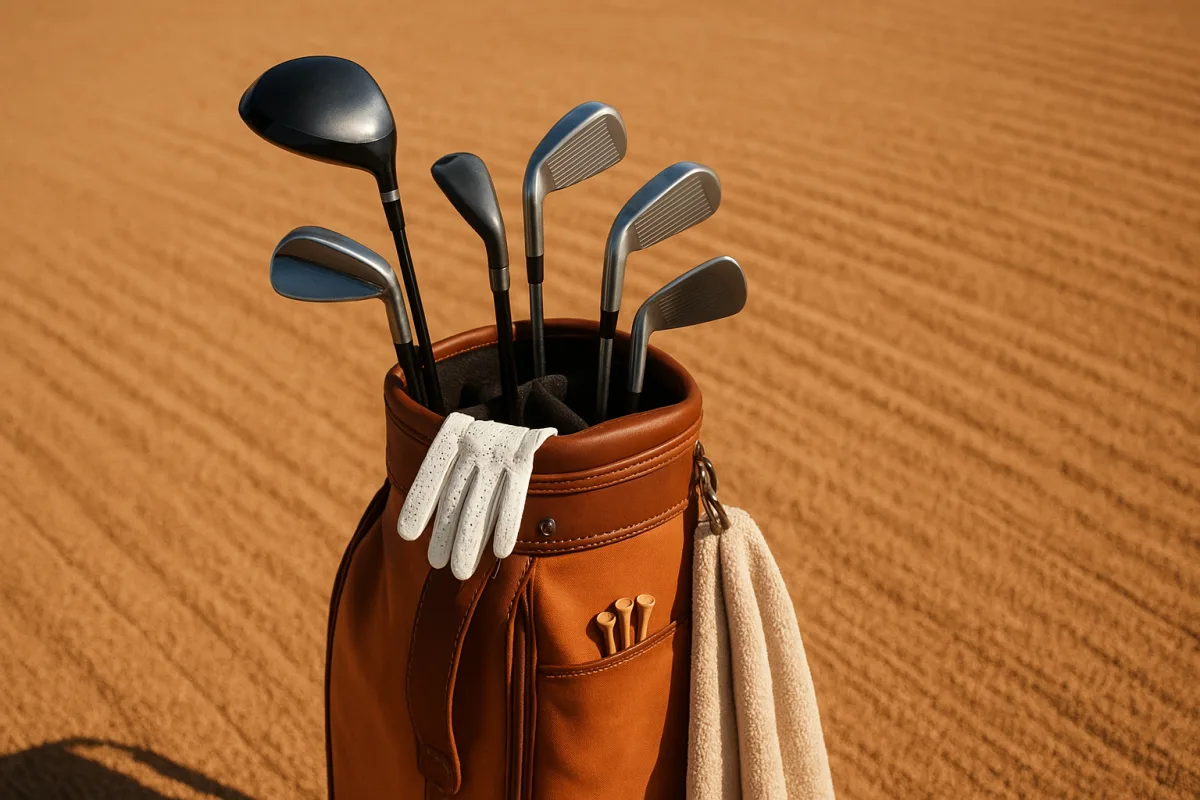
What Equipment Do You Need to Start Golfing?
The essential idea: build a bag with gaps, not club numbers
The beginner equipment question usually gets answered with a shopping list. That matters, but the useful principle is simpler: every club should give you a distinct shot, rather than duplicating the next club in the bag.
The USGA allows a player to carry up to 14 clubs, but that is a ceiling, not a starter requirement. Golf Hub recommends a streamlined seven- or eight-club setup for beginners, which is plenty for learning basic full swings and scoring shots. [1]
A sensible eight-club starting bag is a driver, hybrid, 7-iron, 8-iron, 9-iron, pitching wedge, sand wedge and putter. Add a 6-iron later if you can launch the 7-iron consistently and need more distance coverage.
That bag omits a 3-wood, 4-iron, 5-iron and lob wedge deliberately. Those clubs can be useful, but they ask for more precise strike and launch conditions than most new players can produce reliably.
The important number is not the number stamped on the sole. It is the distance gap between clubs, and whether you can hit each one from the lie where you need it.
Why loft and distance gaps matter
Loft is the angle of the clubface relative to vertical. More loft generally launches the ball higher with more spin, while less loft can produce lower launch and more ball speed, assuming you strike the face well.
That is why a beginner driver should usually have 10.5 to 12 degrees of loft. The added loft helps get the ball airborne, especially for players who do not yet create much upward attack angle or clubhead speed. [3]
A lower-lofted driver is not automatically longer. If it launches too low or carries too little spin for your delivery, it may simply fall out of the sky early. Distance claims are usually within more noise than marketing admits.
For the same reason, a hybrid is often a better early purchase than a long iron. Its wider sole and lower, rearward center of gravity can help launch the ball from the fairway, light rough and tee.
A 3-wood is not compulsory. It can be useful from the tee or fairway, but its longer shaft and low loft make center-face contact harder. A hybrid generally fills the “advance the ball safely” job more often for a new golfer. [10]
Irons numbered 6 through 9 are commonly suggested as the core iron range, covering roughly 100 to 160 yards for many players. That range is only a broad guide, not a promise about what your own clubs will do. [1]
A player with a 65 mph driver swing might not reach those distances. A stronger, faster player may carry every iron farther. Temperature, altitude, ball model, strike location and loft specifications all change the result.
Modern iron lofts also vary widely. One company’s 7-iron may have the loft another company puts on a 6-iron. Comparing clubs by number alone is therefore less useful than comparing loft, carry distance and landing angle.
Your pitching wedge handles fuller short approaches and lower running shots. A 54 to 56-degree sand wedge is the next essential scoring club because it adds loft and bounce for bunkers, soft turf and short shots. [3]
Bounce is the angle created by the sole beneath the leading edge. On sand or soft ground, that sole can resist digging. A wedge that enters too sharply can bury, while one that skims too much can thin the ball.
This is turf interaction, and it is why a sand wedge earns its place before a 60-degree lob wedge. The lob wedge asks for more speed and face control, while the sand wedge covers more useful beginner shots.
The clubs to buy first
A complete beginner set, including a driver, fairway wood, hybrid, irons, wedge, putter and bag, costs about $150 to $700 in 2026. Mid-range sets run roughly $400 to $1,600, while premium customized sets can reach $1,200 to $4,000. [5]
Those figures are equipment prices, not the full cost of learning golf. Lessons, range balls, course green fees, clothing, club fitting and replacement balls can quickly become the larger ongoing expense. [6]
For most new golfers, a complete package set is the sensible route if the budget is tight. It provides matched shaft weights, sensible loft progression and a bag, without forcing you to make eight separate buying decisions.
If buying clubs individually, drivers typically cost $100 to $500, irons roughly $50 to $150 each, and putters $50 to $300. [5] That route makes most sense only when you understand what is missing from your bag.
Choose a driver with enough loft, a hybrid instead of forcing long irons, cavity-back irons with substantial perimeter weighting, and a sand wedge with usable bounce. These are design choices that support imperfect strike, not magic fixes.
For the putter, a mallet design with alignment aids is a good starting category. The larger head can make aiming easier and tends to be more stable on off-center strikes than a compact blade-style putter. [3]
That does not mean every golfer should use a mallet forever. Putter fitting is highly personal, involving eye line, stroke shape, face aim and speed control. Still, a clear alignment line is more useful than an exotic milling pattern.
Shaft flex is a starting point, not a diagnosis
Shaft labels describe relative stiffness, but there is no universal industry standard. A regular-flex shaft from one manufacturer can feel and perform differently from a regular-flex shaft made by another.
The usual speed guide puts ladies flex below 65 mph, senior or A flex around 65 to 75 mph, regular flex around 75 to 90 mph, stiff flex around 90 to 105 mph, and extra-stiff above 105 mph. [12]
Those are driver-speed bands, not rules of identity. Tempo, transition, release pattern, club length and the shaft’s bend profile all influence what works. A smooth 92 mph player and a violent 92 mph player may need different shafts.
A fitter can measure club speed, ball speed, launch, spin, face contact and dispersion. The goal is not chasing one exceptional shot. It is finding a club configuration that produces a playable pattern over several swings.
Launch-monitor results should be treated carefully. A spin number is not a property of a club in isolation, and a carry number does not travel automatically from a fitting bay to a wet fairway in November.
Fitting beats blind buying, even for beginners, but it need not mean a premium custom order. A professional can check length, lie angle, grip size, shaft weight and flex, then point you toward a suitable value set. [14]
Balls: buy enough to learn without fearing every lost shot
Golf balls are consumable equipment. A budget-friendly dozen costs around $20 to $25, while the wider beginner-ball market commonly runs about $20 to $40 per dozen. [7]
For driver speeds under about 85 mph, sources recommend low-compression balls in the 35 to 65 range. Softer construction can help these players generate usable launch and ball speed without needing tour-level compression. [7]
Callaway’s Supersoft is cited at about 49 compression and suits players looking for a soft, low-compression option. Wilson’s Duo Soft is listed around 35 to 46 compression and suits slower-speed players seeking an even softer-feeling ball. [7]
Bridgestone’s e12 High Launch is a low-spin option aimed at golfers who need help launching shots higher. Maxfli’s StraightFli is another low-spin, straighter-flight category option for players trying to reduce excessive curve. [8]
The briefing does not provide individual retail prices for those four specific models, so it would be misleading to invent them. Expect their cost to sit within the cited $20 to $40 beginner-ball range, depending on retailer and promotions. [7]
Low-spin does not eliminate a slice. A slice is primarily a face-to-path and strike problem, often made worse by heel contact. A ball may reduce the severity slightly, but one tip that fixed another golfer’s slice will not fix every slice.
Shoes and the small equipment that keeps a round moving
Golf shoes matter because your feet are the connection between the ground and the swing. Buy comfort and traction first, especially if you walk, play early mornings or live somewhere where turf stays wet.
FootJoy’s FJ Flex costs about $110 and suits golfers wanting a versatile spikeless shoe for mostly dry conditions. PUMA’s Fusion Grip 6 EVO costs about $90 and suits the budget-conscious beginner who still wants golf-specific traction. [9]
FootJoy’s Traditions cost about $150 and suit players wanting waterproof spiked footwear for wetter courses. adidas’s Adizero ZG Spikeless costs about $180 and suits golfers who prefer a lighter premium spikeless option in dry weather. [9]
Nike’s Air Zoom Infinity Tour NEXT% 3 is another premium-oriented golf shoe option, although the supplied pricing varies by seller. It suits players prioritising athletic styling and support, but should be tried on rather than bought for the name alone. [19]
Spikeless shoes are generally practical for dry conditions and can be worn easily off the course. Spiked shoes provide more grip in wet grass, on slopes and during winter rounds, when slipping can affect both confidence and balance. [9]
A glove costs about $12 to $25 and should fit snugly without loose fabric at the palm or fingertips. Loose material moves during the swing and can make a secure grip feel inconsistent. [11]
Buy a pack of 50 tees for roughly $5 to $10. A 2.75-inch tee suits a driver, while shorter tees around 1.5 inches suit fairway woods and hybrids when you want the ball barely above the turf. [11]
Add a towel, divot tool and ball marker. A 16 by 24-inch towel with a carabiner costs about $10 to $20, while durable metal divot tools cost roughly $5 to $15. [11]
A stand bag usually costs $100 to $200. Dual straps matter if you carry, while 14-way dividers help organization but add little to scoring. Smartphone GPS apps are free, so a rangefinder can wait. [11]
A sensible upgrade schedule
Before your first round, aim for the basic bag, shoes, balls, glove, tees and bag. Fairway Labs places the practical first-round equipment budget around $300 to $600, depending on whether you buy a package set or individual items. [6]
After five to 10 rounds, reassess the putter and ball rather than replacing everything. If alignment is your recurring issue, a mallet putter may help. If you lose several balls per round, stay with soft value balls. [14]
After breaking 100 regularly, consider adding a 60-degree lob wedge only if you can already use the sand wedge without digging or blading it. This is also a sensible point for a proper fitting. [16]
After breaking 90, adjustable drivers and fairway woods can become worthwhile because you are more likely to deliver the club consistently enough to evaluate loft and face-setting changes. Cavity-back or forged irons are a personal decision, not a mandatory promotion. [16]
Maintain what you own. Guidance from The Golfing Lad suggests replacing wedges every one to two years or after roughly 75 to 100 rounds, and changing grips every 40 to 60 rounds or annually. [17]
Frequently Asked Questions
What is a good starter golf equipment list for beginners?
A good starter set for beginners typically includes eight clubs: a driver, hybrid, 7-iron, 8-iron, 9-iron, pitching wedge, sand wedge, and putter. This selection covers the shots most new golfers will face without overwhelming them with too many clubs. Additional clubs like a 6-iron can be added later as skill improves.
How many clubs should a beginner golfer carry?
Beginners should carry about seven to eight clubs rather than the USGA maximum of 14. This streamlined approach helps focus on learning basic swings and scoring shots without unnecessary complexity.
Which golf clubs are essential for new golfers?
Essential clubs for new golfers include a driver with 10.5° to 12° loft, a hybrid (often preferred over long irons), irons numbered 7 through 9, a pitching wedge, a 54° to 56° sand wedge, and a putter. These clubs provide useful distance gaps and cover a wide range of typical shots.
What golf equipment do I need before my first round?
Before your first round, budget roughly $300 to $600 for a playable beginner setup that includes clubs, a bag, and basic accessories like comfortable shoes, a glove, tees, and a towel. Prioritize these essentials over gadgets, and consider using free GPS apps instead of expensive rangefinders initially.
How to choose beginner golf clubs based on loft and distance?
Choose clubs that create useful distance gaps suited to your swing rather than relying solely on club numbers. For example, beginner drivers should have loft between 10.5° and 12° to help get the ball airborne. Since loft and distance vary by manufacturer and player, focus on how far you can carry each club and whether you can hit it well from typical lies.
How we researched this
This article was assembled from 20 cited references.
Nothing here is based on hands-on testing. Where a figure or finding appears, it belongs to the source cited beside it, and the writing says so rather than implying otherwise. Every source is listed below so you can check it.
Sources
- Essential Golf Clubs for Beginners: A Starter Guide - The Golf Hub
- This Club May Be Dying Out In The Men's Game But, At The Solheim Cup, It's More Popular Than Ever
- Best Golf Clubs for Beginners in 2026: Complete Bag Guide - GolfSource
- 8 Best Golf Clubs for Beginners (September 2026) Expert Reviews
- Golf Club Set Price Guide: What a New Set Costs 2026 – LatestCost – Real-Time Price Insights
- How Much Does It Cost to Start Playing Golf in 2026? · Fairway Labs
- Best Golf Balls for Beginners in 2026 (Affordable, Forgiving Picks) | BallCaddie
- Best Golf Balls for Beginners in 2026 — SmartFit Golf
- Best Golf Shoes 2026 - Forbes Vetted
- Beginner Golf Equipment Guide – Essential Gear for New Golfers
- Golf Accessories for Beginners: 2026 Starter Guide
- Golf Equipment for Beginners: Essential Guide
- Golf Equipment for Beginners 2026 - Complete Checklist | ANKSO – ANKSO®
- New Golfer's Equipment Roadmap | The Smarter Play
- Starting golf? The gear that matters — and the gear that doesn't · ifrothgolf
- Upgrading Your Golf Game: A Complete Guide to Making Smart Equipment Decisions - Woblogger
- When to Replace Your Golf Equipment: The Complete Timeline - The Golfing Lad
- Best Beginner Golf Starter Sets for 2026 - The Golf Shop Online Blog
- The 10 Best Golf Shoes of Spring 2026
- Golf Accessories Checklist: What to Keep in Your Bag
Related Articles
Best Golf Courses for Beginners: Choosing the Right Layout
Discover the best golf courses for beginners with tips on tees, layout, and course features that make learning golf easier and more enjoyable.
Best Golf Clubs for Beginners: Top Sets Compared
Discover the best golf clubs for beginners with our comparison of top sets, helping you choose the right equipment for your game.
How to Play Golf in the Rain: Gear, Swing & Strategy Tips
Learn how to play golf in the rain with expert tips on gear, swing adjustments, and course strategy to improve your wet-weather game.

Club Champion Unveils Aerotech Nexus Shaft: Steel Fiber Innovation
Club Champion introduces the innovative Aerotech Nexus shaft, blending steel fiber into graphite for enhanced performance. With two models, blue for mid launch and black for low launch, golfers can experience improved dispersion and tailored ball flight options.