
What to Wear Golfing in Hot Weather: Fabric and Fit Tips
Learn what to wear golfing in hot weather with tips on fabrics, fit, and sun protection for comfort and performance on the course.
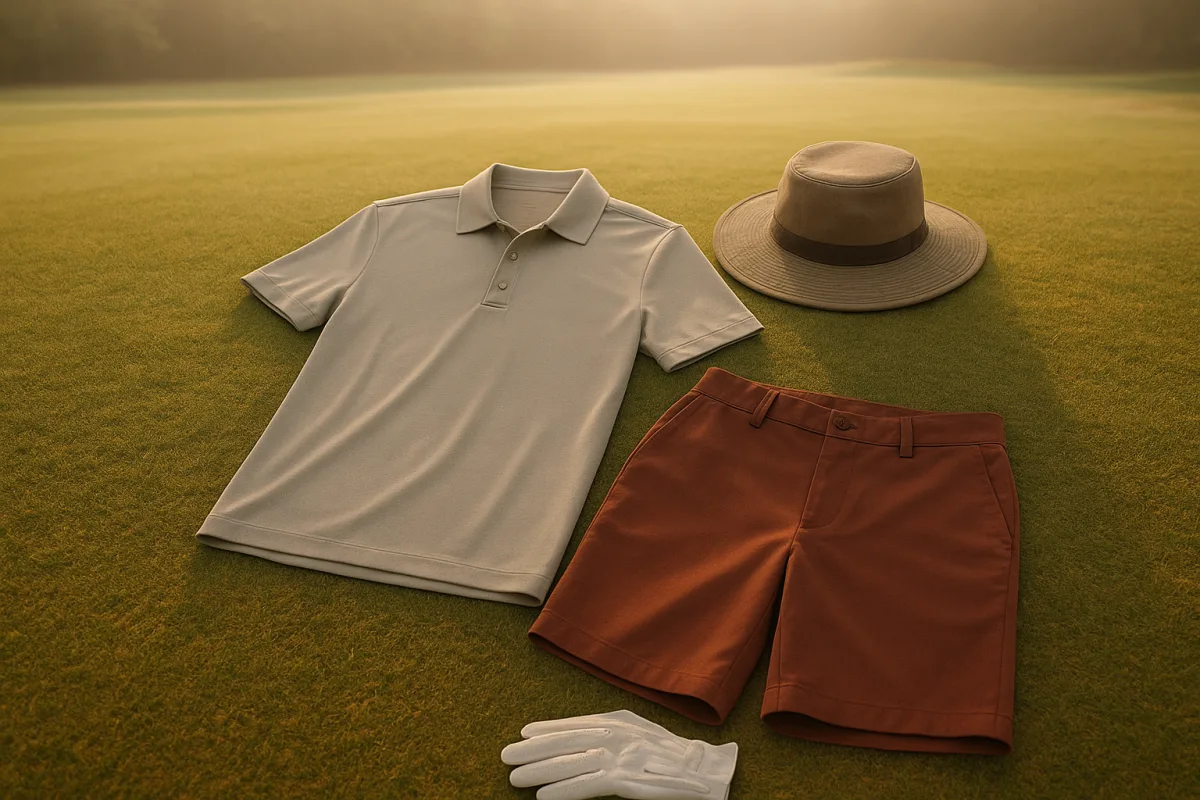
Hot-weather golf clothing is a sweat-management system, not just a light-coloured polo
The useful idea: your clothes have to move sweat before it can cool you
Hot-weather golf clothing is often sold as “cooling” apparel, which is vague enough to be nearly useless. The practical question is simpler: after you sweat, can the garment spread that moisture, expose it to air, and dry before it becomes heavy and clammy?
That is the system to understand. Sweat cools skin when it evaporates. A shirt cannot repeal the weather, and a marketing claim about “cool touch” is not a launch-monitor number. Its usefulness depends on the golfer, the humidity, the breeze, the garment’s fit, and how much fabric is covering you.
Fabric makers commonly distinguish moisture-wicking from breathability. Wicking means moving moisture away from the skin and across more of the fabric surface. Breathability concerns how readily air and water vapour move through the material. Those qualities overlap, but they are not the same thing. [1][24]
For a golfer, the distinction matters because golf is intermittent activity. You may sweat while walking uphill, carrying a bag, or waiting on a hot tee, then make one full-speed swing every few minutes. Clothing has to cope with both movement and long periods in direct sun.
A synthetic polyester-spandex blend is the sensible default because polyester is widely used for moisture management, fast drying, and breathability, while spandex adds stretch through the swing. [1][8] That is not an argument that every polyester polo is good, only that the fibre blend starts in the right place.
The weave and construction still decide a great deal. A dense, heavy synthetic fabric may wick sweat but feel less airy than a lighter open-knit shirt. Conversely, a very airy shirt that holds moisture can leave you damp once the humidity rises and evaporation slows.
Why “moisture-wicking” is not a guarantee of comfort
Polyester does not absorb much water into the fibre itself. Instead, a good performance fabric uses its yarn shape, knit, or finish to pull moisture across the surface. Spread-out sweat has more area exposed to air, so it has a better chance of evaporating.
That sequence is why a shirt can feel good on the first tee and less convincing by the twelfth. In dry heat, evaporation is relatively available, so a quick-drying polyester blend has a strong case. Golf Shop World specifically recommends moisture-wicking polyester blends for dry conditions. [12]
In humid heat, the limiting factor is the air. When the air already contains substantial moisture, sweat does not evaporate as readily. More wicking is still useful than a soaked cotton shirt, but no fabric can create the low-humidity conditions needed for effortless evaporative cooling.
For those sticky rounds, open-weave fabrics are worth seeking because they increase airflow. Golf Shop World also identifies merino wool as a useful humid-weather option, largely because it handles moisture and odour well. [12] Yes, wool sounds backwards for summer, but fine merino can provide natural temperature regulation. [4]
Merino is not magic, nor is it necessarily the best purchase for every golfer. It is a fabric choice for someone prioritising odour control and moisture buffering through a long humid round, rather than simply the fastest drying time after getting drenched in sweat.
Nylon-spandex is another useful alternative. It tends to offer excellent stretch and can feel cool against the skin, which suits golfers who dislike the slightly slick feel of some polyester polos. The trade-off is that nylon can absorb somewhat more moisture and may dry more slowly. [4]
Bamboo-based fabrics are also naturally breathable and moisture-wicking, and they can feel soft in warm weather. [4] The qualification is important: once heavily saturated, bamboo may retain water, so it is a less obvious choice for an especially sweaty golfer walking 18 holes in oppressive humidity.
Cotton is the common mistake because it feels pleasant when dry, then absorbs sweat and remains wet. Hot-weather golf clothing should not become a damp towel attached to your back. Heavy fabrics have the same problem, regardless of whether the label calls them premium. [8][22]
Fit determines whether the fabric can do its job
The usual advice is to wear loose clothing in heat. That is directionally right, but incomplete. A relaxed shirt creates an air gap, allowing air to circulate when you are standing over a putt, riding in a cart, or waiting on a crowded tee.
Make it too loose, though, and the garment may hang away from sweaty skin instead of moving moisture outward efficiently. Fabric that does not contact the body cannot wick much from it. This is why the best fit is rarely a billowing shirt or a compression base layer. [1][24]
For golf, I would look for a polo that skims the torso, leaves room at the shoulders, and does not pull across the chest at address. The sleeve should not bind your lead arm, and the back should stay covered when you bend to read a putt.
That is a fitting issue, much like shafts. A regular-flex shaft is not automatically right because it says regular, and an athletic-cut polo is not automatically cool because it says performance. The result belongs to the person using it, their movement, and the conditions.
Shorts follow the same logic. Golf Deft identifies a 9-inch inseam as the practical balance for hot-weather golf. [7] It provides reasonable coverage for a course dress code without putting excess fabric around the knees during the walk, crouch, and swing.
A 9-inch inseam is not a universal prescription. Taller golfers may prefer slightly more length, while others may be comfortable shorter if the club allows it. The useful point is avoiding excessively long, heavy shorts that trap heat around the thighs.
Sun protection complicates the “wear light colours” rule
Light colours reflect more solar heat than dark ones, making white, pale grey, light blue, and soft pastels logical choices for temperature management. [8][22] But darker colours can provide stronger ultraviolet protection, particularly when combined with a tight weave. [3]
There is no clean winner between those two ideas because they solve different problems. A darker navy shirt may offer more UV protection but absorb more heat. A pale shirt may feel cooler in the sun but require a stronger UPF-rated construction to provide comparable protection.
The better purchase is therefore not merely “a white polo.” It is a light-coloured, UPF-rated polo with a sufficiently substantial or tightly engineered weave. ReadyGOLF recommends UPF 50+ clothing, a level that blocks at least 98% of UV radiation. [3]
Coverage matters as much as the printed rating. A long-sleeved UPF 50+ shirt covers more skin than a short-sleeved shirt, even if both carry the same rating. A collar protects the back of the neck better than a collarless top. [3]
Peak sun from 10 a.m. to 4 p.m. is the time to be less sentimental about traditional short sleeves. [14] A light, loose long-sleeve layer with UPF 50+ protection can be the more comfortable play if it prevents direct sun from baking your forearms for four hours.
A hat needs similar scrutiny. GOLF.com highlights performance golf hats as a practical sun and sweat accessory, while sun-protection guidance favours a wide brim of at least three inches for meaningful facial, ear, and neck coverage. [16][3] A standard baseball cap is better than nothing, not full coverage.
A neck drape can fill the gap left by a cap, especially during midday rounds. Cooling bandanas are another reasonable accessory, provided you view them as a comfort tool rather than a substitute for shade, clothing coverage, water, and sunscreen. [20][21]
What a sensible kit costs
There is no reliable distance claim in apparel, and most claims that a $200 polo is inherently “cooler” than a $75 polo are within the noise of fabric weight, fit, and the day’s weather. Price can indicate construction and styling, but it does not remove humidity.
The Review Caddie places Callaway, Under Armour, and IZOD among budget-friendly choices, with polos starting around $68 to $79. [9] Callaway suits golfers wanting mainstream golf-specific cuts, Under Armour suits those who prefer athletic performance styling, and IZOD suits a conventional, lower-key course look.
Nike, Adidas, and Puma sit in the mid-tier bracket at roughly $88 to $105 for polos, according to The Review Caddie. [9] Nike suits a clean athletic fit, Adidas suits golfers looking for familiar technical apparel, and Puma suits players who prefer more contemporary colours and cuts.
FootJoy, G/FORE, Peter Millar, and J.Lindeberg occupy the premium group, where prices can reach $250. [9] FootJoy suits traditional golf wardrobes, G/FORE suits fashion-forward buyers, Peter Millar suits a refined clubwear look, and J.Lindeberg suits a sharper, modern silhouette.
At the luxury end, Erthe Golf lists Lanvin Blanc and Master Bunny Edition above $260 per piece. [11] Lanvin Blanc suits buyers seeking designer-led golf clothing, while Master Bunny Edition suits golfers drawn to Japanese luxury styling. Neither price tier guarantees a better answer to sweat management.
These are apparel prices, not an installed-system quote with hidden land and utility costs, but the equivalent caution applies. Check exactly what you are paying for: UPF rating, fabric composition, stretch percentage, fit, and return policy, not simply a branded chest logo.
I have not worn or tested these brands. The categories above reflect the price comparisons and positioning reported by The Review Caddie and Erthe Golf, not a claim that one named polo will suit every body shape or climate. [9][11]
Build the outfit around the conditions
For dry heat, begin with a light-coloured polyester-spandex polo, breathable synthetic shorts, moisture-wicking socks, and a UPF 50+ hat. That combination prioritises rapid drying and reflected heat, without making the mistake of wearing absorbent cotton because it felt comfortable indoors. [1][3][8]
For humid heat, prioritise ventilation and avoid over-layering. An open-weave shirt, or a fine merino option if odour resistance matters to you, can make sense. Keep the fit relaxed enough for air movement, but not so loose that soaked fabric simply hangs away from your body. [12][4]
FootJoy WeatherSof and StaSof gloves are commonly recommended moisture-management options, while Druids Performance socks are positioned as moisture-wicking golf socks. [17][18][19] Gloves and socks are small items, but wet hands and sliding feet can make a hot round feel much longer.
Hydration is the other part of this system that clothing cannot cover. Time notes that hot conditions increase the importance of cooling and fluid replacement. [14] A UPF shirt and a cooling towel are not permission to ignore thirst, dizziness, headache, or the need to seek shade.
The practical standard is simple: wear fabric that dries, choose coverage deliberately, and adjust fit to your activity level. Buy one or two well-fitting UPF 50+ pieces first, then let actual conditions, not marketing language, tell you whether your wardrobe needs another solution.
Frequently Asked Questions
What fabrics are best for golfing in hot weather?
Polyester-spandex blends are the sensible default for hot-weather golf clothing because they wick moisture, dry quickly, and provide stretch for the swing. In dry heat, quick-drying polyester blends work well, while in humid heat, open-weave fabrics and merino wool can better manage persistent dampness. Fabric choice should also consider fit, weave, and coverage for optimal comfort.
How does moisture-wicking golf clothing work?
Moisture-wicking fabrics move sweat away from the skin and spread it across a larger surface area of the fabric, which helps sweat evaporate faster. This process cools the skin by allowing sweat to dry before it becomes heavy and clammy. The effectiveness depends on fabric construction, humidity, airflow, and how much skin contact the garment maintains.
Should golf clothes be tight or loose in hot weather?
A relaxed fit improves airflow while standing or waiting, but golf clothing needs reasonable skin contact to move sweat effectively during walking and swinging. Therefore, clothing should not be overly baggy; a balance between relaxed and fitted helps optimize both ventilation and moisture management.
Is UPF 50+ clothing necessary for hot weather golf?
Yes, UPF 50+ clothing is recommended for rounds with significant sun exposure because it blocks more than 98% of UV radiation. However, real-world protection also depends on factors like coverage, fabric weave, color, and fit, so UPF rating should be one part of a broader sun protection strategy.
Can merino wool be worn for golf in humid heat?
Yes, fine merino wool is suitable for humid heat as it naturally regulates temperature and manages moisture and odor well. While it may seem counterintuitive, merino wool can provide comfort during long, humid rounds by buffering moisture rather than simply drying quickly.
How we researched this
This article was assembled from 25 cited references.
Nothing here is based on hands-on testing. Where a figure or finding appears, it belongs to the source cited beside it, and the writing says so rather than implying otherwise. Every source is listed below so you can check it.
Sources
- Golf Apparel Fabric Selection: Breathability vs. Moisture-Wicking - Fuway
- Pickleball Clothing for Hot Weather | ThePickleBase
- Sun Protective Golf Wear (UPF 50+): What to Look For | ReadyGOLF
- The Ultimate Guide to Golf Shirt Materials for Men - 9 Types
- Golf Outfit Guide: Dress Code, Weather & Personalized Gear - Fathom Thread
- Golf Shirts for Hot Weather | J.Crew
- Best Golf Shorts For Hot Weather | Keep Cool & Dry in the Heat -
- What to Wear Golfing in Hot Weather | Arctic Cool
- 2026 Golf Apparel Price Comparison - THE REVIEW CADDIE
- Best Golf Apparel Brands 2026: Ranked and Reviewed - The Golfer's Yard
- Best Luxury Golf Apparel Brands: Global Guide (2026) – Erthe Golf
- What to Wear for Hot, Humid, or Rainy Golf Conditions - Golf Shop World
- Best Golf Shirts for Hot Weather – Clubbage
- How to Cool Down When It's Really Hot Outside
- Men's Golf Outfit: What to Wear on the Golf Course
- Top off your game: the best golf hats for style and performance | GOLF.com
- Best Golf Gloves for Hot Weather (Tested in 90°+ Heat)
- Best Golf Gloves 2026 - Our nine favorite models thoroughly tested
- Golf Accessories Guide – Hats, Belts, Socks, and Gloves
- The Best Golf Accessories for Hot Weather | Florida's First Coast of Golf
- Best Golf Accessories for Hot Weather Rounds – CoolNES®
- How to Choose Performance Golf Apparel for Hot Weather – Haven Golf
- Staying Cool While Playing Golf - The Golf Hub
- Breathability vs. Windproof: Balancing Performance in Golf Clothes
- Too hot to sleep? These 5 cooling bedding materials are 'sleep medicine in fabric form', according to the experts
Related Articles

Winter Golf Clothing: What to Wear for Cold Weather Golf
Learn how to layer winter golf clothing for warmth and mobility. Get tips on materials, layering, and gear to stay comfortable on cold golf days.
How to Play Golf in the Rain: Gear, Swing & Strategy Tips
Learn how to play golf in the rain with expert tips on gear, swing adjustments, and course strategy to improve your wet-weather game.

Best Time of Year to Play Golf: A Seasonal Guide
Discover the best time of year to play golf, considering weather, course conditions, and personal preferences for an optimal experience.

Best Golf Courses for Winter Play: Top Destinations and Tips
Discover the best golf courses for winter play, including top destinations, turf conditions, and travel tips for a great winter golf experience.