
Types of Golf Courses: Links, Parkland, Heathland & More
Explore the types of golf courses and learn how links, parkland, heathland, desert, and resort courses affect play and strategy.
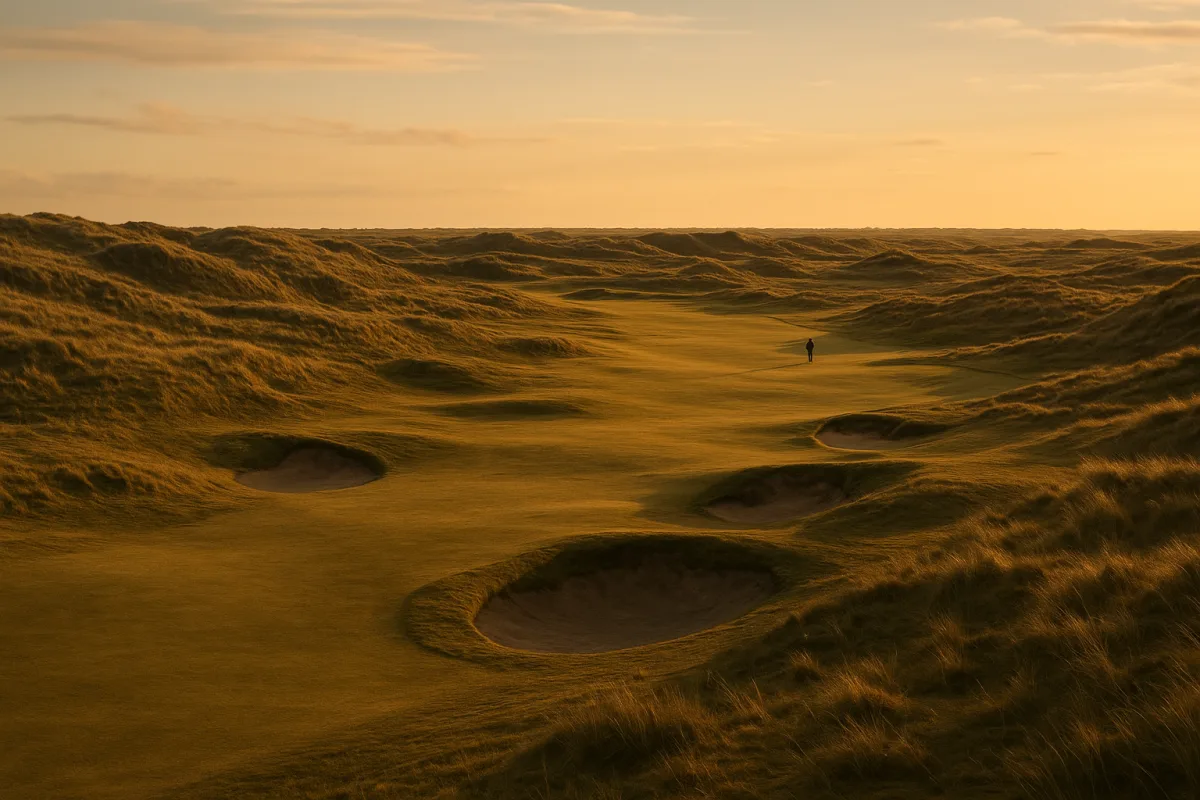
The useful way to understand course types
The most useful distinction is not whether a course is “hard” or “easy.” It is how the ground makes the ball behave after it lands. That one factor changes club selection, target choice and the sort of miss you can survive.
Golfers often use course labels as if they were fixed categories, like driver lofts. They are not. A 10.5-degree driver tells you something measurable. “Links” or “resort” tells you where a course sits, how it was built and usually how it plays.
A proper links course is rooted in sandy coastal land, traditionally between the sea and farmland. Firm fairways, wind exposure, sparse tree cover and deep bunkering are central features, rather than decorative choices added to an inland course. [2]
Parkland golf is largely the opposite environment: inland, greener, usually softer underfoot and framed by mature trees. Fairways are often more sheltered from wind, but trees, rough and water can make a missed target more expensive. [3]
Heathland occupies a useful middle ground. It is inland golf on sandy, free-draining soil, often with heather, gorse and pines rather than the dense deciduous trees associated with parkland. Woodhall Spa’s Hotchkin Course is a commonly cited heathland example. [4]
Desert golf is defined by its contrast. Irrigated turf provides the playable corridors, while native arid ground sits immediately outside them. This style is particularly common in Arizona and parts of the Middle East. [3]
Resort is different again. It is usually a business and visitor category, not a pure design category. Resort courses are intended to serve a broad range of players alongside accommodation and other amenities, and they can borrow features from links, parkland or desert golf. [5]
That is the key point when choosing where to play: a course type describes likely playing conditions, but it does not tell you the yardage, par, green fee or difficulty by itself. Those details still need checking on the scorecard and booking page.
Firm ground changes the whole shot
The cleanest example is links golf. On firm, sandy turf, the ball can run after landing. A shot that carries 140 yards and releases another 20 may be ideal, or it may run straight through a green.
That changes the calculation from “What club flies to the flag?” to “Where can I land this ball and still finish near the flag?” It is closer to planning a putt with a large first bounce.
A mid-handicap player who normally flies a 7-iron to the front edge may find a knockdown 8-iron is the sensible option on a dry links fairway. The loft number is not magic, though. The correct club depends on launch, spin, wind and landing area.
That matters because launch-monitor carry numbers can become misleading when transferred directly to the course. A 155-yard carry is useful information, but it belongs to the swing, ball and conditions that produced it. It does not promise a 155-yard result on firm ground.
Wind adds another layer. A high-spinning shot may stop quickly on a sheltered parkland green, yet balloon into a headwind on an exposed coast. A lower flight can reduce wind influence, though it also brings more roll into the equation.
This is why genuine links golf is not simply “golf by the ocean.” Suitable coastal land is limited, particularly in the United States, so authentic links are relatively rare there. Many American seaside courses may have ocean views without the firm natural linksland conditions. [2]
Links courses also tend to drain well. That can make them playable through wet winters, while summer dryness may brown the fairways and increase roll rather than make the course unplayable. [14]
For a golfer deciding whether to book one, the question is not whether links golf is harder. Ask whether you enjoy creative recovery shots, low trajectories and accepting that a well-struck full wedge is not always the best answer.
Softer turf asks for a different plan
Parkland golf generally produces more familiar carry-based decisions. Lusher fairways and softer greens reduce rollout, so the number to the front, pin and trouble becomes more important than the number to the back edge.
That does not mean a parkland course is target golf in the simple sense. Mature trees can block recovery routes, and a ball that misses the fairway on the wrong side may require a punch-out rather than an ambitious curve.
The practical difference is that trees make direction costly, while firm ground makes distance control costly. On a parkland course, missing 15 yards right can leave no path to the green. On a links course, missing long by 15 yards may be the bigger problem.
Heathland can offer some of both. Its sandy soil encourages firmer, faster-draining conditions, but gorse, heather and pines create visual framing and penal rough. The ground may invite a running shot, while the vegetation demands a conservative starting line. [4]
For many players, heathland is a useful first step toward firm-ground golf. It rewards attention to bounce and rollout without asking you to judge every approach in a 25-mph coastal wind.
Desert golf makes target selection especially clear. The maintained turf is often a narrow playing corridor surrounded by native desert. A miss can mean scrub, rocks or an awkward lie, so “driver everywhere” is not automatically good strategy. [3]
The sensible club off the tee is the longest club that keeps your usual dispersion inside the playable area. That is a better rule than copying a professional’s aggressive line, because their launch, spin and strike pattern are not yours.
Course format is separate from course style
Course type and course format are easily confused. A links or parkland course can be 18 holes, nine holes or something shorter. Format tells you how much golf is being offered, while terrain tells you how it is likely to play.
A typical 18-hole course measures roughly 6,500 to 7,500 yards and is commonly par 70 to 72. [6] That range is broad enough that the scorecard still matters more than the phrase “championship course.”
Nine-hole courses usually run from 1,500 to 3,000 yards, with par ranging from 27 to 36. [6][7] They are not automatically beginner courses, because a compact nine can still have demanding greens, water and narrow landing areas.
Par-3 courses generally total 1,000 to 2,000 yards, with par 27 to 36. [8] They remove much of the driver game, but they expose an area many mid-handicaps need most: carrying a precise distance with a wedge or short iron.
Executive courses usually measure 3,000 to 5,000 yards and play to par 54 to 65. [8] They commonly mix par 3s with shorter par 4s, making them a realistic option for golfers who want more variety than a par-3 course.
These formats are not lesser versions of 18 holes. If your goal is improving scoring, an executive layout may give you more meaningful approaches from 80 to 160 yards than a long course where several holes become driver, long iron and a scramble.
Par itself is not a judgment on your score. It is based on the strokes a scratch golfer is expected to need, including two putts, and course setup can shift it slightly. [7] A par-68 executive course can be plenty demanding.
Pick difficulty with rating and slope, not reputation
The number players should learn to read is the pairing of Course Rating and Slope Rating. Together, they are more useful than a course’s reputation, its back-tee yardage or a photo of a terrifying bunker.
Course Rating estimates the score a scratch golfer is expected to shoot under normal conditions from a specific set of tees. It can change when a course is altered or rerated, so it should not be treated as a permanent property of the club. [16]
Slope Rating is more relevant to the typical mid-handicap player because it reflects how much more difficult the course is expected to be for a bogey golfer relative to a scratch golfer. [16]
This distinction matters. A long course can have a formidable Course Rating but a comparatively manageable Slope if fairways are wide and trouble is limited. A shorter course can have a higher Slope when hazards and difficult recovery shots remain in play.
That is also why moving forward does not necessarily make a course easy. Forward tees reduce forced carries and length, but they do not always remove water, trees, bunkers or heavily sloped greens. Both ratings should be considered together. [17]
For a mid-handicap golfer choosing tees, the practical aim is to leave reasonable approach clubs rather than repeatedly hitting fairway woods into par 4s. The scorecard is telling you how the course is calibrated, not demanding that you prove something from the back markers.
Course length alone is an incomplete difficulty measure. Fairway width, rough, bunker placement, hazards and green contours can matter as much as yardage, which is why two 6,600-yard courses can produce very different rounds. [16]
Price and conditions do not follow the course label
There is no reliable nationwide rule saying links are cheaper than parkland, or desert courses cost more than resort courses. Green fees follow location, season, demand, access and facilities at least as much as design style.
The U.S. public-course average is about $43 for 18 holes, although reported state averages range from $31 in Oklahoma to $113 in Nevada. [9][10] Municipal golf is commonly quoted at $15 to $40, while daily-fee public courses often fall between $30 and $80. [11]
Resort pricing can move far beyond that range. Typical resort rounds are listed at $100 to $250 or more, while Pebble Beach was priced at $695 in April 2026 and Bandon Dunes around $375 in peak season. [11][12]
Those prices buy access to a particular venue and its operation, not a guarantee that the golf will suit your game. For many players, a $40 municipal round from appropriate tees is better value than a famous layout played from a set of markers that turns every hole into survival.
Twilight rates are often 30% to 50% lower than standard times. [9] That can make a more expensive course accessible, although you still need enough daylight for the number of holes you expect to complete.
Finally, course conditions are not fixed. More rounds, labor shortages, drought and heat all reduce the margin maintenance teams have to produce consistent turf. Rounds played were up 5% through April 2026, tightening maintenance windows at many facilities. [20]
Some courses use robotic mowers and other technology to maintain standards, with more than 1,700 courses worldwide reported to use robotic mowers. [19] That may improve consistency, but it does not erase weather, water restrictions or a scheduled aerification week.
Before booking, look past the category. Check the tees, ratings, recent condition notes, expected weather and whether the turf will be firm or soft. That small amount of homework is more useful than assuming every links, parkland or resort course plays the same.
Frequently Asked Questions
What are the main types of golf courses?
The main types of golf courses are links, parkland, heathland, desert, and resort. Links courses are coastal with sandy soil and firm fairways; parkland courses are inland with lush fairways and mature trees; heathland features sandy soil with heather and pines; desert courses have irrigated turf surrounded by arid land; resort courses combine features from other types and focus on serving a broad range of players.
How does a links golf course differ from a parkland course?
Links courses are typically firm, sandy, coastal grounds with few trees, exposed to wind, and deep bunkers, causing the ball to roll significantly after landing. Parkland courses are inland with softer, greener turf, sheltered from wind by mature trees, making direction more critical because trees and rough punish errant shots more than firm ground does.
What defines a heathland golf course?
Heathland golf courses are inland and built on sandy, free-draining soil. They often feature vegetation like heather, gorse, and pines rather than dense deciduous trees. Heathland offers a mix of firm ground that encourages running shots and penal rough that demands careful shot placement.
What is unique about desert golf courses?
Desert golf courses are characterized by irrigated lush turf playing corridors set amid native arid, desert terrain. This contrast between green fairways and dry surroundings is common in regions like Arizona and parts of the Middle East, creating a distinct visual and playing environment.
How do different golf course types affect playing strategy?
Course types influence how the ball behaves after landing, which affects club selection and shot planning. For example, firm links turf allows for more rollout and requires planning for bounce and roll, while softer parkland turf demands precise distance control and punishes directional errors due to trees and rough. Heathland combines elements of both, rewarding attention to rollout and conservative shot lines. Desert courses require managing lush playing corridors amid arid surroundings.
How we researched this
This article was assembled from 20 cited references.
Nothing here is based on hands-on testing. Where a figure or finding appears, it belongs to the source cited beside it, and the writing says so rather than implying otherwise. Every source is listed below so you can check it.
Sources
- Tree removals at East Potomac golf course raise alarms
- Types of golf courses explained from links to parkland and beyond | FairwayDB
- Types of Golf Courses | A Complete Guide to Layouts, And Designs
- Woodhall Spa Golf Club Hotchkin Course: Review, Tee Times and Key Info
- A guide to the different types of golf courses | Golfbreaks
- What Is The Length Of A Golf Course | Golf Life Wiki
- What Is Par in Golf? Meaning, Examples, and Scoring Explained
- How Long Is the Average Golf Course? Exploring Typical Course Lengths
- Is Golf an Expensive Hobby? (Honest Breakdown) | The Other Golf Channel
- Average Public Golf Green Fees by State: 2026 US Data Report | Green Fee Tracker
- The Average Cost of a Round of Golf in 2026
- United States Golf Green Fee Trends 2026 | GolfForKings
- Casino Resort Green Fees: 2026 Pricing Guide by Region | Golf & Casino Resorts
- What Makes Links Golf The Best
- Golf Course Conditioning: What SWFL Courses Do in the Off-Season – Southwest Florida Golf Directory
- How Golf Course Ratings Work: A Complete Guide for Everyday Golfers - Burlingame Country Club | Sapphire's Finest Golf Course
- Course Rating and Slope Rating Explained - Golf Tracking & Strokes Gained
- 2026 Numbers to Know: Facing the challenge - Golf Course Industry
- Golf course maintenance tools in 2026 | TeeAdmin
- The Impact of More Rounds Being Played, USGA Central Region Update - Michigan Golf Course Superintendents Association
Related Articles

Best Golf Courses for Winter Play: Top Destinations and Tips
Discover the best golf courses for winter play, including top destinations, turf conditions, and travel tips for a great winter golf experience.

Types of Golf Grips: Overlapping, Interlocking & More
Learn about the types of golf grips, including overlapping, interlocking, 10-finger grips, grip sizes, and materials to improve your game.
Best Golf Courses to Play in Summer: Top Picks and Tips
Discover the best golf courses to play in summer with tips on conditions, tee times, and course selection for an enjoyable round.
Best Golf Courses in Fall: Top U.S. Autumn Destinations
Discover the best golf courses in fall with tips on course conditions, booking, and top U.S. autumn golf destinations for 2026.