
How to Read a Golf Scorecard: A Complete Beginner's Guide
Learn how to read a golf scorecard, understand tees, yardage, par, and stroke index to track your score accurately on the course.
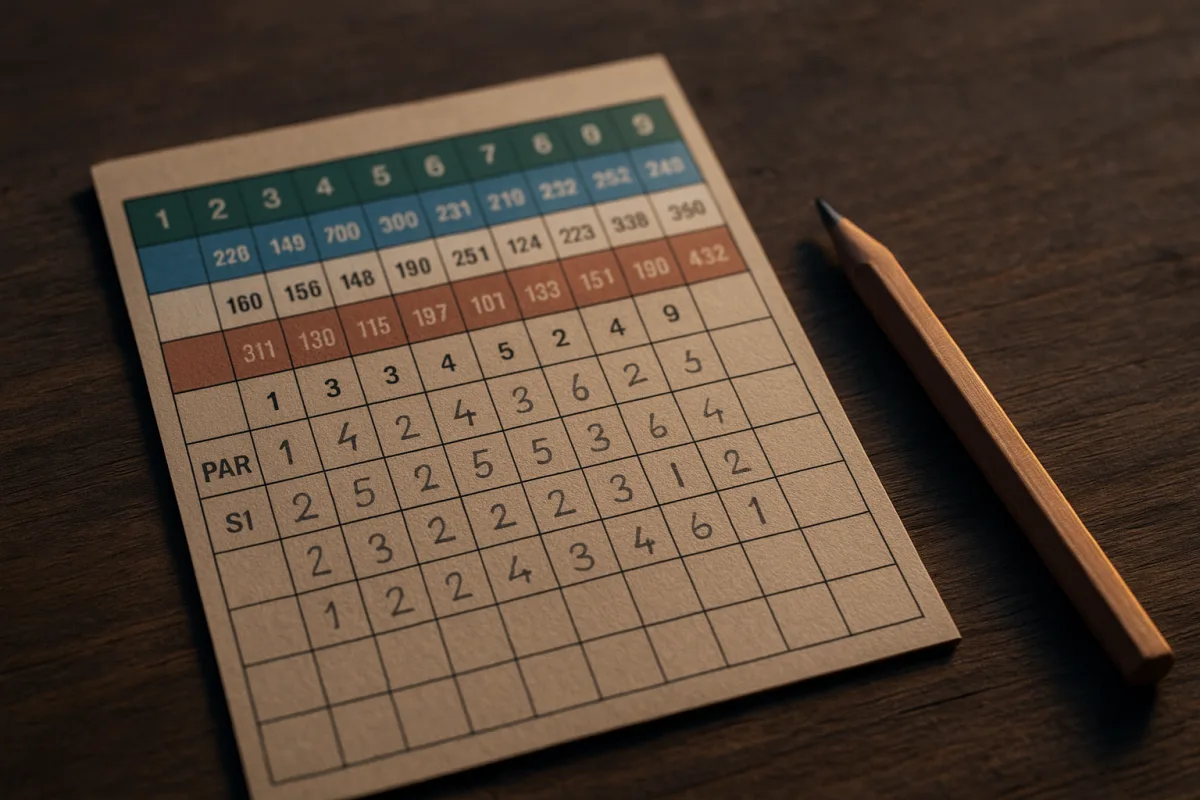
Before you tee off: identify the course, date and tee row
The top of the card normally tells you the course name and gives space for the date, player names, marker or scorer, and sometimes handicap information. Fill these in before the first tee if you are playing a score that matters. [1][4]
Then find the set of tees you are playing. The card may call them Black, Blue, White, Gold, Red, or something more course-specific. Colour is a label, not a universal difficulty rating.
A common guideline is that black tees can stretch from 7,000 to 7,500-plus yards, while red tees may be below 5,200 yards and often suit beginners. That is only a guideline, though. The same colour can mean very different yardages at another course. [1][5]
Read across the row for your tee colour and find three useful numbers: total yardage, course rating and slope rating. On many European-style cards, rating and slope are shown separately for each tee, while US cards often focus on hole number, par, yardage, stroke index and scoring spaces. [1][6]
For a new player, total yardage is the practical starting point. It tells you what sort of day you have chosen. A 6,700-yard course and a 5,600-yard course may both be par 72, but they are not remotely the same playing test.
Do not choose tees because they are labelled “men’s,” “ladies’,” “championship” or “members.” Choose a tee set that lets you reach most par 4s in a sensible number of shots and play without holding everyone up.
That is not a marketing decision and it is not a pride decision. It is a scoring decision. If you are repeatedly hitting driver, fairway wood and another long club into ordinary par 4s, moving forward is usually the sensible call.
On the first hole: read the columns in the right order
Most cards run from hole 1 to hole 18, with each hole in its own column. The basic rows are usually hole number, par, yardage by tee, handicap or stroke index, and a blank scoring row for each player. [1][9]
Start with the hole number. It sounds obvious, but it prevents a surprisingly easy mistake after a crossover or when the course starts players on a different hole during a busy day.
Next, look at par. Par is the score a scratch golfer is expected to make under the course’s intended playing conditions. It gives you a reference point, not a target you must chase with a risky shot. [2][3]
A par 3 is typically up to 250 yards, a par 4 generally runs from 251 to 470 yards, and a par 5 is usually over 470 yards. Course design and terrain matter too, so those ranges are useful guides rather than fixed rules. [2][3]
For a mid-handicap golfer, par is most useful as a quick way to understand the hole’s shape. On a par 3, you are normally planning one shot to the green. On a par 5, you need to decide whether the second shot is an advance shot or a genuine attempt to get home.
Now look at yardage, using the row for your tees only. The number is measured from that teeing area to the centre of the green, in yards. It is not the distance to a front pin, a tucked back-right flag or the edge of a hazard. [1][5]
That distinction matters. If the card says 155 yards and the pin is cut at the front, the actual carry may be materially shorter. If it is on the back tier, it may be longer, and elevation or wind can change the effective number again.
The card cannot tell you every detail. Use it to establish the hole’s baseline distance, then use a rangefinder, GPS, yardage book, course markers or your eyes to refine the shot. The number on the card is useful, but it is not a launch monitor readout.
Understand par before you start adding pluses and minuses
A full 18-hole card commonly has a total par of 70 to 72, though layouts vary. Nine-hole courses are generally between par 27 and par 36. Add the par row and you will usually see an “Out” total after hole 9 and an “In” total after hole 18. [1][3]
“Out” means the front nine total, and “In” means the back nine total. Those terms survive even when the ninth hole does not literally take you away from the clubhouse and the 18th does not literally bring you back.
Your gross score is every stroke you took. If you make 6 on a par 4, write 6. You can later describe it as a double bogey, but the scorecard’s essential job is to preserve the actual number.
This is where beginners often create avoidable confusion. “One over,” “net par” and “I got a shot there” are not substitutes for recording the gross score. Write the gross number first, clearly, on every hole. [6][7]
If you want a running total relative to par, do it separately or in your head. A score of 45 after nine holes on a par-36 front side is nine over par, but the official raw total is still 45.
There is nothing wrong with being 12 over through 11 holes. There is something wrong with turning that into an invented 10 over because you forgot a penalty or decided a short putt “didn’t really count.”
When you see stroke index: use it for handicaps, not strategy
The row labelled “HCP,” “HDCP,” “SI” or “Stroke Index” ranks holes from 1 to 18 for handicap-stroke allocation. Index 1 is the first hole where a player receives a handicap stroke, and index 18 is the last. [7][9]
It does not necessarily mean the index-1 hole is the most visually intimidating hole. A long par 4 may be index 1, but so might a short hole with a severe green, water in play or a scoring pattern the club has accounted for.
If you are simply recording a social gross score, you can ignore this row while you play. It becomes relevant when the group is using handicaps for net scoring, match play, Stableford or another competition format.
The exact number of strokes you receive depends on your playing handicap for that course and tee set. Do not guess from your handicap index or assume you get one stroke on every hole. Confirm the day’s competition rules or handicap calculation before starting.
The practical method is simple once the number is known. If you receive 12 strokes, you get one stroke on holes with stroke indexes 1 through 12. If you receive more than 18, some holes receive a second stroke under the applicable format.
Keep gross and net separate. Write your actual 7 on the hole. If handicap scoring applies, calculate the net score from that 7 using the strokes allocated. Mixing the two in one box is how arguments and arithmetic errors start. [6][8]
After every hole: count what actually happened
The number in your score box is your total strokes for the hole, including putts and penalty strokes. A putt from two feet counts exactly the same as a full pitching wedge in the scoring total. [4][6]
If you hit a tee shot, a recovery shot, a wedge and take two putts, that is 5. If your tee shot went out of bounds and you proceeded under stroke-and-distance, the penalty also belongs in the total.
Penalties are where new golfers most often lose track. Do not wait until the clubhouse to reconstruct whether a ball was lost, out of bounds, in a penalty area or played under a local rule. Agree the situation with the group and write the total before moving on. [4][8]
You can track putts separately if your card has a putts row or if you are using an app. That can be useful for spotting whether your scores are driven by missed greens, poor recovery play or too many three-putts.
But putts are an analysis number, not a replacement score. A card showing “2” in a putts column does not mean you made 2 on the hole. Your main score box must still show all strokes taken.
Do not leave a blank score box because you had a bad hole or cannot remember the number. A blank creates a bigger problem later than writing a provisional total and checking it immediately with the playing group. [6][8]
At the turn: check the arithmetic before it becomes a mystery
When you reach the ninth green, total holes 1 through 9 and compare the result with the “Out” box. This is the easiest time to find a missed hole, transposed number or penalty nobody included.
A simple check is to count the number of completed score boxes first. There should be nine numbers for nine holes. Then add them once, rather than repeatedly re-adding while everyone is trying to order food.
Do the same after the 18th hole. Add the back nine into the “In” box, then add Out and In for the final total. Most scorecard errors are basic accounting errors, not complicated rules disputes. [6][8]
If you are comparing scores against par, add the total par shown on the card. An 89 on a par-72 course is 17 over. An 89 on a par-70 course is 19 over. The gross score stays 89, but the relationship to par changes.
For handicap or competition purposes, use the tee row you actually played. Course rating and slope rating are tied to a specific tee set, so copying a friend’s numbers from a different tee row defeats the purpose. [1][5]
Before leaving: compare, correct and sign
At the end of the round, the marker should compare the recorded score with the player’s own recollection hole by hole. Do this before signing, especially if there was a penalty, a concession in match play or a hole where the group was unsure. [4][8]
For an official scorecard, the player and marker signatures matter. A card that is not properly checked and signed can be invalidated, even if the golf itself was fine. [4][8]
Digital scorekeeping is a workable alternative, and scorecard apps are now common. Whether you use paper or a phone, the principle is unchanged: the score must be complete, accurate and agreed before submission. [10][11]
Do not blame scorekeeping for a slow round. Recording a score takes only a few seconds per hole, while a lost-ball search can consume two to five minutes. Excess practice swings, lengthy putt analysis and returning to the cart for the wrong club cost more time. [10]
The cleanest routine is also the fastest: finish the hole, count strokes aloud if needed, write the gross score, confirm it with the marker, and move to the next tee. That gives you a scorecard you can trust when the round is over.
Frequently Asked Questions
What information is on a golf scorecard?
A golf scorecard typically includes course and player information such as the course name, date, tee color, total par, course rating, slope rating, player names, handicap index, and marker/scorer details. It also shows hole-by-hole details including hole number, par, yardage by tee color, and stroke index. Finally, there are scoring rows for each player and spaces to total the front nine, back nine, and overall scores.
How do I read the yardage and par on a golf scorecard?
Yardage is listed by tee color and shows the distance in yards from that tee to the center of the green for each hole. Par indicates the expected number of strokes a scratch golfer should take on a hole, generally based on length: par 3 up to 250 yards, par 4 between 251 and 470 yards, and par 5 over 470 yards. Par provides a reference for planning your shots rather than a target to chase.
What does stroke index mean on a golf scorecard?
The stroke index is a tool for allocating handicap strokes and does not rank holes by difficulty from the tee. A stroke index of 1 means it is the first hole on which handicap strokes are given. It helps players apply their handicap evenly across the course rather than indicating which holes are hardest to play.
How do I fill out a golf scorecard correctly?
Record every stroke that counts on each hole, including putts and penalty strokes, in the scoring box for that hole. Do not leave holes blank and be sure to add the front nine, back nine, and total scores before finishing. For an official round, both the player and the marker must verify the scores and sign the card.
How do I choose the right tee on a golf scorecard?
Select the tee set that matches your ability to reach most par 4 holes in a reasonable number of shots and allows you to play without slowing the group. Tee colors are not standardized and can vary widely in yardage between courses, so choose based on yardage and your comfort rather than labels like “men’s” or “championship.” Moving forward to a shorter tee is often the sensible choice for better scoring and pace of play.
How we researched this
This article was assembled from 11 cited references.
Nothing here is based on hands-on testing. Where a figure or finding appears, it belongs to the source cited beside it, and the writing says so rather than implying otherwise. Every source is listed below so you can check it.
Sources
- How to Read a Golf Scorecard: Complete Guide
- What Is Par in Golf? Par 3, 4 and 5 Explained | The Other Golf Channel
- What Is the Average Par for a Golf Course and How Is It Determined?
- Rules of Golf - Scorecards - FSGA
- Reading a Scorecard Before You Play: The Information Most Golfers Ignore | RYZE Golf
- Golf Scorecard: How to Read and Use It - The Golf Hub
- Golf Scorecard Explained: 7 Things Every Weekend Golfer Needs to Know
- Golf Rule 3.3b: Scorecard Rules & Disqualification Explained
- How to Read a Golf Scorecard (Every Row Explained) | Flash Caddie
- The Beginner's Guide to Tracking Golf Scores Without Slowing Down - Golf Tracking & Strokes Gained
- mScorecard - Golf Scorecard App - App Store
Related Articles

How to Start Playing Golf
Learn how to start playing golf with beginner equipment advice, practice routines, swing basics, and etiquette tips for new golfers.
How to Read Greens in Golf
Learn how to read greens in golf by understanding slope, grain, and speed to improve your putting accuracy and lower your scores.

Common Golf Swing Faults: Trail Arm Lift, Head Sway & More
Learn about the most common golf swing faults like trail arm lift, head sway, and pelvis thrust, and how to identify them in your swing.
How to Avoid Three Putts: Key Tips and Strategies
Learn how to avoid three putts with tips on speed control, green reading, and putting drills to improve your golf performance.