
Practice Golf Swing with a Friend: Safe, Effective Tips
Learn how to practice golf swing with a friend safely and effectively using structured drills, feedback roles, and focused sessions.
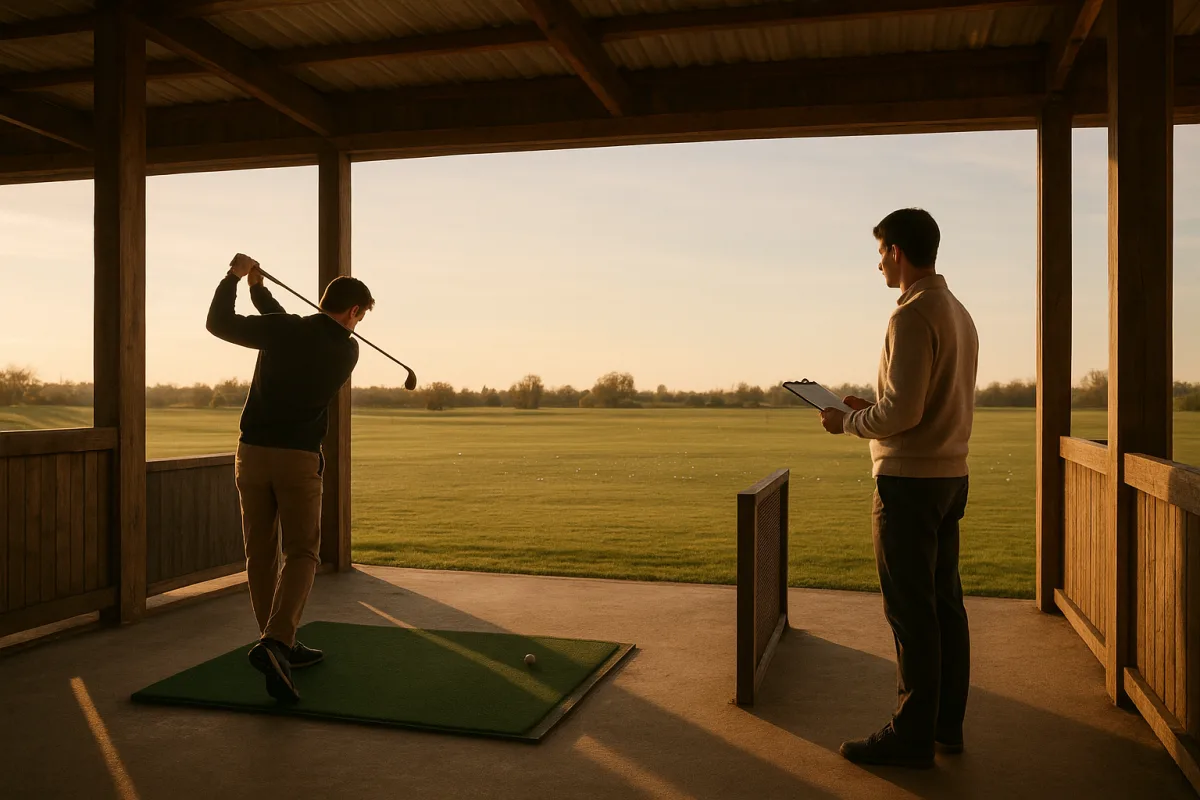
Start by making the practice arrangement safe
The first problem with practising golf swings with a friend is physical space. A driving range may feel casual, but a club travelling at speed and balls leaving the bay demand clear rules before either player starts offering swing advice.
Use separate designated stalls when the facility provides them. Mt. Prospect Golf Club’s practice-area rules call for one person per stall, while Golf Burnaby’s safety guidance tells golfers to stay behind tee lines and use designated hitting areas. [15][16]
That means the useful two-player setup is normally sequential. One player hits while the other stands well behind the tee line, watches from a safe position, and collects feedback. Then switch roles after a defined number of balls.
Do not invent a spacing rule because no universal distance exists for golfers practising side by side. Each range has its own bay size, barriers and local rules, so follow the facility’s instructions rather than assuming a friend is safely out of reach. [15][16]
Also agree that neither person takes practice swings while the other is near the ball or in front of the hitter. GOLF.com identifies practice swings made too close to the ball as a common avoidable mistake. [17]
Decide what you are trying to change before hitting balls
Friends can make practice more social, but they can also turn it into 90 minutes of unsolicited fixes. Before warming up, each player should name one swing outcome to work on, not five mechanical theories.
A useful target is observable: “start more iron shots on my intended line,” “hold my finish without stepping forward,” or “make centre contact more often.” “Fix my swing” gives your partner nothing reliable to watch.
This is where mid-handicap golfers can get fooled by a good-looking shot. One flushed 7-iron tells you very little. A launch-monitor number, strike pattern or ball flight belongs to the swing that produced it, on that strike, with that club.
Most claimed distance improvements are within normal shot-to-shot noise unless you have enough comparable swings. Do not turn a friend’s one longer drive into proof that a grip tweak or a new shaft has transformed your game.
Use a simple agreement: the hitter chooses the goal, and the observer only comments on that goal. Golf Blab’s feedback guidance favours specific cues and objective checkpoints, while UK Coaching emphasises active listening and actionable feedback. [25][26]
Build a session that does not run out of focus
Links at Sunset Ridge, TeeBetter and PracticeCaddie all point toward a compact, repeatable practice structure rather than occasional marathon sessions. Their recommended joint-practice window is 30 to 60 minutes, ideally repeated two or three times a week. [5][6][7]
Start with five to 10 minutes of warm-up. Hit easy shots, make a few rehearsal swings and establish whether your back, hands or tempo feel different than usual before trying to judge a technical change. [5][6]
Reserve 20 to 30 minutes for two to four drills with clear goals. That is enough structure to learn something, without changing drills every three balls because the last shot was poor. [6][7]
Finish with five to 10 minutes of pressure practice. Pick a target, club and consequence, such as each player needing two balls that start inside a chosen window before moving on. The point is to make the practice motion survive a task. [5][6]
There is no research-backed rule in the brief for exact minutes per drill, so avoid pretending that eight minutes is scientifically superior to 10. Switch when both players have had enough attempts to identify a pattern.
Give each player a job during the drills
The best collaborative drill is one where the hitter can focus on moving the club, while the observer has a visible checkpoint. The observer should not narrate the whole swing from takeaway through finish.
For an Alignment Stick Gate drill, set the gate and agree what counts as success before the first ball. The hitter’s task is to send the ball through the intended window, while the friend checks whether the ball started through it. [1]
This is more useful than asking a friend whether the swing “looked on plane.” A gate gives both golfers the same reference point, and it keeps the conversation on start direction and alignment rather than armchair swing diagnosis.
Use the Two Tee drill when contact and impact path are the priority. Golf Smart Academy’s drill uses two tees as a narrow impact checkpoint, giving the observer a direct job: watch whether the club passes through cleanly without disturbing the wrong tee. [2]
Run it in sets. One player hits five balls with the tees in place, then the observer reports a simple total: clean passes, contacts with either tee, and any obvious ball-flight pattern. Then change roles.
Use balance and tempo drills when ball-striking becomes messy
When players begin trying too hard to hit the ball, balance usually goes first. The Feet Together drill is useful because it reduces the ability to hide poor balance with a big lateral move. [3]
Have the hitter make controlled swings with the feet together, beginning with shorter clubs or shorter swings if needed. The observer watches only whether the player remains balanced through the finish, rather than trying to diagnose every body position. [3]
The goal is not to hit a personal-best carry distance from a restricted stance. It is to feel a repeatable rhythm and finish. If the player repeatedly falls toward the ball or target, note it without adding three more fixes.
The Two-Club Swing drill can provide a different tempo and sequencing feel. Golf Info Guide presents it as a power drill, but treat it as a rehearsal tool first, not evidence that a player has found extra clubhead speed. [4]
One golfer rehearses the motion with two clubs, then hits normal shots with one club. The partner watches for whether the intended feeling carries over, rather than praising the rehearsal itself. A sensation is only useful if it changes a real shot.
Keep feedback short enough to use on the next swing
The useful feedback loop is: hitter states the goal, observer watches one checkpoint, observer gives one concise cue, hitter decides whether it matches the feel. This is structured experimentation, not a debate over golf swings. [25][26]
Try language such as, “Three of five started right of the stick gate,” or, “You held the finish on four swings.” Those are observations. “You came over the top” may be a theory, and it is rarely an actionable instruction by itself.
Ask permission before changing the cue. A player who says, “I am working on balance today,” should not receive a lecture about wrist angles after one thin shot. Active listening matters because the hitter owns the practice goal. [26]
Be equally careful with slice advice. A tip that helped one player reduce a slice will not fix every slice, because the visible curve can come from different delivery patterns. Keep the task narrow and assess the result rather than copying a friend’s fix.
Add technology only when it answers the current question
A launch monitor can make two-player practice more objective, particularly when ball flight is hard to judge indoors or into a crosswind. It is useful when both players agree on which number matters for the drill.
The PRGR Portable Launch Monitor is listed at roughly $199 by Rain or Shine Golf and is suited to golfers who want basic portable speed and distance feedback without turning a range session into a simulator build. [9]
At the other end, the Foresight Sports GC3 is listed at $6,999 by Golfroom España and suits players wanting premium launch-monitor capability for serious indoor or outdoor measurement. Tom’s Guide also positions the GC3 as a high-end unit after extended testing. [11][12]
Those are hardware prices, not a complete indoor-practice budget. They do not automatically include an enclosure, impact screen, projector, computer, software subscriptions, room preparation, shipping or any retailer-specific package additions.
HackMotion and Blast Motion swing analyzers offer motion-focused feedback rather than simply ball data. They may suit players who specifically want to monitor wrist or swing-motion patterns, but the available research brief does not provide reliable current prices for either. [13][14]
Do not buy an analyzer because a friend has one. First decide whether your problem is strike, start line, balance or club delivery, then choose the simplest feedback tool that can answer it. Fitting beats buying when equipment is involved.
Avoid turning training aids into the whole session
Swing trainers can be useful, but they can also make a golfer perform for the device rather than make a functional swing. Golf Swing Shirt’s review of common trainer mistakes warns against overcomplicating practice and using aids inconsistently. [18]
Keep one aid in play at a time. If you have alignment sticks out, use them for alignment or a gate drill. Do not combine them with a wrist sensor, an oversized training club and three new feels in one bucket of balls.
Check basic setup before blaming the swing. GOLF.com highlights grip pressure and posture among common mistakes, while its corrective approach stresses a more relaxed grip and a sound setup sequence. [17]
Your friend can help here without becoming a swing coach. Ask them to check whether your grip appears excessively tight, whether you set the club behind the ball before settling in, and whether you are repeating the same pre-shot setup.
Do not let full swing practice erase the short game
Two golfers on a range tend to chase full shots because those are easy to compare. That is exactly why a joint session needs a deliberate short-game allocation, even if it is only the final pressure block. [17]
Move to a putting green or short-game area when available. Give each player the same landing spot, putt length or up-and-down task, then alternate attempts. The friend’s role is to record outcomes, not offer a new stroke thought every putt.
A simple competitive format works well: each player chooses a target and gets three attempts, then reports the result honestly. It adds consequence without making every miss an argument about mechanics.
Choose indoor or outdoor practice for the question at hand
Outdoor ranges offer real ball flight, target depth and the social rhythm of hitting together, but weather can make the feedback inconsistent. Indoor simulators provide a controlled environment that is especially useful in winter or extreme climates. [19][20][23]
For outdoor work, use the friend to observe start line, curvature and finish position. Wind can still complicate ball-flight conclusions, so do not overreact to a single shot that rides a gust.
For indoor work, use the repeatable setting to test one change at a time. Golf Digest notes that winter indoor practice can be particularly useful for making swing changes, since golfers can work without weather pressure or the urge to simply play. [23]
The practical answer is often both. Use indoor sessions for controlled repetition and measurable feedback, then take the change outside to see whether it produces a useful flight and target result in normal golf conditions. [19][20]
Frequently Asked Questions
How can I safely practice my golf swing with a friend?
Practice swings safely by using separate designated stalls if available, with only one person hitting at a time while the other stands well behind the tee line. Follow the driving range’s local safety rules, avoid swinging when your partner is near the ball, and do not make practice swings too close to the ball. This sequential setup prevents accidents and complies with common range policies.
What drills can I do to practice golf swing with a partner?
Effective two-player drills include Alignment Stick Gate, Two Tee, Feet Together, and Two-Club Swing drills, which involve clear setups and allow partners to give focused feedback on specific swing aspects. Assign one observable job per drill to the observer, such as checking alignment or balance, to keep feedback actionable and precise.
How should we structure a golf swing practice session with a friend?
A joint practice session should last 30 to 60 minutes, starting with 5 to 10 minutes of warm-up to loosen up and assess feel. Follow with 20 to 30 minutes working through two to four drills focused on specific goals, and finish with 5 to 10 minutes of pressure practice to simulate on-course conditions. Repeat sessions two to three times per week for best results.
What roles should each person take when practicing golf swings together?
One person should be the hitter focusing on a specific swing goal, while the other acts as an observer providing feedback only on that goal. The observer’s comments should be specific and objective, such as noting alignment or contact location, rather than vague advice. This clear role division helps maintain focus and effective communication.
How long should a joint golf swing practice session last?
Joint practice sessions are best kept between 30 and 60 minutes. This duration includes warm-up, focused drills, and pressure practice, helping maintain concentration and avoid fatigue. Consistent shorter sessions are more beneficial than infrequent, longer ones.
How we researched this
This article was assembled from 26 cited references.
Nothing here is based on hands-on testing. Where a figure or finding appears, it belongs to the source cited beside it, and the writing says so rather than implying otherwise. Every source is listed below so you can check it.
Sources
- https://www.swingspec.com/golf-club-guides/golf-accuracy-drills?utm_source=openai
- Improve Your Impact with the Two Tee Drill | Text Version - Golf Smart Academy
- Feet Together Golf Drill: Fix your tempo and balance
- More Power Golf Drills: Two Clubs for Distance
- How Often Should You Practice Golf? Weekly Plan
- How to Structure a Golf Practice Session — Plan & Routine | TeeBetter
- 10 Golf Practice Drills Tour Coaches Actually Use (And the Research Behind Them) | PracticeCaddie
- Best Golf Launch Monitors in 2026 — Ranked & Reviewed | Bestest.io
- PRGR Launch Monitor – Buy from Rain or Shine Golf
- Best Portable Launch Monitors 2026
- Foresight Sports GC3 | Golfroom España
- You haven't used a golf launch monitor until you've tried Foresight GC3 - here's my thoughts after 6 months of testing
- HackMotion New Sensor | Old Duffer Golf
- Analyseur de Swing Blast Blast Motion Swing Analyzer - Eté 2022 | Monsieurgolf
- Practice Area Rules | Mt. Prospect Golf Club
- Safety on the range | Golf Burnaby Website
- 5 common mistakes golfers make — and how to fix them | GOLF.com
- Top 5 Mistakes Golfers Make with Swing Trainers (And How to Avoid Them) – golfswingshirt.com®
- Choosing Your Swing Space - Indoor vs. Outdoor Golf Simulators — Simply Golf Simulators
- Indoor vs Outdoor Golf: Key Differences | GolfSimIQ
- Swing Zone Golf Reviews: Full Guide | Golf Swing Drills Blog
- Are Indoor Golf Ranges Better Than Outdoor Ranges?
- Don’t dread indoor winter practice. It’s the perfect time to make swing changes | How To Play Golf | GolfDigest.com
- Indoor Golf Simulator vs Outdoor Range | Cero Golf UAE
- Fix Your Biggest Misses With 4 Drills and Golf Swing Feedback Examples - Golf Blab
- Coaching Techniques in Sport | Guide - UK Coaching
Related Articles
How to Start Playing Golf
Learn how to start playing golf with beginner equipment advice, practice routines, swing basics, and etiquette tips for new golfers.
Improve Golf Swing Path: Tips, Drills, and Common Mistakes
Learn how to improve golf swing path with drills, setup tips, and launch monitor insights for better ball flight and consistency.
Best Golf Drills for Short Game: Improve Chipping & Control
Discover the best golf drills for short game to improve chipping accuracy, distance control, and course strategy with practical landing spot methods.
Improve Golf Swing Tempo: Tips and Drills for Success
Learn how to improve golf swing tempo with practical tips, drills, and training aids to enhance your rhythm and consistency on the course.