
Golf Handicap System Explained
Learn how the golf handicap system works, including Handicap Index, Course Rating, and Slope Rating, to understand your scoring potential.
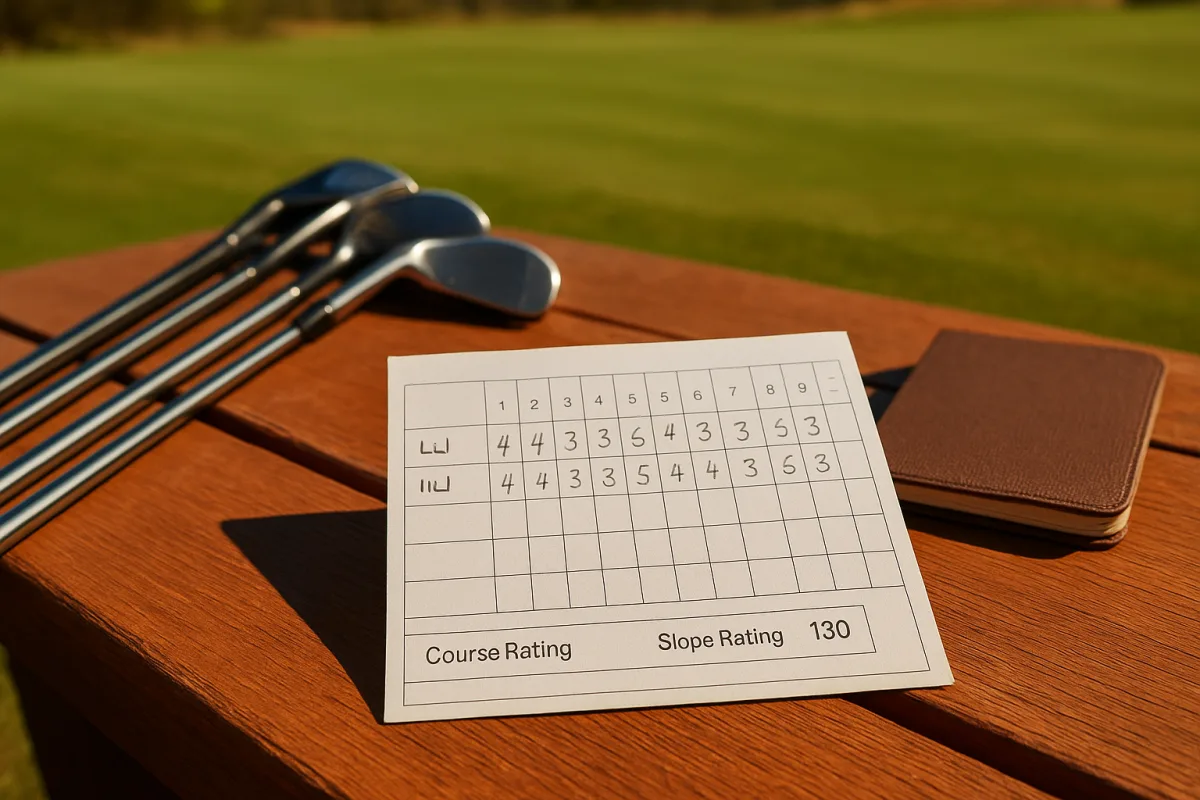
The number that matters is the Handicap Index
The World Handicap System, usually shortened to WHS, is the common handicap framework used internationally. It was introduced in 2020 by The R&A and the USGA, bringing systems such as USGA, CONGU, EGA and Golf Australia handicapping under one structure. [1][3]
That does not mean a 15-handicap golfer should expect to shoot 87 every time on a par-72 course. The Handicap Index is a measure of demonstrated potential, based on better performances, not a prediction of your next Saturday medal score. [4][5]
That distinction catches plenty of golfers out. If your Index is 15.0 and you normally shoot somewhere between 90 and 95, that is not proof the system is broken. Golfers commonly score two to five strokes above their Handicap Index. [4]
Think of it like launch-monitor data, but with more moving parts. A 7-iron carry number belongs to the swing, strike, ball and conditions that produced it. Likewise, a Handicap Index belongs to the scores, courses and adjustments used in its calculation.
The useful question is not, “What should I shoot today?” It is, “How does the system convert my posted score into a comparable number?” That comparable number is called a Score Differential. [1][3]
A round becomes a Score Differential
The WHS does not simply record your gross score and place it beside other gross scores. A 90 at a short, easy course should not automatically mean the same thing as a 90 from championship tees on a course with a higher rating. [1][3]
The calculation is:
Score Differential = (113 ÷ Slope Rating) × (Adjusted Gross Score − Course Rating − PCC Adjustment). [1]
That looks more complicated than it plays out on the app or score-entry screen, because the system does the arithmetic. Still, knowing what each term means helps explain why two rounds with the same gross score can produce different differentials.
Your Adjusted Gross Score begins with what you actually made, but WHS limits the maximum score on any one hole for handicap purposes. The limit is net double bogey: par plus two strokes, plus any handicap strokes you receive on that hole. [1][3]
Suppose you receive one stroke on a par 4 and make 9. For handicap calculation, that hole is capped at 7, calculated as par 4 plus two, plus your one allocated stroke. Your scorecard can still show the 9, but the handicap record uses 7. [1][3]
This is not a free pass to stop trying after a bad tee shot. It is a way to stop one truly awful hole from overwhelming the evidence from the other 17. Most mid-handicappers know a single penalty-stroke spiral can otherwise make a decent round look far worse.
Course Rating and Slope are not decorative numbers
Course Rating is the expected score for a scratch golfer playing a particular set of tees under normal conditions. It is why the white tees and back tees at the same club can have different values. [1][3]
Slope Rating measures how much more difficult that tee set is for a bogey golfer relative to a scratch golfer. The standard slope is 113, and the possible range runs from 55 to 155. [1][3]
A slope above 113 means the course is rated as relatively tougher for the bogey golfer than the standard course. A slope below 113 means the relative difficulty is lower. That is not a verdict on whether the course is “easy.” [1][3]
A course can be brutally long, heavily bunkered or firm enough to make approach shots awkward, yet still produce a particular rating only for the tees and conditions on which it was rated. The number is specific, not a marketing badge.
For men, Slope Rating is derived from the difference between Bogey Rating and Course Rating multiplied by 5.381. For women, the multiplier is 4.240. [1] Those are governing-body calculations, not figures a player needs to recreate before the first tee.
A worked example of the differential
Take a round with an Adjusted Gross Score of 91, on tees rated 71.5 with a slope of 130. If the Playing Conditions Calculation is zero, the differential is about 16.9:
(113 ÷ 130) × (91 − 71.5 − 0) = 16.9. [1]
The same 91 from a course rated 69.0 with a slope of 113 would produce a differential of 22.0. That is the point of the system. The gross score remains 91, but the context is different.
This is also why comparing gross scores across clubs can be mostly noise. A mate’s 84 may be better, worse or broadly equivalent to your 88 depending on tee rating, slope and the adjustments applied to each score.
Why your worst rounds do not define your Index
Once a golfer has a developed scoring record, the Handicap Index is the average of the best 8 Score Differentials from the most recent 20 rounds. [1][3] The system is deliberately looking for your stronger demonstrated scoring, rather than averaging every number you post.
That design explains the word “potential.” A player who has eight differentials around 15 but twelve around 20 does not get an Index around 18 simply because that looks like the arithmetic average of all rounds.
The poor rounds still matter in one important way: they occupy places in the most recent 20. As new scores arrive, older scores fall out of the record. A good differential can eventually stop counting, while a fresh good score can enter the best eight. [1][4]
To establish a Handicap Index, a golfer must submit at least 54 holes of acceptable scores. That can mean three 18-hole rounds, six 9-hole rounds, or a combination that reaches 54 holes. [2][3]
The Index updates daily, rather than waiting for a monthly revision. [1][3] That is generally a better reflection of current form, although it also means an improving player can see their number move more quickly than under older systems.
Your Handicap Index is not your Course Handicap
The Handicap Index is the portable number attached to you. The Course Handicap is the number of strokes you receive from a particular tee set, after accounting for that tee’s slope and course rating. [1][6]
The formula is:
Course Handicap = Handicap Index × (Slope Rating ÷ 113) + (Course Rating − 72). [1]
For example, a golfer with a 15.0 Handicap Index playing tees with a slope of 130 and Course Rating of 71.5 has a Course Handicap of roughly 16.8, normally rounded to 17 strokes for play.
The slope portion increases the number because 130 is above the standard 113. The Course Rating portion trims half a stroke because 71.5 is half a stroke below par 72. The result is about 17, not automatically 15. [1]
That is why it is worth checking the tees before arguing about how many shots someone receives. If two players use their Indexes without converting them to Course Handicaps, they are skipping the part designed to make different courses comparable.
Then there is Playing Handicap, which is not the same thing again. A Playing Handicap applies the handicap allowance required by the competition format, such as a better-ball or team event, to the Course Handicap. [6]
For a normal individual stroke-play round, the distinction may feel academic. In team formats, it matters. Use the allowance specified by the competition, rather than assuming every player gets 100 percent of their Course Handicap. [6]
What PCC does, and what it cannot do
Playing Conditions Calculation, or PCC, is WHS’s attempt to account for days when a course plays meaningfully different from normal. It can range from minus 1.0 to plus 3.0 strokes. [1][3]
A positive PCC generally reflects unusually difficult scoring conditions. Since PCC is subtracted in the differential formula, a positive adjustment reduces the differential produced by a given score, recognising that the day played tougher than usual. [1]
PCC is not automatically applied because it rained, blew 25 mph, or because the greens felt quick to you. It requires at least eight acceptable scores from players with Handicap Indexes of 36.0 or lower to be posted that day. [1][3]
A negative PCC can apply when scoring conditions are unusually easy. The important point is that PCC assesses the pattern of scores from the field, not the story attached to one player’s round. [1]
There is no solid published figure in the available research showing precisely how much seasonal weather changes individual handicap accuracy beyond PCC. It is sensible to recognise that wet fairways, winter rough and firm summer turf alter golf, but not to pretend the system provides a neat seasonal correction number.
Limits on upward movement
WHS also includes safeguards against a Handicap Index rising too quickly after a poor spell. The soft cap and hard cap are based on your lowest Handicap Index during the previous 12 months. [1][3]
The soft cap begins limiting upward movement once your Index is 3.0 strokes above that low point. The hard cap prevents it rising more than 5.0 strokes above that low point. [1][3]
That matters after injury, a long layoff or a stretch where the driver has gone missing. The system will not let a run of poor scores immediately inflate your Index without limit, which protects the competitive balance for everyone else.
The maximum Handicap Index under WHS is 54.0 for both men and women. [1][3] That ceiling is about making the game accessible while retaining a common scale across the associations that use the World Handicap System.
For practical scoring, post your acceptable rounds, enter the correct tees, and let the calculation do its work. Do not chase an Index by selectively omitting ugly cards, but do not assume a rough scoring average means the number is wrong either.
Frequently Asked Questions
What is the golf handicap system?
The golf handicap system, specifically the World Handicap System (WHS) introduced in 2020, is a unified global framework that measures a golfer’s potential ability rather than their average score. It combines previous regional systems into one consistent method used internationally to allow players of different skill levels to compete fairly.
How is a golf handicap index calculated?
A Handicap Index is calculated by averaging the best 8 Score Differentials from a player’s most recent 20 posted rounds. Each Score Differential adjusts a player’s score for course difficulty and conditions, reflecting the player’s demonstrated potential rather than typical scoring.
What is the difference between Handicap Index and Course Handicap?
The Handicap Index represents a player’s potential ability and is a standardized number. The Course Handicap is the number of handicap strokes a player receives for a specific course and set of tees, calculated by adjusting the Handicap Index based on that course’s Slope Rating and Course Rating.
How do Course Rating and Slope Rating affect golf handicaps?
Course Rating estimates the expected score for a scratch golfer on a specific set of tees, while Slope Rating measures the relative difficulty for a bogey golfer compared to a scratch golfer. These ratings are used in the Score Differential formula to adjust gross scores, ensuring handicaps fairly reflect the challenge of each course.
Why does the golf handicap system limit the maximum score on a hole?
The system caps the maximum score on any hole at net double bogey (par plus two strokes plus any handicap strokes received) to prevent a single very high score from disproportionately affecting the overall handicap calculation. This helps maintain a more accurate representation of a player’s ability by reducing the impact of one poor hole.
How we researched this
This article was assembled from 6 cited references.
Nothing here is based on hands-on testing. Where a figure or finding appears, it belongs to the source cited beside it, and the writing says so rather than implying otherwise. Every source is listed below so you can check it.
Sources
- The World Handicap System | Home | WHS - World Handicap System: USGA | R&A
- How Many Rounds Do You Need for an Official Golf Handicap? | Golf Handicapp
- Everything You Need To Know About Golf's World Handicap System
- Handicap Index myths: 5 details that most golfers misunderstand | GOLF.com
- Common Misconceptions about Golf Handicaps
- Handicap Index vs. Course Handicap (September 2026)
Related Articles
Average Golf Score for Amateurs: What to Expect
Discover the average golf score for amateurs and how handicap and course difficulty affect your performance.
How to Choose the Right Golf Course Using Course and Slope
Learn how to choose the right golf course by understanding course and slope ratings to match your skill and carry distances.

Best Golf Courses for Winter Play: Top Destinations and Tips
Discover the best golf courses for winter play, including top destinations, turf conditions, and travel tips for a great winter golf experience.

Improve Golf Course Management
Learn how to improve golf course management with club selection, aiming strategies, and adapting to conditions for better scoring.