
Improve Golf Swing Path: Tips, Drills, and Common Mistakes
Learn how to improve golf swing path with drills, setup tips, and launch monitor insights for better ball flight and consistency.
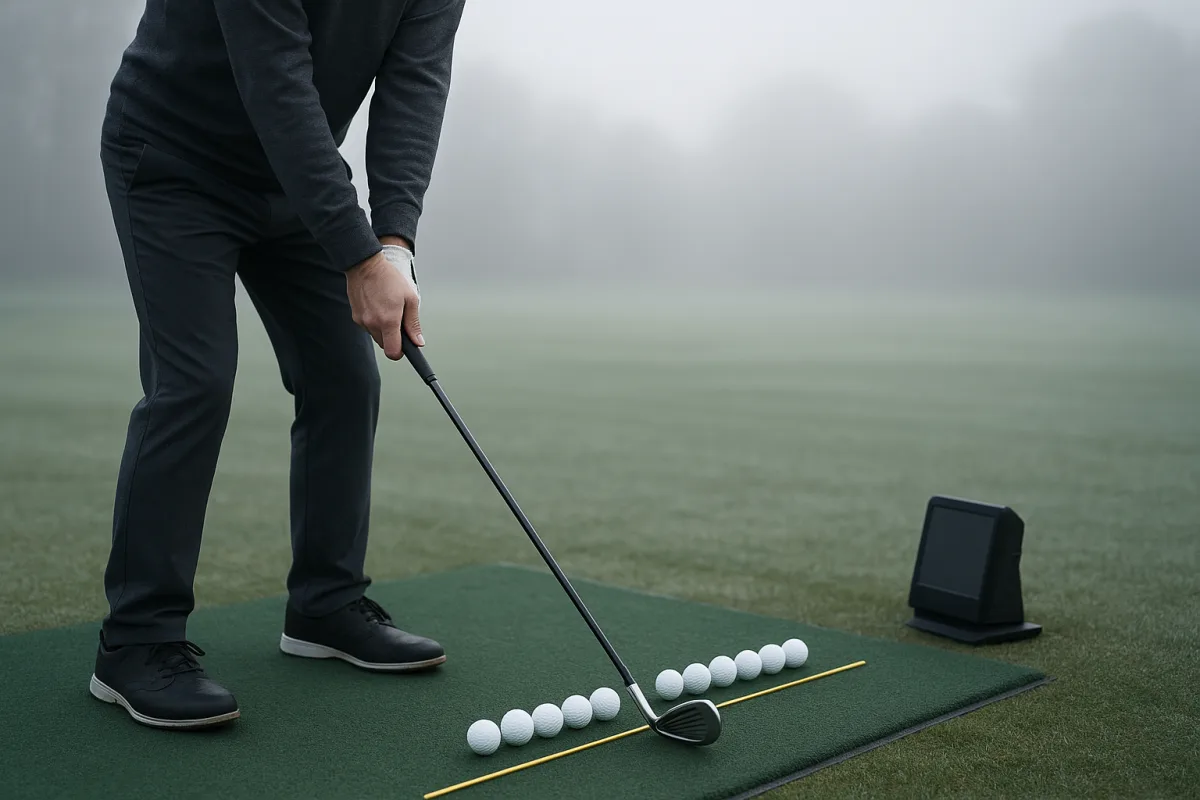
First, separate swing direction from ball direction
The usual reason golfers start chasing swing path is a slice. The ball starts left, bends right, and the instinct is to swing more from the inside. Sometimes that is right, but it is not the whole diagnosis.
Titleist’s clubface guidance is the important starting point: face angle at impact accounts for approximately 75 to 85 percent of where the ball initially launches. Club path has a smaller effect on start direction, roughly 15 to 25 percent, and has the larger role in curvature. [5]
In practical terms, a ball that starts right and curves farther right is not automatically an out-to-in path problem. It may be an open face with a path that is only slightly left, neutral, or even right of target.
A ball that starts left and peels right is more likely to involve the classic outside-to-inside pattern, where the face is open relative to a leftward path. That is the slice most path drills are designed to address. [3]
Before changing anything, hit ten shots with one club and write down three things: start line, curve and strike location. Do not judge the swing by whether one ball flew straight. A straight ball can be a good swing, or two errors cancelling out.
Measure the path before trying to repair it
TrackMan-based guidance published by NeoGolf puts the PGA Tour average club path around +1.0 degrees, or marginally in-to-out. The amateur average is reported around -3.5 degrees, an outside-to-inside direction associated with the common slice pattern. [3]
That does not mean every amateur needs a +1 degree path. A near-zero path can work well for straight shots. A modest +2 to +4 degree path can support a controlled draw, while a slight -2 to -4 degree path can support a fade. [3]
There is no precise universal ideal. Body shape, grip, face delivery, angle of attack and intended shot shape all matter. If you normally play a reliable fade, turning your path strongly positive may remove your best pattern rather than improve it.
If you have access to a launch monitor, look first at club path, face angle and face-to-path. Then compare those numbers to ball start line and curve. One number without the other two is usually an invitation to chase noise.
Foresight’s GC3 is one example of the type of monitor that can provide immediate club and ball data, although launch-monitor access is not cheap. Buying guides place the broader market from about $500 for entry-level units to $7,000 for professional-grade options. [12] [13]
A number from a monitor belongs to the swing that produced it. One good +3-degree path does not prove that +3 is your permanent answer, just as one poor -6-degree path does not mean you should rebuild everything between holes.
Check the setup errors that can disguise themselves as path problems
Set an alignment stick on the ground parallel to your target line, not pointed directly at the target. Poor alignment can make a golfer swing left simply because their feet and shoulders are aimed left, then they blame the resulting path. [4]
Check the clubface next. A weak grip can leave the face open, and an open face often makes golfers throw the club farther from the inside in an attempt to stop the slice. That response can turn one miss into two.
The result is often a push-slice, a block, or a high shot that starts well right. Fixing path without controlling face angle is incomplete, and fixing face angle by simply rolling the hands can create a pull-hook. Work on both deliveries together. [5]
For a right-handed player, make a few slow rehearsals where the clubface is square to the intended start line at impact, while the handle continues moving through. The goal is not to hold the face open or slam it shut.
If your path is outside-to-inside, give the club something to miss
The easiest early intervention is an obstacle just outside the ball-target line. GolfLaunchLab’s gate-style path drills use a physical reference to discourage the clubhead from approaching the ball from outside. [1]
Place a headcover just outside and slightly behind the ball, far enough away that a normal swing will not hit it. Make half swings first. If you strike the headcover, the club is still moving outward too early in the downswing.
The Headcover Gate Drill suits higher-handicap players because it gives clear feedback without requiring a complicated swing thought. Hole19’s handicap-based guidance similarly favours simple obstacle drills and alignment aids for players above roughly a 20 handicap. [7]
Another version is the basket-outside-the-line drill described by Golf Info Guide. Position a basket or similar safe object outside the intended clubhead approach area, then make controlled swings that deliver the club without contacting it. [2]
Use soft balls or rehearsal swings initially. The purpose is not to force a huge inside-out loop. It is to remove the outside approach, then see whether your path settles closer to neutral or modestly positive.
GolfGuideBook also includes a club-points-to-inside-out-path drill among its path exercises. The useful part of that concept is the rehearsal: stop around delivery position and check that the shaft and clubhead are not being thrown over the target line. [8]
Do not turn a slice cure into a hook problem
The common overcorrection is chasing an exaggerated in-to-out path. A player moves from -5 degrees to +8 degrees, leaves the face open, and hits blocks. Then they flip the hands to square the face and begin hitting quick hooks.
For most mid-handicap golfers, that is not progress. A repeatable path near zero, with a face that starts the ball where intended, is normally more useful than a dramatic draw number. Most claimed distance gains from a path tweak are within normal shot-to-shot noise.
Watch the ball flight during practice. If the ball begins right and turns left too much, your path may be excessively positive relative to the face. If it starts left and turns farther left, the face is likely shutting too quickly.
Practical-Golf’s guidance on excessive club path is relevant in both directions: path can become too in-to-out as well as too out-to-in. The correction should be measured against the shot you want, not against a belief that every good swing draws. [11]
A good checkpoint is a ten-ball pattern. If your intended stock shot is a small draw, aim for similar start lines and similar curvature across the set. One spectacular draw followed by four blocks is not a functional correction.
Mid-handicappers should improve sequence, not add more hand action
For a player in the 10 to 19 handicap range, the issue is often inconsistency rather than a permanently wrong path. Hole19 recommends moving beyond basic obstacle drills toward sequencing work as skill improves. [7]
The pump drill is useful here. Make a backswing, lower the club to delivery position in a controlled rehearsal, then return it partway up before swinging through. This lets you feel the club shallow without trying to save it at impact.
Golf Monthly’s sequencing guidance stresses that the downswing is not just an arm move. A better order of movement helps prevent the upper body from spinning open immediately, which is one route to the over-the-top, leftward path. [10]
Keep the rehearsal slow enough to preserve balance. If the lower body races and the chest stalls, you may simply create a stuck delivery from too far inside. The goal is coordinated rotation, not deliberately leaving the club behind you.
Film from down the line if you can. Put the camera roughly hand-high and on the target line. Compare several swings, because a single still image can be misleading when the camera is poorly positioned or the club is moving quickly.
Match the drill to your skill and speed
High-handicap golfers should keep the task simple: alignment stick, headcover gate and half swings. The immediate job is learning where the club approaches the ball from, not memorising a long list of positions. [7]
Mid-handicappers can blend obstacle drills with the pump drill and launch-monitor feedback. At this stage, improvement usually comes from reducing the spread of paths, not searching for the most extreme number in a practice session. [7] [10]
Lower-handicap players can use more advanced step drills and video work to refine smaller delivery changes. Hole19 identifies these as more appropriate for golfers who already control basic contact and need subtler path adjustments. [7]
Swing speed also changes the practical challenge. Slower swingers may benefit from more flexible shafts, while faster swingers need particularly stable sequencing because a large path overcorrection can create much bigger curvature at speed. [4]
That does not mean a flexible shaft fixes path. Equipment may help a golfer deliver the club more consistently, but it cannot replace diagnosis. Get fit using your normal swing, and judge shaft options by dispersion, strike and launch rather than marketing promises.
Take the corrected pattern onto the course carefully
Do not debut a major path change with driver on a narrow first hole. Use a club that exposes the pattern but keeps the consequence manageable, such as a mid-iron from the practice ground or a wide fairway.
In a headwind, avoid trying to manufacture extra draw by exaggerating an in-to-out swing. Wind strategy guidance from Golf Club Brokers estimates that a 10 mph headwind can cost a mid-iron roughly 15 to 20 yards of carry. [14]
Take more club, make a balanced swing and accept the lower-risk shape. Trying to hit harder often brings the old outside-to-inside move back, particularly when the player is anxious about clearing trouble.
A tailwind can add approximately 5 to 10 yards of carry with a mid-iron, while a crosswind can move a ball more than 20 yards offline, according to Fulcria Labs’ wind strategy guide. [15] Let those conditions influence target and club selection.
On sidehill lies, do not expect your range path to appear unchanged. Slopes can require one or two clubs of adjustment, altered ball position, a stance matched to the slope and a more controlled finish. [14]
The sensible course strategy is to choose room for your usual shape. If your work-in-progress swing still produces a small fade, aim for the portion of fairway that allows it. Forcing a draw around every dogleg is not swing improvement.
Frequently Asked Questions
How do I measure my golf swing path accurately?
To measure your swing path accurately, use a launch monitor that provides club path, face angle, and face-to-path data along with ball start line and curve. Hit multiple shots with one club and record these numbers to understand your typical swing pattern. Devices like the Foresight GC3 offer this data, though costs range from about $500 to $7,000 depending on the model.
What drills help improve an outside-to-inside golf swing path?
For an outside-to-inside path, obstacle drills such as the Headcover Gate Drill are effective. Place a headcover just outside and slightly behind the ball to discourage swinging from outside the target line. Making half swings without hitting the headcover trains a more inside-to-out path. These simple drills are especially recommended for higher-handicap players.
How does clubface angle affect golf swing path?
Clubface angle at impact controls approximately 75 to 85 percent of the ball’s initial launch direction, while swing path influences curvature and about 15 to 25 percent of start direction. An open clubface combined with certain swing paths can produce various ball flights like slices, pushes, or blocks. Therefore, controlling face angle is crucial alongside managing swing path.
Can alignment and grip issues cause swing path problems?
Yes, poor alignment can cause a golfer to swing left or right unintentionally, leading to path errors. Similarly, a weak grip often leaves the clubface open, which can prompt compensatory swing path changes that worsen ball flight. Checking and correcting alignment and grip should be part of diagnosing swing path issues.
What is a neutral golf swing path and how to achieve it?
A neutral swing path is roughly zero degrees, meaning the clubhead moves straight along the target line at impact. Achieving this involves understanding your natural swing tendencies and using feedback from launch monitors or drills. Many golfers aim for a neutral or modestly in-to-out path (+1 to +4 degrees) to support straight or controlled draw shots, but individual variations apply.
How we researched this
This article was assembled from 15 cited references.
Nothing here is based on hands-on testing. Where a figure or finding appears, it belongs to the source cited beside it, and the writing says so rather than implying otherwise. Every source is listed below so you can check it.
Sources
- Inside Out Golf Swing: Path Drills & Diagrams | GolfLaunchLab
- Slice Golf Shot Drills: Basket Outside the Line
- Club Path Explained — Fix Your Slice with TrackMan Data | NeoGolf
- What Is a Swing Path for Golfers: Quick Guide - Golf Blab
- Golf Club Face Angle: What is It at Impact? | Titleist
- Fixing an In-to-Out Golf Swing Path - The Golf Hub
- Golf Swing Mistakes by Handicap Level | Hole19
- Golf Swing Path Drills: 7 Proven Exercises For Consistent Ball Striking
- Drills to Improve Your Golf Swing Path
- Why Sequencing Matters In The Golf Swing And How To Improve It
- Swing Path Drills Guide: How to Fix Your Excessive Club Path · Practical-Golf.com
- You haven't used a golf launch monitor until you've tried Foresight GC3 - here's my thoughts after 6 months of testing
- Launch Monitor Buying Guide — Every Monitor Compared
- How to Play Golf in the Wind: Equipment and Strategy | Golf Club Brokers
- How to Play Golf in the Wind: Complete Strategy Guide | Fulcria Labs Blog
Related Articles
Improve Golf Swing Tempo: Tips and Drills for Success
Learn how to improve golf swing tempo with practical tips, drills, and training aids to enhance your rhythm and consistency on the course.

How to Fix a Hook in Golf: Grip, Stance, and Swing Tips
Learn how to fix a hook in golf with grip, stance, and swing adjustments that improve ball flight and reduce hooks quickly and effectively.

Practice Golf Swing with a Friend: Safe, Effective Tips
Learn how to practice golf swing with a friend safely and effectively using structured drills, feedback roles, and focused sessions.

Tumi Golf Bag Review: Luxury Performance for Discerning Golfers
Discover the luxury and performance of the Tumi golf bag on Modern Golf. Crafted with ballistic nylon and premium materials, this $1,000 bag offers unique features like a foldable neoprene rain hood and ample storage. Perfect for golfers seeking style and functionality on the course.