
How to Avoid Three Putts: Key Tips and Strategies
Learn how to avoid three putts with tips on speed control, green reading, and putting drills to improve your golf performance.
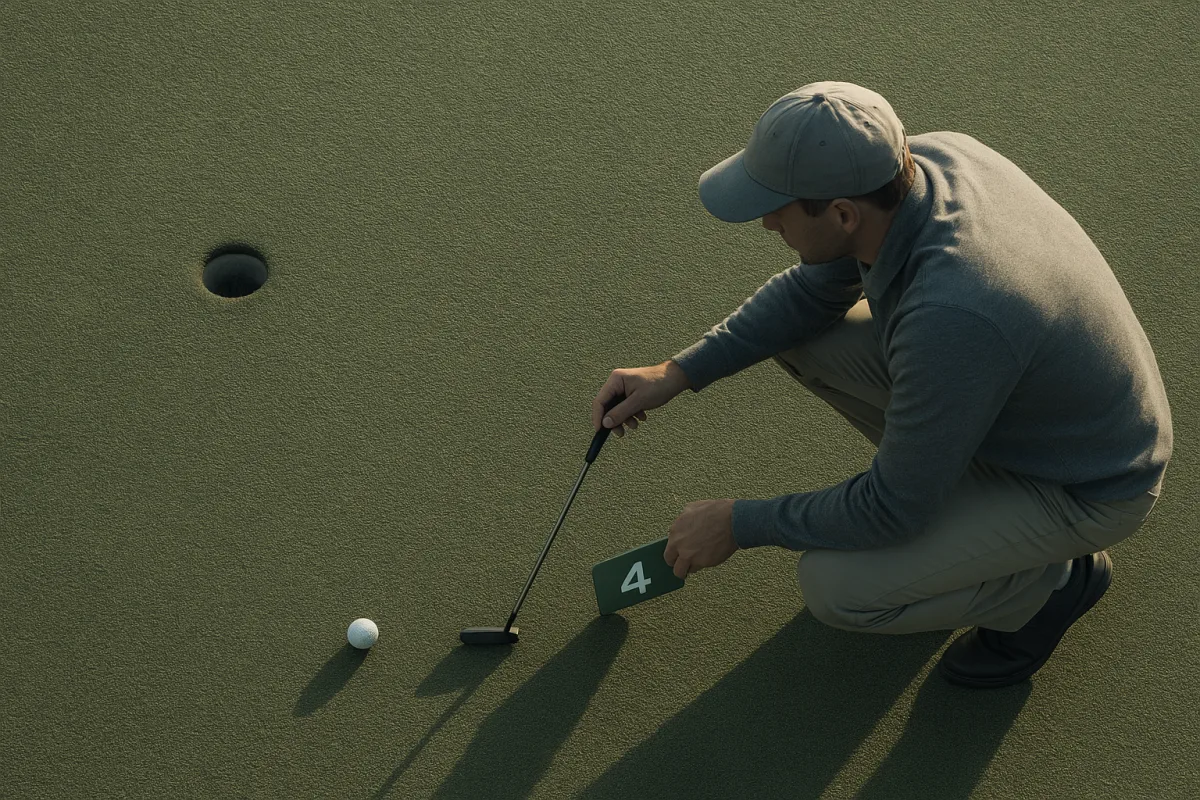
Start with the putt that creates the three-putt
Most three-putts are not caused by missing a nervy four-footer. They start with a first putt that finishes too far away, usually because speed control, green reading, or stroke consistency breaks down. [1][2]
The useful statistic is not your total putts. Track how often you three-putt and, more importantly, how far your first putt was. Fairway Labs notes that the danger rises materially once the opening putt gets beyond 30 to 40 feet. [4]
That should change how you think on the green. From 45 feet, your primary job is not making a low-percentage birdie. It is rolling the ball into a sensible second-putt range, preferably below three feet on a straightforward line.
Amateurs three-putt roughly 10 to 15 percent of greens, while PGA Tour players are around 3 percent. [4] That gap is not an instruction to copy a tour player’s stroke or equipment. It is a reminder that the first-putt miss matters.
After a round, write down three things for every three-putt: first-putt distance, distance left after it, and whether the first putt missed mainly long, short, high, or low. Within a few rounds, the pattern becomes clearer.
If your long first putts routinely finish six feet short, you have a pace problem. If they finish two feet left or right with acceptable speed, your read or start line is more likely the priority.
Before you putt, establish the day’s speed
Do not assume the practice green and the course greens will play identically, but use the practice green to establish a baseline. Hit several longer putts before the round and pay attention to how far the ball rolls past a target.
Stimpmeter readings provide useful context: around 8 is generally slow, 8 to 10 is medium, and 12 or more is fast. [6] You do not need to know a precise Stimp number on the first tee.
You do need to notice whether a putt that looks familiar requires a shorter, quieter stroke than usual. On a fast green, a downhill six-footer can be a defensive putt. On a slower morning surface, the same line may need more committed pace.
Green speed and slope clearly make the task harder, particularly on fast, tilted surfaces. The exact effect on three-putt rates is less settled than golfers often suggest, though, so avoid pretending that green speed alone explains a poor putting day.
Conditions can also shift across a round. Morning moisture can make greens play slower, while drying conditions can make them faster later. Bentgrass and bermudagrass also behave differently through their respective cooler and warmer growing conditions.
The practical move is simple: refresh your calibration during the round. On the first green after a long wait, a weather change, or a turn from shaded holes into exposed ones, pay closer attention to the first putt’s release and roll.
There is not good direct evidence isolating wind or moisture as causes of three-putts. That does not mean they never matter. It means you should respond to what the ball is doing that day instead of claiming a universal wind adjustment.
Read the whole putt, especially the last three feet
A common amateur error is reading the middle of a 30-footer while barely considering what happens near the cup. The last three feet matter disproportionately because that is where a slowing ball is most affected by slope. [7][8]
Walk behind the ball to see the overall fall, then look from behind the hole back toward the ball. Reading from only one position is a listed cause of missed break, especially when the green has subtle side slope. [7][9]
Do not aim directly at the cup when the putt breaks. Pick a start line that accounts for the ball entering from the high side, with the amount of allowance based on both the slope and the speed you intend to use. [8][10]
This is where poor pace and poor reads get confused. A ball struck too firmly will not take the break you saw. A ball dying into the hole will take more. Decide on the delivery speed before settling the exact start line.
If you tend to under-read, give yourself a disciplined checkpoint: ask where the ball is meant to start, where it is expected to turn, and from which side it should enter the hole. That is more useful than staring at the cup.
On bermudagrass, grain deserves attention as well as slope. Neglecting grain is a recognised green-reading error, and it can affect both pace and break. [7][9] Look at the grass sheen and surrounding cup wear, then confirm what you see with the roll.
Rushing is the other avoidable mistake. You do not need a long routine, but you do need the same sequence. Read from behind, assess the hole-side slope, choose pace, select a start line, then commit.
Make the first stroke about pace, not perfection
For a long putt, the hole is still the target, but your practical landing zone is a circle around it. That mental shift makes it easier to accept a two-foot leave rather than forcing a hit that runs five feet by.
Use the length of your stroke as the main speed control. A sufficiently long, smooth backstroke gives the putter momentum without a last-second jab, while a tiny takeaway followed by a hit often produces inconsistent distance. [2]
Set up with forward tilt from the hips and relaxed arms. Golf Monthly’s putting guidance also emphasises coordinated thumb and wrist action rather than an overactive, flicking release. [2] The goal is repeatability, not a deliberately rigid stroke.
On a 40-footer, make a rehearsal stroke while looking at the target rather than the ball. Then return your eyes to the ball and reproduce that overall length. This is not magic, it is a way to connect feel with a measurable motion.
If your misses alternate between badly short and badly long, avoid changing three technical things at once. First check strike quality, then check whether your backswing length is varying, and only then start adjusting setup or grip pressure.
A launch monitor number belongs to the swing that produced it, and putting feedback works similarly. One golfer’s ideal backstroke length or tempo is not automatically yours. Use your own leave distances and dispersion to judge whether a change worked.
Give yourself a second putt you can actually make
Once the first putt finishes outside three feet, reset. Do not automatically label the second putt “short” because it followed a 50-footer. Read it like a standalone putt, particularly if it is downhill or sidehill.
For the second putt, use a shorter version of your full routine, not a panicked tap. Read the final few feet, identify the high side, make one pace rehearsal, and commit to the start line.
The worst response to a first putt left four feet away is frustration. Frustration tends to create a rushed second-putt read, then a pushed or pulled stroke. That is how a manageable lag-putt error becomes a three-putt.
If you consistently leave the same awkward distance, adjust the first-putt target. A putt that finishes two feet below the hole may be more makeable than one that dies three feet above it on a slippery downhill return.
Practise lag putting with a clear purpose
There is no established single best lag-putting drill, and published recommendations vary on both drill type and duration. The useful part is regular, focused work on pace, not declaring one routine the universal answer.
Nomae Golf recommends spending 15 to 20 minutes on its Lag Putting Ladder drill. [11] Use a session like that to test whether you can change stroke length predictably across several distances rather than simply hitting identical putts repeatedly.
GolfPass recommends lag-putting work as a route to avoiding three-putts. [12] The point of this category of practice is to shrink the size of your first-putt miss, not to chase an unrealistic target of holing every long putt.
Rotate drills over the week. A 10-minute centre-contact session can help if speed varies because impact location varies. A 15-to-20-minute speed-control block makes more sense when contact is solid but your leaves are consistently too long or short.
Use an eyes-closed drill for roughly 10 minutes only if you need to improve awareness of strike and stroke length. It should support target-focused practice, not replace it. You still need to read slope and judge pace with your eyes open.
Keep score during practice. For example, record how many long putts finish within a putter-length of the hole, then repeat from a different distance or direction. A drill without a result tends to become random rolling.
Do not copy another golfer’s practice duration as if it were a fitting specification. Ten focused minutes may be enough before a round, while 20 minutes may suit a dedicated practice session. The quality of feedback matters more than the timer.
Equipment can help, but it cannot read the green
A mallet putter is often recommended for golfers who need more visible alignment help and more forgiveness when contact drifts away from the centre. Golf Monthly has highlighted the category as useful for the large group of amateurs who could benefit from it. [2]
That is not proof that mallets beat blades for every golfer. There is no strong direct comparative evidence showing that a mallet automatically reduces amateur three-putts. A blade that you aim well and strike consistently can be the better club for you.
If you are considering a change, get fit rather than buying on appearance. Check whether you start the ball on your intended line, whether the face returns square consistently, and whether the head shape helps or distracts at address.
Also check putter length, lie angle, loft, grip size, head weight, and toe hang. A putter that fits your posture and stroke can make setup repeatable. It cannot compensate for ignoring grain, under-reading a slope, or racing the first putt six feet past.
The equipment decision should follow your evidence. If your tracking shows reasonable reads but poor start lines, alignment and face control deserve attention. If you are repeatedly wrong on pace, spend the next practice block on lag putting before shopping.
Frequently Asked Questions
What are the best strategies to avoid three putts in golf?
The main strategy is to focus on speed control for the first putt, especially when it is longer than 30 to 40 feet. Instead of trying to hole long putts, aim to leave a makeable second putt within about three feet. Tracking the distance and direction of your first putt misses can help identify whether you need to improve pace, green reading, or stroke consistency.
How can I improve my first putt to reduce three putts?
Improving the first putt involves practicing distance control deliberately with several drills rather than relying on a single exercise. Establish the green speed early in the round by hitting longer putts and adjusting your stroke accordingly. Using a mallet putter can help with alignment and off-center hits, but a consistent setup and stroke matter more than the putter type.
How does green reading affect three-putt avoidance?
Accurate green reading is crucial, especially focusing on the last three feet of the putt where slope has the greatest effect on ball break. Avoid rushing your read and consider the break apex rather than aiming directly at the hole. Reading the green from multiple positions and accounting for subtle slopes and grain can reduce missed breaks that lead to three-putts.
What drills help with distance control to avoid three putts?
Practicing lag putting drills in short, focused sessions is recommended to improve distance control. Using a variety of drills helps address different aspects of pace control. Consistent practice with these drills, rather than relying on one method, is key to reducing three-putts caused by poor speed management.
How should I adjust my putting on fast or slow greens to avoid three putts?
On fast greens, use a shorter and quieter stroke to avoid overshooting, while on slower greens, a more committed stroke with greater pace is necessary. Conditions can change during a round, so recalibrate your feel and stroke whenever you encounter a change in green speed, moisture, or temperature. Paying attention to how the ball rolls on the first putt after such changes helps maintain proper speed control.
How we researched this
This article was assembled from 12 cited references.
Nothing here is based on hands-on testing. Where a figure or finding appears, it belongs to the source cited beside it, and the writing says so rather than implying otherwise. Every source is listed below so you can check it.
Sources
- No More 3-Putts: The Simple Putting Drill That Actually Works | Oli Tucker Golf
- How To Use The Club 95% Of Amateurs Should Add To Their Bag
- 10 Putting Tips to Lower Your Score Immediately (2026)
- What Is Three-Putt Avoidance? · Fairway Labs
- This fascinating chart shows how likely you are to 3-putt | GOLF.com
- Stimpmeter in Golf: Green Speed and Readings
- The Complete Guide to Reading Greens in Golf: Tips, Techniques & Tools – Green Books
- How To Read Greens In Golf: Speed And Break
- How to Read a Golf Green: A Step-by-Step Guide for Amateur Golfers
- Reading greens: the method, not the mystique - Panxis Golf
- Lag Putting Ladder - Golf Drill | Nomae Golf
- Lag Putting Drills - The Best Way To Avoid 3-Putts | GolfPass
Related Articles

Best Golf Drills for Short Game: Improve Chipping & Control
Discover the best golf drills for short game to improve chipping accuracy, distance control, and course strategy with practical landing spot methods.
How to Read Greens in Golf
Learn how to read greens in golf by understanding slope, grain, and speed to improve your putting accuracy and lower your scores.
Best Golf Ball for Control: Srixon Z-Star Diamond vs Pro V1
Compare the best golf ball for control: Srixon Z-Star Diamond vs Titleist Pro V1 for wedge spin, feel, and short-game performance.

Best Golf Tee Height: How to Find Your Optimal Tee Height
Learn the best golf tee height to improve launch, spin, and distance with tips to find your optimal tee height for consistent drives.