
Average Golf Score for Amateurs: What to Expect
Discover the average golf score for amateurs and how handicap and course difficulty affect your performance.
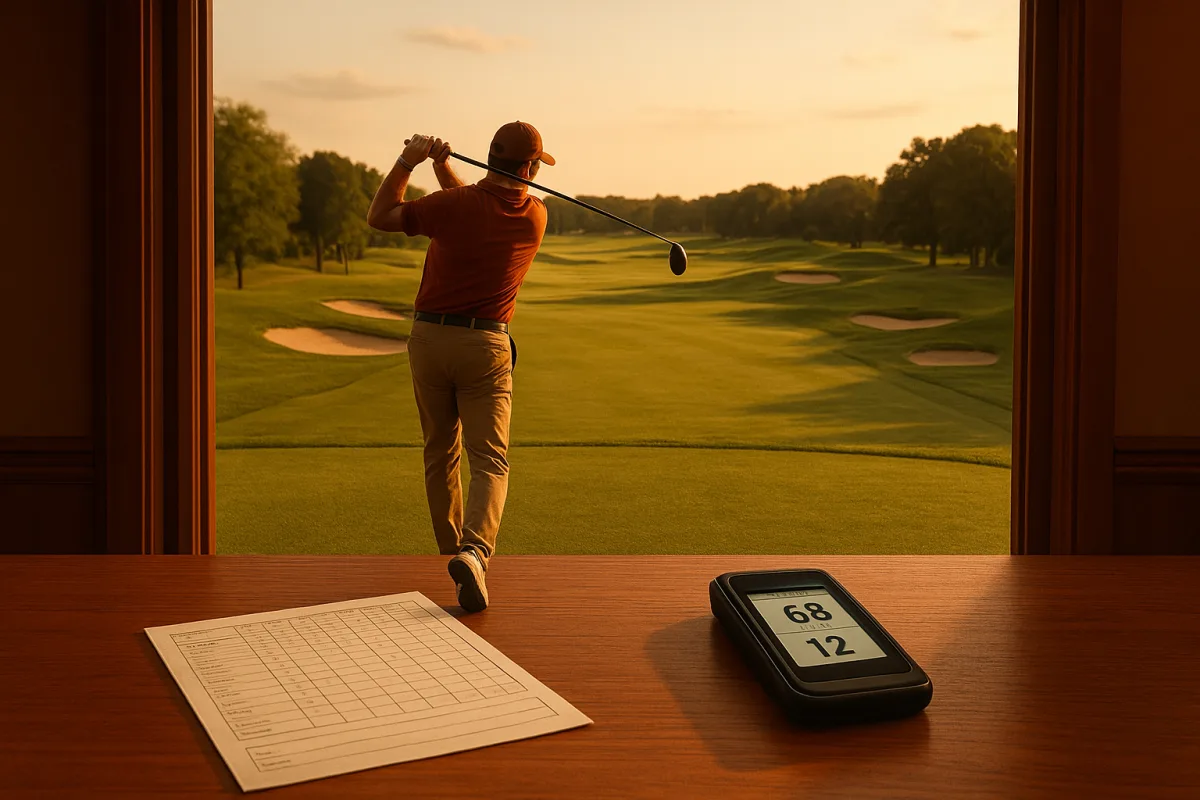
The number that makes a golf score comparable
The useful answer to “what does the average amateur shoot?” is not one score. It is the relationship between a golfer’s score, their Handicap Index, and the course set-up that produced that score.
That may sound like golf making a simple question complicated, but it is necessary. A 90 can be solid golf from one set of tees and a poor return from another. Without context, gross score is just a number.
For male golfers who maintain a handicap, the broad average sits close to 90 strokes for 18 holes. GolfLaunchLab reports roughly 90, linked to an average Handicap Index around 14.2, while The Golf Hub places the range at 90 to 92. [1][3]
That is a useful reference point for a mid-handicap golfer. If you are routinely around 90, you are not shooting an exceptional score, but you are also not outside the mainstream of handicapped male amateur golf.
The catch is that registered golfers are not the entire amateur population. GolfLaunchLab notes that estimates including male players without handicaps can stretch towards 100. [1] Plenty of occasional golfers do not submit scores, and they are unlikely to be represented cleanly in handicap data.
That selection effect matters. A golfer who has an active Handicap Index is usually playing enough rounds to record scores, understand basic course procedures, and care about comparison. The “average golfer” at a Saturday charity event may be a different player entirely.
Gross score is the result, not the whole measurement
Your gross score is simple: count every stroke taken during the round. A golfer who shoots 90 has taken 90 strokes, whether the course was a short, forgiving municipal layout or a long championship course with trouble everywhere.
A Handicap Index tries to put that score in context. It is designed to express demonstrated playing ability in a way that can travel between courses, rather than claiming that you should shoot one fixed number every time out.
That distinction is where many comparisons go wrong. Golf Monthly identifies ignoring course difficulty, overlooking handicap context, and judging players from single rounds as common errors in amateur score comparisons. [6]
I would treat a score like launch-monitor distance. A 255-yard drive belongs to the swing speed, strike, ball, weather, altitude and fairway conditions that produced it. Likewise, a 90 belongs to the player, course, tees and day that produced it.
Most amateur golfers know this instinctively after playing a hard track from the back tees. The scorecard may still say par 72, but the shots required to make bogey can be very different from those on a flatter, shorter par-72 course.
Course rating and slope explain why par is not enough
Course rating and slope rating are the two numbers that give an 18-hole score context. They appear on the scorecard for a particular set of tees, so check the tees you actually played, not simply the numbers at the top of the card.
Course rating is an estimate of what a scratch golfer should score under normal conditions from those tees. A rating close to 72 suggests that a scratch player is expected to score roughly around par, while a higher rating indicates a sterner test. [11]
Slope rating measures how much more difficult a course is for a bogey golfer relative to a scratch golfer. In plain language, it recognises that added length, forced carries, narrow landing areas and penal rough tend to punish mid- and high-handicappers disproportionately. [11]
This is especially relevant if you are comparing yourself with a friend from another club. One player’s 90 may come from a course with generous driving areas and limited hazards. Another player’s 90 might require managing water, uneven lies and approach shots into raised greens.
The ratings do not tell you every detail about a golf course. They do not know whether you played into a three-club wind, whether the greens were unusually quick, or whether your driver stayed in the bag because your normal shot shape was not safe that day.
They do, however, provide a much better starting point than par. The system is not trying to claim that all 90s are equal. It is trying to make scores from different courses less misleading when golfers compare results.
There is an important data limit here. While course rating and slope clearly affect expected scoring, no comprehensive published 2026 dataset gives average amateur scores for specific course ratings or slope bands. [11]
So be wary of anyone claiming that a 15-handicapper “should” shoot a precise score on a course of a particular slope. The principle is sound, but the exact average score table people often want does not appear to exist.
What handicap-level scoring benchmarks can tell you
The best available score-by-handicap figures are broad benchmarks, not promises. Learn Golf estimates that a scratch golfer averages about 74, a 10-handicapper about 83, a 15-handicapper about 89, and a 20-handicapper about 94. [10]
At the higher end, Learn Golf estimates roughly 103 for a 25-handicap golfer. [10] Those numbers show the general relationship clearly: as Handicap Index rises, typical gross scores rise, but not in a neat one-stroke-for-one-index pattern.
That lack of a clean conversion is not a flaw in your game. Handicap is built to compare scoring potential after course difficulty is considered, while the score you write down is the raw result on one particular day.
A 15-handicap golfer shooting 89 fits the broad estimate neatly. But a 15-handicap golfer can also shoot 82 on a good day, or 98 after a few penalty shots and poor bunker lies. Both rounds are believable.
This is why chasing a fixed benchmark can be unhelpful. If your index is around 15 and you think every round above 89 is failure, you have turned a general population estimate into a standard no real golfer meets consistently.
The cleaner question is: over a meaningful run of rounds, are your scores producing a stable or improving Handicap Index? That tells you more than whether your latest score beats an internet average.
The male and female averages are not equally precise
For male golfers with registered handicaps, the data clusters fairly tightly around 90 strokes and an index around 14. GolfLaunchLab’s figure is approximately 90, and The Other Golf Channel reports a 2025 USGA average male Handicap Index of 14.0. [1][5]
The similar figures are reassuring, but they should not be treated as proof of a precise relationship. There is no comprehensive, current dataset that maps every specific Handicap Index to an exact average gross score for 2026.
Female amateur figures are broader and less settled. GolfLaunchLab estimates about 100 for female golfers with handicaps, and gives an overall female amateur range of 95 to 110. [1]
The Golf Hub gives a narrower 90-to-100 range, while Golf Verdict reports that single-digit-handicap female golfers commonly score in the 80s and higher-handicap golfers in the 90s. [3][4] Those are not necessarily direct contradictions, because they may describe different groups.
The sensible reading is that female amateur scoring varies substantially by the population sampled, especially when sources mix regular handicapped players with all recreational golfers. It would be false precision to announce one definitive female “average” from these figures.
The handicap data itself also suggests different population profiles. The Other Golf Channel reports average USGA Handicap Indices of 14.0 for men and 28.8 for women in 2025. [5] That does not explain every score, but it helps explain why one blended average can hide a lot.
Use scoring patterns to find the shots worth improving
Average hole scoring is more useful than many golfers realise because it shows where the typical bogey golfer loses ground. Golf Monthly puts amateur averages at 3.7 on par 3s, 4.9 on par 4s and 5.8 on par 5s. [6]
That is roughly bogey-level golf across the scorecard, with par 4s carrying most of the scoring burden simply because there are usually more of them. A 90 is often not built from spectacular disasters. It is built from repeated small losses.
For a golfer trying to move from around 90 toward the mid-80s, the target is rarely “find 20 more yards.” Distance can help, but claims of huge gains are often within the noise unless strike, launch and dispersion genuinely improve.
The more reliable score-saving question is whether you are turning routine holes into doubles. A penalty off the tee, a poor lay-up decision, a missed green from a manageable distance, then a three-putt can turn a likely bogey into seven quickly.
Driving distance still matters, particularly on longer par 4s. Golf Monthly reports average drives of about 285 yards for scratch golfers and roughly 204 yards for 25-handicappers. [6] But that gap does not establish one universal cure for higher scores.
A golfer who slices because the face is open relative to path needs a different solution from one whose slice comes from a steep, out-to-in delivery. The same goes for scoring: one player leaks shots through penalties, another through wedges, another through putting.
Fitting beats buying if the equipment is part of the problem. A driver with the wrong loft, shaft weight or face angle can make a playable pattern harder to manage, but no shaft flex or premium ball automatically converts a 95 into an 85.
A practical way to gauge your own level
Start by separating your last score from your normal scoring level. Keep a rolling average of enough completed rounds to smooth out the one day when you putted everything, and the one day when three tee shots found trouble.
Then record three pieces of context beside each score: the tees played, the course rating and slope, and any unusual conditions. You do not need a spreadsheet full of launch-monitor-style detail, but you do need more than a final total.
Next, compare your rolling scores with your Handicap Index and broad peer benchmarks. If you are a 15-handicap player generally scoring around the high 80s to low 90s, Learn Golf’s estimated 89 average offers reasonable context. [10]
Finally, use the average score figures as reassurance, not a verdict. There is no reliable published regional comparison, no detailed current score table for every handicap index, and no clear five-year trend showing amateurs universally scoring better or worse.
Golf is too variable for one number to settle your standing. But used correctly, handicap-adjusted scoring gives you something much better than an empty claim that you are “average”: a fairer picture of where your game is now.
Frequently Asked Questions
What is the average golf score for male amateurs?
The average score for male amateur golfers with a registered handicap is about 90 strokes for 18 holes. This figure corresponds to an average Handicap Index around 14.2. Scores may be higher, around 100, when including male players without handicaps who play less frequently.
How does handicap affect average golf scores?
A golfer’s handicap provides context for their score by reflecting their demonstrated playing ability across many rounds. For example, a scratch golfer typically scores around 74, a 10 handicap around 83, a 15 handicap near 89, and a 20 handicap about 94. Using handicap helps compare scores fairly across different courses and rounds.
What is the average golf score for female amateurs?
Female amateur averages vary more widely, with handicapped female golfers generally scoring near 100 strokes per round. Broader estimates for female amateurs range from 95 to 110 strokes, reflecting differences in data sources and player populations.
How do course rating and slope influence amateur golf scores?
Course rating estimates the score a scratch golfer should make from a particular set of tees, while slope rating measures how much more difficult the course is for a bogey golfer relative to a scratch golfer. These ratings provide essential context, making scores from different courses more comparable by accounting for course difficulty.
What golf score should a 15 handicapper expect?
A 15 handicap golfer can generally expect to shoot around 89 strokes per 18 holes. This estimate is based on average scoring data correlating handicap levels to typical scores, though actual results will vary depending on course difficulty and playing conditions.
How we researched this
This article was assembled from 11 cited references.
Nothing here is based on hands-on testing. Where a figure or finding appears, it belongs to the source cited beside it, and the writing says so rather than implying otherwise. Every source is listed below so you can check it.
Sources
- Average Golf Score for 18 Holes (2026 Data) | GolfLaunchLab
- What Is a Good Golf Score? Benchmarks by Skill & Age
- What's an Average Golf Score for an Amateur Golfer? - The Golf Hub
- What is a Good Score in Golf for 18 Holes? - Golf Verdict
- What's the Average Golf Handicap? Real USGA Numbers by Gender and Skill | The Other Golf Channel
- How Far Does The Average Amateur Golfer Drive The Ball In 2026?
- Use this formula to fix one of the most common mistakes golfers make | GOLF.com
- What Does Each Handicaper Shoot? Average Scores by Handicap - Break X Golf
- Compare Golf Score Ranges by Skill Level and Course Setup
- Average Golf Score: What Golfers Actually Shoot | Learn Golf
- What do golf course rating and golf course slope mean? : Golf Pad Support
Related Articles
Golf Handicap System Explained
Learn how the golf handicap system works, including Handicap Index, Course Rating, and Slope Rating, to understand your scoring potential.
How to Choose the Right Golf Course Using Course and Slope
Learn how to choose the right golf course by understanding course and slope ratings to match your skill and carry distances.
Best Time of Day to Play Golf
Discover the best time of day to play golf by comparing morning and afternoon conditions for optimal performance and course strategy.
Best Golf Courses for Winter Play: Top Destinations and Tips
Discover the best golf courses for winter play, including top destinations, turf conditions, and travel tips for a great winter golf experience.