
How to Choose the Right Golf Course Using Course and Slope
Learn how to choose the right golf course by understanding course and slope ratings to match your skill and carry distances.
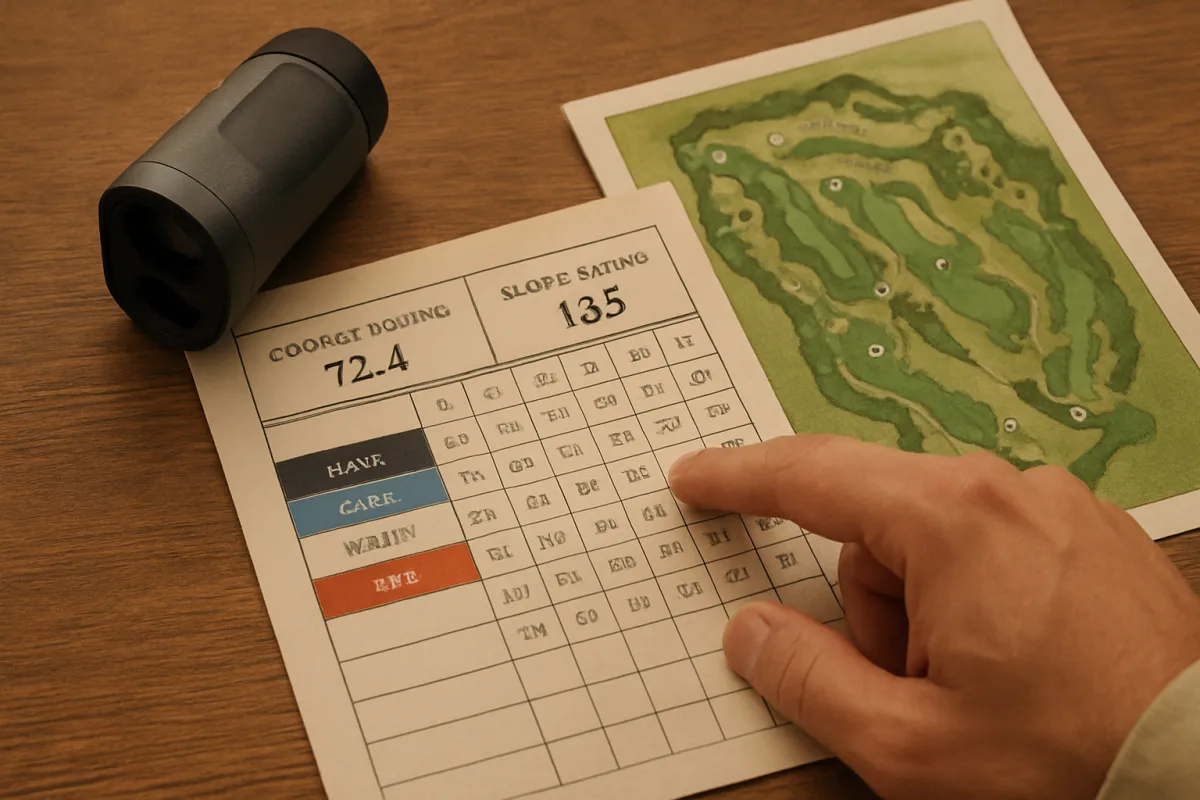
The number that matters most: Slope Rating
Most golfers choose a course in the wrong order. We look at the total yardage, perhaps the photos, then the green fee. For matching a course to your ability, the better starting point is the USGA Course Rating system.
There are two numbers on a scorecard or booking page: Course Rating and Slope Rating. They work together, but they answer different questions. Course Rating describes the expected score for a scratch golfer from a particular set of tees. [1]
A Course Rating of 71.2, for example, means a scratch player is expected to average roughly 71.2 strokes under normal conditions from those tees. It is not a prediction that you, a 14-handicapper, should shoot 71.
Slope Rating is the more revealing number for the rest of us. It measures how much harder that tee is expected to play for a bogey golfer compared with a scratch golfer. The USGA scale runs from 55 to 155, with 113 defined as standard difficulty. [1]
That “relative” part is important. A course can have a modest-looking Course Rating but a high Slope Rating if its hazards, recovery shots and trouble areas hurt bogey golfers much more than they hurt skilled players.
As a mid-handicap golfer, that tracks with how rounds actually feel. A scratch player may fly a fairway bunker, hit a long iron high enough to hold a green, or escape from heavy rough. I may face a lay-up, a punch-out and a wedge to a firm green.
Why Slope exposes the courses that can wreck a round
Think of Slope Rating as a measure of penalty for imperfect golf. It is not simply a count of bunkers or water hazards. It reflects how the whole design separates a scratch player from a bogey player.
A course rated 71.0/113 from one tee is basically calibrated as average relative difficulty. A tee rated 71.0/135 has the same scratch expectation, but it creates substantially more problems for the bogey golfer. [18]
That distinction makes more sense than judging a course by par. Two par-72 layouts can both look conventional on a website. One may offer wide landing zones and run-up approaches, while the other asks for repeated forced carries into angled fairways.
The Southern California Golf Association’s course-rating guidance includes obstacles such as topography, fairway difficulty, rough, bunkers, trees, green-surface difficulty, psychological factors and recovery demands. [9] Those are not decorative details. They explain why the scorecard can understate the challenge.
Take a 390-yard par 4 with water cutting across the fairway at 220 yards. A longer, accurate player can carry it, leaving a short iron. A player who drives it 190 yards must lay back, then hit a longer approach over the same hazard.
The hole is not impossible for the shorter hitter. It is just asking for three well-executed shots rather than two. Add narrow fairways or rough that prevents clean contact, and the expected score rises quickly for golfers who miss more often.
That is what a higher Slope Rating is trying to capture. It is not saying the course is unfair. It is telling you that the course’s defenses are more costly if your game includes the ordinary misses of a 15-, 20- or 24-handicap player.
Course Rating is not a tee recommendation by itself
Course Rating still matters because it tells you the base level of challenge. But it should not be read alone. A 68.5/132 tee and a 72.5/113 tee present different questions, even though one number looks easier and the other looks harder.
The lower-rated, high-slope tee may be shorter but more penal for a bogey golfer because trouble is constantly in play. The longer, standard-slope tee may demand more distance while allowing more room to recover from a missed target.
That is why the USGA system uses these ratings to calculate Course Handicap. Your Handicap Index is portable, while your Course Handicap changes with the tee and course you choose. [2] The system is designed to account for difficulty rather than pretending every set of tees plays alike.
Official ratings are not casual guesses by a club’s marketing department. Regional authorized associations administer the process, and the Utah Golf Association, for example, publishes official course-rating information for its member facilities. [3] Courses must also be re-rated at least every 10 years.
The practical point is simple: use the numbers already printed for you. If your normal course is around 120 slope and you book a 140-slope layout from the same apparent yardage, do not be surprised if your usual handicap score suddenly feels distant.
That does not mean avoiding every tough course. A high-slope course can be exactly the right choice for a special round, a competitive event or a day when you want to test your game. Just choose it knowingly, not because the card says 6,300 yards.
Yardage is the second filter, not the first
There is no universal yardage chart that assigns every handicap a correct tee. Sources offering fixed rules can be useful as rough prompts, but they cannot know your launch, carry distance, typical dispersion or ability to get the ball airborne.
For beginners, published baseline distances commonly put driver carry around 150 to 180 yards and 7-iron distance around 90 to 120 yards. [6] Those numbers may help identify obviously overlong tees, but they are not a fitting chart and not a measure of golfing potential.
The key word is carry. If a hole requires 145 yards over water, a player whose 7-iron sometimes reaches 150 but normally carries 135 has not found a comfortable 7-iron hole. Wind, cold air and a damp ball can remove the margin.
Marketing often frames tee choice as a question of ego, age or gender. That is not especially useful. Parkstone Golf Club’s roughly 5,000-yard “50” tees are aimed at older players, juniors and women, but the useful takeaway is the shorter setup, not the label. [4]
A player who drives it 210 yards but hits reliable wedges may enjoy a course differently from a player who drives it 250 yards with a wide two-way miss. One needs manageable approaches. The other may need more room off the tee.
For my own course selection, I would check whether the par 4s repeatedly leave a realistic second shot after an ordinary drive. If the common approach is a fairway wood or hybrid, I want to know whether there is room short of the green.
That is not an argument that everyone should play forward. It is an argument against selecting tees from one flushed driver on the range. Launch-monitor numbers belong to the swing that produced them, and so do your on-course distances.
Read the reasons behind the rating
A high Slope Rating tells you that the course will be demanding. It does not tell you whether the problem is length, water, green contours or rough. Before booking, look at the scorecard, hole flyovers and any course guide.
Rough is a major divider between skill levels. Courses may use a shorter first cut and a taller, denser second cut, with the latter making it harder to advance the ball cleanly and control spin. [8] That is a bigger issue when fairways are missed often.
Fast greens can create the same effect. Stimpmeter readings around 8 feet are generally slow, 10 feet is medium, and 12 feet is fast. [16] At 12, a putt that finishes four feet past can be more damaging than a missed fairway.
I would rather play a longer course with receptive greens than a shorter one with severe slopes and fast putting surfaces if the aim is a relaxed scoring round. That preference is not universal, but it is a sensible way to interpret difficulty.
Hazards deserve the same attention. Water beside a green is manageable if there is a large safe bail-out area. Water short of the green, with a forced carry and no room for a running shot, is a different test entirely.
Look especially for repeated forced carries. One intimidating tee shot can be fun. Four carries that require the longest club in your bag to clear, particularly into prevailing wind, can turn a casual game into a ball-searching exercise.
Conditions can change the course more than the scorecard does
Course and Slope Ratings are assigned under normal playing conditions. They do not promise that every Tuesday afternoon will play the same. Weather and turf conditions can make a familiar course feel like a different property.
Cool-season grasses such as bentgrass and Poa annua generally thrive around 60 to 75 degrees Fahrenheit, while bermudagrass and zoysiagrass perform best in the 80s and 90s. [15] Those seasonal changes affect firmness, rollout and green speed.
A dry, firm fairway can make a short course play longer or shorter depending on where it sends the ball. A wet course removes rollout, makes bunkers heavier and often turns a front bunker into a genuine carry requirement.
Wind is the variable I would check before almost anything else on an exposed course. A long par 3 into a two-club wind is not just longer. It may require a lower-flight shot and leave less stopping power on the green.
Research covering 40 years of Masters tournament scoring found associations between mean scores, wet-bulb temperature and wind speed. [23] Tour scoring is not weekend scoring, but the basic lesson holds: weather changes the test, not merely comfort.
If you are travelling, ask the shop which tees and greens are in use, whether overseeding or maintenance is underway, and how firm the course has been playing. That five-minute call can be more useful than a dozen online photographs.
Use technology to reduce the guesswork
The GHIN app is useful because it puts handicap information alongside course tools. Its newer version includes hazard-distance improvements, course heat maps and a Rules AI feature, according to Tom’s Guide. [22] That helps turn a vague booking choice into a more informed one.
Heat maps and hazard distances do not replace judgement, but they can show whether your normal tee shot brings a creek, bunker complex or narrowing fairway into play. That is much more actionable than saying you “usually play blue tees.”
Shot-tracking systems can help as well, provided you read them honestly. Shot Scope 6 uses a large shot database and Tour statistics to identify performance metrics. [19] The useful output is your normal distance pattern and misses, not your single longest drive.
For golfers who are also choosing playing partners, TrueTee says it matches players using skill, handicap, pace and preferences. [20] F4Golf similarly combines tee-time booking with GPS, scorecards, group chat and skill-based matching. [21]
Those apps address the social side of course fit, which matters. A 135-slope round can be enjoyable with a group expecting a challenge, but miserable when one player wants to break 90 and the rest insist on the back tees.
Difficulty and price are separate decisions
Do not assume expensive means difficult, or that a cheap municipal course will be easy. Public-course weekday green fees average $48 nationally, but state averages range from $31 in Oklahoma to $113 in Nevada. [10]
Those numbers reflect location, season, demand, facilities and land costs as much as course architecture. In Spain, the reported median green fee is €84, with a range from €32 to €600. [13] None of that is a Slope Rating.
Resort pricing makes the point even more clearly. Casino-resort rounds can range from about $80 at off-peak Midwest tribal facilities to $850 at Wynn Las Vegas during peak periods. [11] Price buys access, timing and experience, not a guaranteed level of difficulty.
Choose the course that fits the round you want. For a confidence-building game, favour moderate slope, manageable forced carries and greens that are unlikely to run at tournament pace. For a test, move up in slope deliberately, not accidentally.
The best booking habit is boring but effective: pick a likely tee, note its Course Rating and Slope Rating, compare the key carries with your normal distances, then check wind and conditions. Fitting the course beats buying into the back-tee story.
Frequently Asked Questions
What is the importance of slope rating when choosing a golf course?
Slope Rating measures how much harder a course plays for a bogey golfer compared to a scratch golfer. It captures the penalty for imperfect shots, reflecting hazards, rough, and recovery difficulty that disproportionately affect higher-handicap players. For mid-handicappers, Slope Rating is often more useful than Course Rating in assessing how challenging a course will feel.
How do course rating and slope rating affect golf course selection?
Course Rating estimates the expected score for a scratch golfer from a specific set of tees, indicating base difficulty. Slope Rating shows how much more difficult the course is for bogey golfers relative to scratch players. Together, they help golfers choose tees that match their skill level, with Course Rating setting the baseline and Slope Rating highlighting how penal the course is for typical mistakes.
Should I choose a golf course based on yardage or slope rating?
Yardage should be a secondary consideration after Course Rating and Slope Rating. A shorter course can be more difficult if it has a high Slope Rating due to hazards and forced carries. It is better to confirm that the yardage fits your actual carry distances only after ensuring the ratings align with your skill level.
How can I match my carry distances to the right golf course tees?
First, select tees with Course and Slope Ratings appropriate for your handicap. Then verify that the yardage from those tees fits your realistic carry distances, not just your longest drives. This ensures you can handle forced carries and hazards without excessive penalty, making the round more enjoyable and fair.
Why is green fee not a reliable indicator of golf course difficulty?
Green fee reflects price and market factors like location, exclusivity, and season rather than difficulty. For example, a public course in Nevada may charge $113 while a course in Oklahoma charges $31, yet the more expensive course is not necessarily harder. Therefore, green fee should not be used as a proxy for course challenge.
How we researched this
This article was assembled from 23 cited references.
Nothing here is based on hands-on testing. Where a figure or finding appears, it belongs to the source cited beside it, and the writing says so rather than implying otherwise. Every source is listed below so you can check it.
Sources
- Golf course slope rating and course rating explained | FairwayDB
- Course Rating
- Course Rating
- How to Choose the Right Golf Course for Your Skill Level | RYZE Golf
- Is Your Golf Club Overlooking The Most Strategic Way To Retain Members And Attract New Players?
- Stop Guessing Your Yardages with This Beginner Distance Guide
- What Is the Average Yardage of a Golf Course?
- Types of Rough on Golf Courses
- SCGA.org | Obstacles | SCGA
- Average Public Golf Green Fees by State: 2026 US Data Report | Green Fee Tracker
- Casino Resort Green Fees: 2026 Pricing Guide by Region | Golf & Casino Resorts
- Washington State Green Fees 2026 | GolfForKings
- Green Fee Index Q3 2026 — Spanish golf green fees
- Thailand Golf Green Fees 2026 — Bangkok, Pattaya, Hua Hin Pricing | Thailand Golf Guide
- The same course plays four different ways a year - Panxis Golf
- Course Difficulty Grading – What Makes a Golf Course Hard? | Caddy Scout | Caddy Scout
- Golf Course Difficulty Explained (and How to Choose the Right One) — Alba
- Slope Rating and Course Rating Explained | ParPath
- Course Fit Data - Why Some Courses Destroy You - Golf Course Intel
- TrueTee - Play Golf With People Who Match Your Game
- Golf Tee Times
- I tried the new GHIN app's massive upgrade that will settle every golf course argument
- The effect of weather conditions on scores at the United States Masters golf tournament | International Journal of Biometeorology | Springer Nature Link
Related Articles
Golf Handicap System Explained
Learn how the golf handicap system works, including Handicap Index, Course Rating, and Slope Rating, to understand your scoring potential.
Average Golf Score for Amateurs: What to Expect
Discover the average golf score for amateurs and how handicap and course difficulty affect your performance.
How to Choose a Golf Course for Vacation
Learn how to choose a golf course for vacation with insights on course quality, destination types, and group playability for your ideal golf trip.
Best Time of Day to Play Golf
Discover the best time of day to play golf by comparing morning and afternoon conditions for optimal performance and course strategy.