
Best Golf Tee Height: How to Find Your Optimal Tee Height
Learn the best golf tee height to improve launch, spin, and distance with tips to find your optimal tee height for consistent drives.
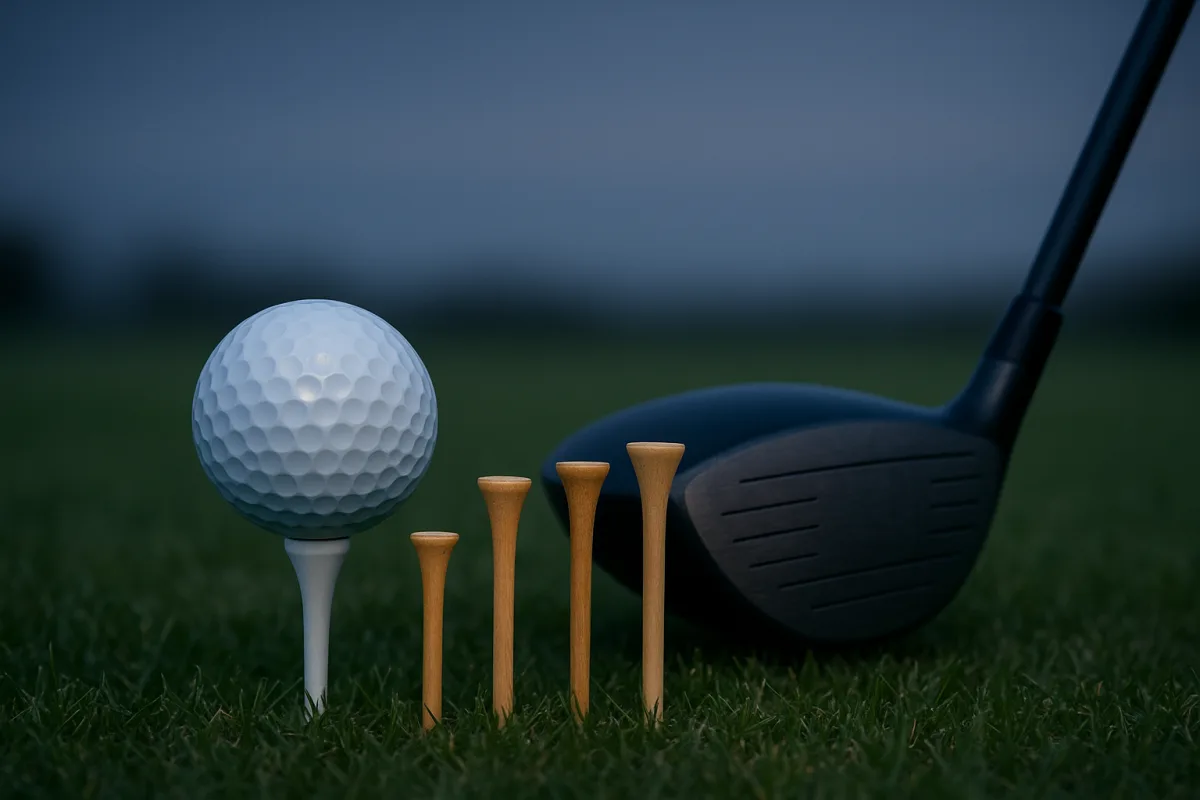
Tee height is a strike-location setting
The best golf tee height is not a universal measurement. It is the height that helps you strike your driver in the part of the face that produces a useful combination of launch, spin, start line and playable curvature.
That sounds less tidy than “tee it high and let it fly,” but it is closer to what is happening. The tee changes where the ball sits relative to the clubhead at impact, and that changes the delivered strike.
GOLF.com’s conventional starting point is simple: tee the driver so roughly half the ball sits above the top edge of the clubhead. That works out to about 1.5 inches, or 40 mm, above the ground. [1]
It is a starting point, not a distance guarantee. GolfGuideBook also presents the half-ball-above-the-crown setup as a common driver recommendation, roughly 1.5 to 1.75 inches depending on the driver and tee. [2]
The reason is not that a tall tee contains extra yardage. A driver is designed to be swept or struck with a reasonably shallow, often upward attack. The half-ball reference gives enough room to approach the ball without driving the clubhead into the turf.
For a mid-handicap golfer, that is the useful way to think about it. You are not trying to copy a tour-player tee height from a freeze frame. You are trying to create a repeatable impact pattern with your own delivery.
Why a few millimetres can change the shot
Golf Distillery describes a straightforward relationship: a higher tee tends to encourage contact higher on the driver face, raising launch while reducing spin. A lower tee tends to produce lower launch and more spin. [5]
That matters because driver distance is not just ball speed. Carry needs enough launch to stay in the air, but not so much spin that the ball climbs, stalls or loses forward momentum after landing.
The important caveat is that launch and spin are outputs, not instructions. If a player moves the tee higher and starts catching the ball high on the face, their launch monitor numbers may improve. Another player may simply hit more pop-ups.
A launch monitor number belongs to the swing that created it. A player who delivers the club steeply, with the handle forward and the face travelling down sharply, can react very differently to a high tee than a player who sweeps upward.
Sebo Golf makes this distinction directly: steeper swings may benefit from a lower tee to avoid skying the ball, while shallower swings can use a higher tee to help promote an upward strike. [4] That is why one tee-height tip cannot fix every slice either.
A slice caused by an open face and an out-to-in club path is not cured by a higher tee. A higher tee might change strike height and launch, but it does not automatically change the face-to-path relationship that put the ball into right field.
Likewise, lowering the tee because a player is hitting a high, weak fade can be a sensible on-course adjustment, but it is not a diagnosis. The golfer may be striking too high on the face, adding loft, or simply aiming poorly.
The 2.25-inch contradiction is useful
Golf Monthly’s 2026 tee-height testing is worth reading precisely because it does not support a neat universal answer. Its testing identified 2.25 inches, or 5.7 cm, as an optimal height in that setup, above the usual half-ball guideline. [3]
Yet Golf Monthly also found that the highest tee height it tested did not always produce the longest result. [3] That is the part golfers should retain, rather than treating 2.25 inches as a newly certified distance setting.
The study shows what launch-monitor testing often shows: a change can help a particular delivery without being broadly transferable. The useful question is not, “What height won?” It is, “What changed in strike, launch and spin when height changed?”
Most claimed distance gains from a small setup tweak are within normal shot-to-shot noise unless the change also improves contact quality. One flushed drive, or one poor swing, tells you little about whether a tee height works.
A better test is to hit enough balls at two or three controlled heights, using the same driver, ball, target and swing intention. Record where each strike lands on the face, then compare carry, total distance, launch, spin and dispersion.
If the higher setting adds carry but also produces occasional sky marks on the crown, it may be too aggressive for your current delivery. If the lower setting tightens dispersion but costs only a few yards, it may be the better scoring choice.
This is where fitting beats buying. There is no driver model, shaft flex or advertised low-spin head that can guarantee useful launch conditions if the ball is teed at a height that repeatedly produces the wrong strike.
A practical way to find your height
Begin at the GOLF.com half-ball standard, with about half the ball visible over the driver crown at address. [1] Use the same tee type and press it into the ground the same way for a small batch of shots.
Then test one clearly lower setting and one clearly higher setting. Do not make tiny, random changes after every drive. If you cannot tell which height you used, you cannot learn what the result means.
Face impact spray or impact tape is more useful here than watching the ball alone. A ball can look acceptable while repeatedly striking high on the face, low on the face, heel-side or toe-side, each of which changes launch and spin.
The high tee is working if it lets you strike the upper-middle part of the face consistently without pop-ups, huge launch variation or a loss of control. It is not working merely because one ball flew farther downwind.
The lower tee is working if it improves centre-face contact and start-line control without turning every drive into a low-spinless bullet. Golf Distillery’s general pattern is lower launch and higher spin from lower tee settings, which can become expensive in carry distance. [5]
Wind is a reasonable reason to adjust lower. FairwayWise notes that a lower tee can be useful where control matters, including windy conditions. [8] That is a shot requirement, not evidence that your basic tee height should change by season.
There is no solid evidence in the supplied research that grass type, region or time of year dictates a different standard tee height. The ball is on a tee, so turf interaction is mostly about whether your delivery clips the ground after impact.
The two mistakes at either extreme
Teeing the ball too high can encourage a strike near the top of the face or even under the ball. The visible version is the pop-up, often accompanied by very high launch, poor ball speed and an ugly mark on the crown.
Teeing it too low makes many golfers hit down or catch the lower face. GOLF.com identifies both extremes as common amateur errors, with too-low teeing associated with low launch and excessive spin. [5]
Neither error needs a dramatic overhaul. If your normal strike is consistently too high on the face, reduce tee height a little before rebuilding your swing. If it is low on the face, raise it slightly and check ball position as well.
Ball position still matters because it determines where in the swing arc you meet the ball. A high tee with the ball too far back can still produce a downward strike. A low tee with the ball forward can still be struck well.
This is why a fixed measurement is less valuable than a repeatable visual reference. For many golfers, the driver crown through the ball’s equator is easier to reproduce on the course than trying to judge 1.5 inches by eye.
Keep other clubs lower
For fairway woods and hybrids played from a tee, Golf Tees Etc recommends about 0.5 inches, or 12 mm, above the clubhead. [6] The objective is a clean, shallow strike, not the upward driver strike many players want.
For irons, Golf Tees Etc recommends setting the ball just above ground level. [6] An iron is built to contact the ball first and turf afterwards, so raising it like a driver can make centre-face contact less predictable.
Those measurements also explain why a single long driver tee can create inconsistency. It is possible to use it for every club, but judging three separate depths by feel is less repeatable than using an appropriate tee length or marked tee.
Buy consistency, not a miracle tee
Tee material does not create ball speed, but it can make the experiment cleaner. Passenger Golf lists wooden tees at $2.99 to $5.99 for packs of 25 to 50, a low-cost option suited to golfers content to replace broken tees often. [10]
Bamboo tees cost about $4.99 to $7.99 per 25 in Passenger Golf’s guide. They suit players who want better durability than basic wood while retaining a conventional-looking tee and a straightforward, inexpensive consumable. [10]
Plastic tees cost roughly $6.99 to $12.99 for packs of 10 to 20, according to Passenger Golf. They suit golfers prioritising durability and repeatable height, although a plastic tee is still only useful if its chosen setting matches the player’s strike. [10]
Graduated or step tees, often made from plastic or bamboo, are designed to stop at the same insertion depth. Passenger Golf puts these consistency-oriented tee options between $6.99 and $11.99 per pack. [10]
That extra few dollars does not buy distance by itself. It buys the chance to remove one variable, which is valuable if you are trying to determine whether a 1.5-inch baseline, a slightly lower tee, or a higher setting actually suits your driver delivery.
The best tee height, then, is the one you can reproduce and defend with your impact pattern. Start at half a ball above the crown, test with enough shots to ignore noise, and keep the setting that gives your own swing the best usable drive.
Frequently Asked Questions
What is the best golf tee height for a driver?
A common starting point is to tee the ball so that roughly half of it sits above the top edge of the driver’s clubhead, about 1.5 inches (40 mm) off the ground. This height allows a shallow, upward strike without hitting the turf. However, the best height depends on your swing and strike pattern, so adjustments may be needed based on your results.
How does tee height affect golf ball launch and spin?
Higher tee heights tend to encourage contact higher on the driver face, which raises the launch angle and reduces spin. Conversely, lower tee heights usually produce lower launch angles and increased spin. These changes affect ball flight and distance but depend on the individual’s swing mechanics.
How can I find the optimal golf tee height for my swing?
Start with the half-ball-above-the-crown guideline and then test different heights while observing strike location, launch, spin, and ball flight. Use a consistent tee height for repeatability and consider your swing type—steeper swings may benefit from a lower tee, while shallower swings may prefer a higher tee. Comparing data from multiple shots at different heights can help identify what works best for you.
Does tee height impact driving distance and accuracy?
Yes, tee height influences where on the clubface you strike the ball, which in turn affects launch conditions and spin rates. While a higher tee can increase carry distance by promoting higher launch and lower spin, it may also cause pop-ups or inconsistent strikes if too high for your swing. Lower tees can tighten dispersion but might reduce distance slightly.
What tee height should I use in windy conditions?
The article and research do not provide specific guidance on adjusting tee height for windy conditions. However, it notes that environmental factors like wind do not have established evidence supporting changes in tee height. Adjustments should focus on controlling ball flight through swing and club selection rather than tee height.
How we researched this
This article was assembled from 11 cited references.
Nothing here is based on hands-on testing. Where a figure or finding appears, it belongs to the source cited beside it, and the writing says so rather than implying otherwise. Every source is listed below so you can check it.
Sources
- Are you teeing the ball up at the correct height? Here's how to find out | Instruction | GOLF.com
- Golf Tee Height Guide (2026): How High Should You Tee The Ball?
- Which Tee Height Produces The Longest Distance? | Golf Monthly
- How to Choose the Right Tee Height for Your Driver – Sebo Golf
- How the Tee Height Impacts your Golf Shots - Golf Distillery
- Golf Tee Height Chart: How to Pick the Right Tee Height for Drivers, I – Golf Tees Etc
- Average Driver Distance by Swing Speed (2026 Data) - GolfSource
- Golf Tee Guide: Height, Material & Types — What Actually Matters - FairwayWise
- Golf Tee Guide: Types, Sizes, Heights & Rules
- Golf Tees Buying Guide for Pro Shops
- Tee Materials Encyclopedia
Related Articles
Best Golf Ball for Distance
Compare the best golf ball for distance in 2026, including Titleist Velocity and Callaway Warbird, plus tips on compression and launch for max distance.
Hitting a Wrong Ball in Golf: Rules and Penalties Explained
Learn what to do if you hit a wrong ball in golf, the penalties involved, and how to correct your mistake in stroke and match play.
Best Time of Day to Play Golf
Discover the best time of day to play golf by comparing morning and afternoon conditions for optimal performance and course strategy.
Best Golf Drills for Short Game: Improve Chipping & Control
Discover the best golf drills for short game to improve chipping accuracy, distance control, and course strategy with practical landing spot methods.