
Types of Golf Grips: Overlapping, Interlocking & More
Learn about the types of golf grips, including overlapping, interlocking, 10-finger grips, grip sizes, and materials to improve your game.
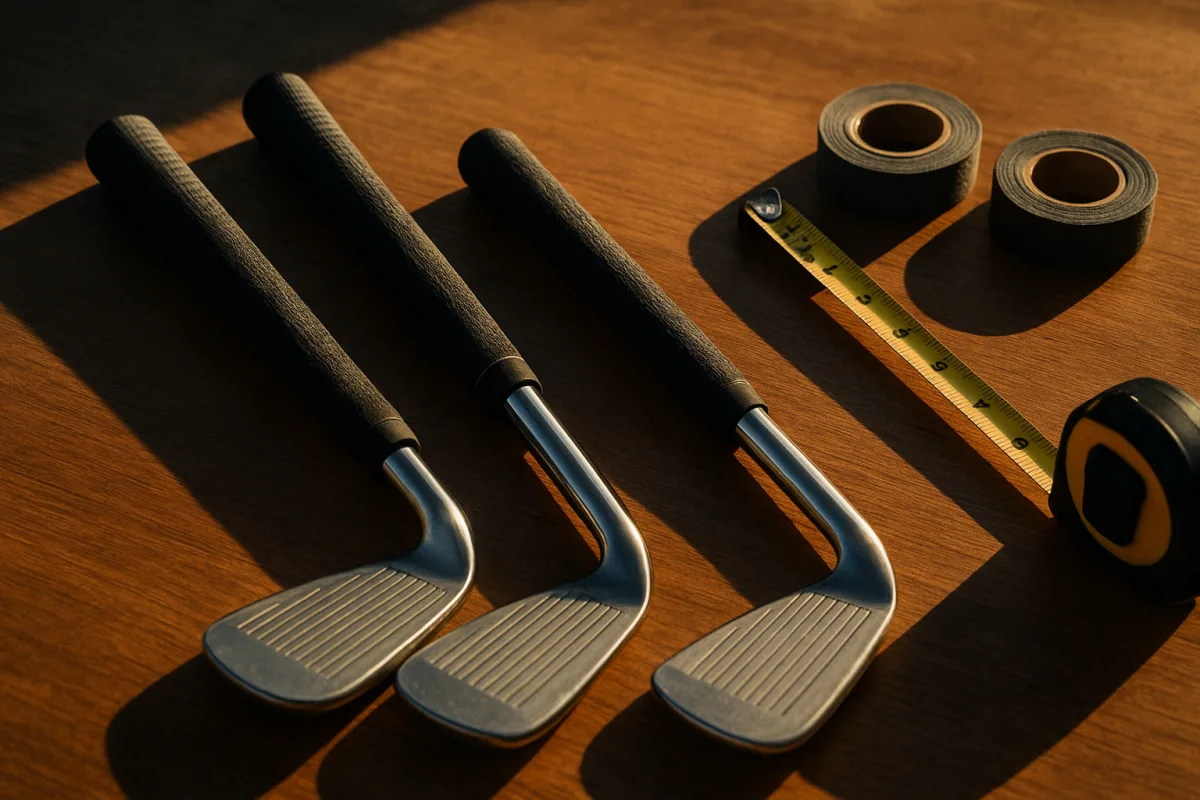
The important distinction: how you hold it versus what you hold
When golfers ask about “types of golf grips,” they often mean two different things. One is the hand position, meaning overlapping, interlocking or 10-finger. The other is the physical grip fitted to the shaft, including its size, taper, material and texture.
The first decision affects how your hands work together. The second affects how easily your hands can move, how hard you need to squeeze and how secure the club feels in changing weather. They overlap, but they are not the same adjustment.
For most mid-handicap golfers, grip size is the more useful system to understand properly. A launch monitor can tell you what happened on one set of swings, but it cannot decide whether a larger grip caused a better strike or merely changed your timing that day.
That matters because grip claims can become silly quickly. A midsize grip will not automatically cure a slice, and an undersize grip will not automatically create speed. Those outcomes depend on the golfer’s hand size, grip pressure, wrist action and face delivery. [3]
The three ways to connect your hands
The overlapping grip, also called the Vardon grip, places the little finger of the trailing hand over, or in the space between, the index and middle fingers of the lead hand. It is commonly recommended for golfers with average to larger hands. [1]
Its practical idea is simple: it joins the hands without locking them together too rigidly. That can provide a blend of control and freedom, which is why it remains the most common conventional choice among experienced players. [1]
The interlocking grip connects the trailing-hand little finger with the lead-hand index finger. Rather than resting on top, the two fingers physically link. Golfers with smaller hands often find this produces a more unified hold. [1]
That extra connection can make the club feel more secure, especially if your hands tend to separate during the swing. It does not mean every player with small hands should interlock, but it is a sensible option to test. [12]
The 10-finger grip, sometimes called the baseball grip, keeps all ten fingers on the handle without overlap or interlock. It is common among beginners and can feel immediately natural to golfers coming from other bat-and-ball sports. [13]
Because every finger contacts the grip, the 10-finger method can create a strong sensation of leverage and security. The trade-off is that some players find the hands work too independently, particularly when trying to control face rotation. [13]
None of these methods is inherently “correct” in isolation. If the club arrives square enough, contact is repeatable and your hands are not straining, the grip method is doing its job. A tip that fixed one golfer’s slice will not fix every slice.
Why diameter changes the swing feel
Grip diameter changes the amount of finger closure needed to hold the club. A smaller diameter allows the fingers and wrists to work more freely. A larger diameter can quiet hand action because there is physically less room for the fingers to wrap around it. [3]
That is the real mechanism behind many fitting recommendations. It is not that a midsize grip contains anti-slice technology. It is that a player who releases the club excessively may feel less able to overwork the hands with more diameter. [4]
Undersize grips can encourage active hands and, for some golfers, make the clubface easier to close. That can be useful for a player who chronically leaves the face open, but it can also make hooks or pull-hooks worse. [3]
Midsize grips can reduce hand action, which is why they are frequently suggested for golfers who fight a fast closure rate or want a calmer feel through impact. But if a player already struggles to release the club, going larger may simply leave more shots right. [4]
Jumbo grips reduce wrist action further and are often considered by golfers with arthritis, hand discomfort or a preference for less movement through the handle. The possible cost is reduced clubhead speed or a loss of feel for players who need active wrists. [3]
This is where fitting beats buying. A golfer who adds a larger grip because a friend stopped slicing may be changing both hand comfort and face delivery at once. If the ball flight changes, that does not prove the same result will travel to another swing.
Tape is the sensible middle ground
Extra tape under a grip is the useful adjustment many golfers miss. Each additional tape layer adds approximately 1/64 inch to the finished diameter, allowing smaller steps than changing from standard directly to midsize. [3]
That is especially useful when one hand feels different from the other. Some golfers prefer extra tape under the lower, trailing hand to reduce taper, while keeping the upper hand closer to a conventional standard size. [4]
A reduced-taper grip does something similar without requiring a custom tape build. It keeps more diameter in the lower hand, which can reduce the feeling that the trailing hand needs to squeeze harder than the lead hand.
The goal is not to eliminate hand action. Golf requires some. The goal is to make the handle secure enough that you can hold it with reasonable pressure, hinge the wrists naturally and return the club consistently.
Materials: traction is not the same as softness
Rubber and synthetic grips are the conventional all-purpose choice. They are generally softer and more cushioned than corded designs, which suits golfers who prioritise comfort or play mostly in dry conditions. [10]
Corded grips have fibres embedded in the surface to increase traction. In hot, humid or rainy environments, that texture can be useful when hands are sweaty and a smooth rubber grip starts to feel slippery. [11]
The downside is that cord can feel abrasive, especially for players who grip tightly or play without a glove. A golfer who gets worn patches in a glove may need to address pressure and grip condition, not simply move to the roughest available cord model.
Multi-compound or hybrid grips attempt to split the difference. They typically combine a firmer, higher-traction upper section with a softer lower section, aiming to provide control where the lead hand anchors the club and comfort lower down. [5]
Regional preferences follow weather more than fashion. Golfers in humid southern climates often favour cord for moisture management, while dry northern-climate players may prefer softer rubber for comfort and sufficient traction. [11]
Cold weather complicates that choice. Rubber can harden and lose tackiness when temperatures fall, so a softer, more flexible grip can feel better in winter. All-weather designs with moisture-management features are increasingly trying to cover both extremes. [11]
Common setup errors that a new grip will not solve
Grip pressure is the first issue to check. Holding the club too tightly reduces feel and can restrict speed, particularly when tension climbs before the takeaway. A tackier or better-sized grip may help, but it cannot replace a lighter hold. [14]
Placing the handle too much in the palm is another common problem. It can restrict wrist hinge and encourage casting, because the club is not sitting securely across the fingers where the hands can support leverage. [12]
An overly strong or weak hand position can also influence curvature. Too strong can contribute to a closed face and hooks, while too weak can make it harder to square the face. Those are setup patterns, not material problems. [15]
Set the hands after lifting the club rather than gripping it while it rests on the turf. Grounding the club can lead golfers to adjust posture, shaft angle and hand position differently every time, which makes a supposedly consistent grip inconsistent. [13]
What a regrip actually costs
At the budget end, Geoleap sells a 13-grip set for about $40, including tape. That suits the golfer who needs a low-cost full-set refresh, although price alone does not establish that its diameter or texture is the right fit. [8]
Golf Pride pricing cited by Grip It Forward ranges from about $8 for an MCC Plus4 grip to around $15 for Tour Velvet 360 and Z Grip models. The MCC Plus4 suits golfers seeking a reduced-taper, hybrid-style profile, while Tour Velvet and Z Grip options suit players prioritising familiar rubber feel or traction. [5]
Lamkin grips are listed around $8 to $10 per grip, while a 13-grip Sonar+ set is around $130. The Sonar+ option suits a golfer who wants a more premium, full-set matching installation rather than the lowest entry cost. [5]
SuperStroke grips range from roughly $7 to $35 depending on the model and category. IOMIC grips are approximately £15 each. These figures cover the grips themselves, not necessarily installation, old-grip removal or any shaft repairs uncovered during the job. [5]
A local shop may charge separately for fitting, tape and labour, so compare the finished price rather than the sticker. Unlike driver distance claims, which are often within normal swing-to-swing noise, a regrip has a clear cost and a measurable diameter change.
New designs are mostly refinements, not new grip categories
The main grip categories have not changed. As of 2026, the market still revolves around overlapping, interlocking and 10-finger hand placement, then physical variations in size, taper, texture and alignment aids. There is no evidence of another mainstream hand-placement type. [1]
Golf Pride introduced its CP grip in July and August 2026 with localised tack zones and reduced taper, in standard and midsize. Golf News reported the design, but the available research brief does not provide a retail price, so it cannot be compared fairly on cost. [22]
SuperStroke’s February 2026 Zenergy TLT is marketed as a zero-torque, lie-angle-balanced grip available in several sizes and colours. Golf One Media reported the launch, but no price is supplied in the research brief. It suits golfers specifically interested in that alignment concept. [17]
Lamkin’s Calibrate Technology, available from February 2026, combines a reminder-style shape with Smooth Tack material and reduced taper. Golf Tips presented it as an option for golfers wanting a repeatable hand reference, though the brief does not state pricing. [18]
WMX Grips launched Hyper+ midsize and jumbo designs in March 2026, using lighter weight, reduced taper and a lower-hand profile. First Call Golf reported the release. These suit golfers wanting larger diameter without adding as much handle weight, but no price is provided. [19]
Golf Pride expanded ALIGN MAX in March 2026 with a ridge said to be 25 percent higher, plus ZGRIP and additional sizes. The Golf Range Association reported the update. It suits golfers who want a pronounced reminder ridge, with price not supplied in the brief. [20]
SuperStroke’s REVL Element 4X, released in May and June 2026, uses reduced taper and an enlarged lower-hand profile to simulate extra tape wraps. It is an off-the-shelf option for golfers who want that profile without a custom build, although no price is listed. [9]
P2 Grips introduced new putter grips in March 2026 with a tacky, high-traction outer layer and firm rubber core for all-weather use. Irish Golfer Magazine reported the launch. These are putter-specific grips, and the available brief gives no retail price. [21]
The sensible order is straightforward: pick a hand connection that feels unified, measure for diameter, choose material for your weather and pressure needs, then use tape or reduced taper to fine-tune. That is a fitter’s problem-solving sequence, not a marketing exercise.
Frequently Asked Questions
What are the different types of golf grips?
The three primary types of golf grips are the overlapping (Vardon) grip, the interlocking grip, and the 10-finger (baseball) grip. The overlapping grip places the trailing hand's pinkie over the lead hand's index and middle fingers and is common for average to large hands. The interlocking grip links the trailing hand's pinkie with the lead hand's index finger, often favored by golfers with smaller hands. The 10-finger grip keeps all fingers on the club without overlap or interlock, commonly used by beginners.
How do overlapping, interlocking, and 10-finger grips differ?
The overlapping grip joins the hands without locking them, offering a balance of control and freedom. The interlocking grip physically links two fingers, creating a more unified hold that can help prevent the hands from separating during the swing. The 10-finger grip involves no overlap or interlock, providing a strong sense of leverage but sometimes allowing the hands to work too independently, which may affect face rotation control.
How does grip size affect golf swing mechanics?
Grip size changes how much the fingers must close around the club. Smaller grips allow freer wrist and finger movement, potentially encouraging a more active hand release, which can lead to hooks. Larger grips reduce hand action by limiting finger closure, which can help calm excessive wrist movement and reduce slices. Choosing the correct grip size helps balance control and swing feel without forcing unnatural hand positions.
What grip materials are best for different weather conditions?
Cord grips are recommended for sweaty hands and humid or rainy conditions because their embedded fibers provide better traction. Softer rubber grips are generally better suited for dry or cold weather since rubber can harden and lose tackiness in low temperatures. Some all-weather grips now combine moisture-wicking technology to perform well across varying conditions.
How do I choose the right golf grip size?
Start by measuring your hand size and considering your glove size to find a grip diameter that allows comfortable finger closure without excessive squeezing. Fine-tune grip size by adding layers of grip tape, with each wrap increasing diameter by about 1/64 inch, rather than jumping immediately to a much larger size. Testing different sizes helps ensure the grip supports your natural wrist action and face control during the swing.
How we researched this
This article was assembled from 22 cited references.
Nothing here is based on hands-on testing. Where a figure or finding appears, it belongs to the source cited beside it, and the writing says so rather than implying otherwise. Every source is listed below so you can check it.
Sources
- How to Hold a Golf Club: The Proper Golf Grip - GOLF.com | Instruction | GOLF.com
- Best Golf Grips 2026: Select, Size & Regrip Guide
- Golf Grip Size Chart: Hand Measurement + Diameter Tables (2026) | Club Fitting Directory
- Golf Grip Size Guide: Measure Your Hand and Get the Fit Right - FairwayWise
- Golf Grips Catalogue – Golf Pride, SuperStroke, Lamkin & Winn | Grip It Forward
- 10 Best Golf Grips [ 2026 ] - Bulle Rock Golf | Bulle Rock Golf
- Best Golf Grips 2026 — Tested for Feel and Durability
- Golf Grip Brands Compared: What 13 Clubs Cost – Geoleap
- Best Golf Grips 2026: Our expert picks for feel and comfort | Golfmagic
- Golf Grip Guide: Find the Right Feel & Performance - Golf Place
- How Weather Affects Golf Grips | Golf Grip Guide
- How to Grip a Golf Club: Proper Golf Grip Guide (With Testing Data + Pictures) | The Golf Ace
- Golf Grip Basics: The Complete Guide to a Proper Golf Grip | Caddie Data
- What Are the Most Common Mistakes in a Golf Swing?
- Golf Grip: The Complete Guide for Weekend Warriors
- Best Golf Grips for Sweaty Hands | Golf Sim Finder
- Superstroke Debuts Zenergy TLT Grip - Golf One Media
- Lamkin Grips Feature Calibrate Technology - Golf Tips
- WMX Grips: Introduces Hyper+ Midsize, Jumbo grips
- Golf Pride Builds on ALIGN Technology Success, Adds ZGRIP and New Sizes to ALIGN MAX Category - Golf Range Association
- New P2 putter grips designed to bring good vibes on the greens - Irish Golfer Magazine
- Golf Pride introduces new CP grip - Golf News | Golf Magazine
Related Articles

Types of Golf Courses: Links, Parkland, Heathland & More
Explore the types of golf courses and learn how links, parkland, heathland, desert, and resort courses affect play and strategy.
How to Fix a Hook in Golf: Grip, Stance, and Swing Tips
Learn how to fix a hook in golf with grip, stance, and swing adjustments that improve ball flight and reduce hooks quickly and effectively.
How to Fix a Slice in Golf: Causes and Effective Solutions
Learn how to fix a slice in golf with grip, setup, and swing tips that address the real causes for straighter, more consistent shots.
Summer Golf Trip Planning: Courses, Conditions & Deals
Learn how to plan a summer golf trip with tips on course conditions, pricing, packages, and what to expect from summer turf and weather.