
Driving Range Etiquette
Learn driving range etiquette to practice safely and respectfully with tips on space, session length, and avoiding common mistakes.
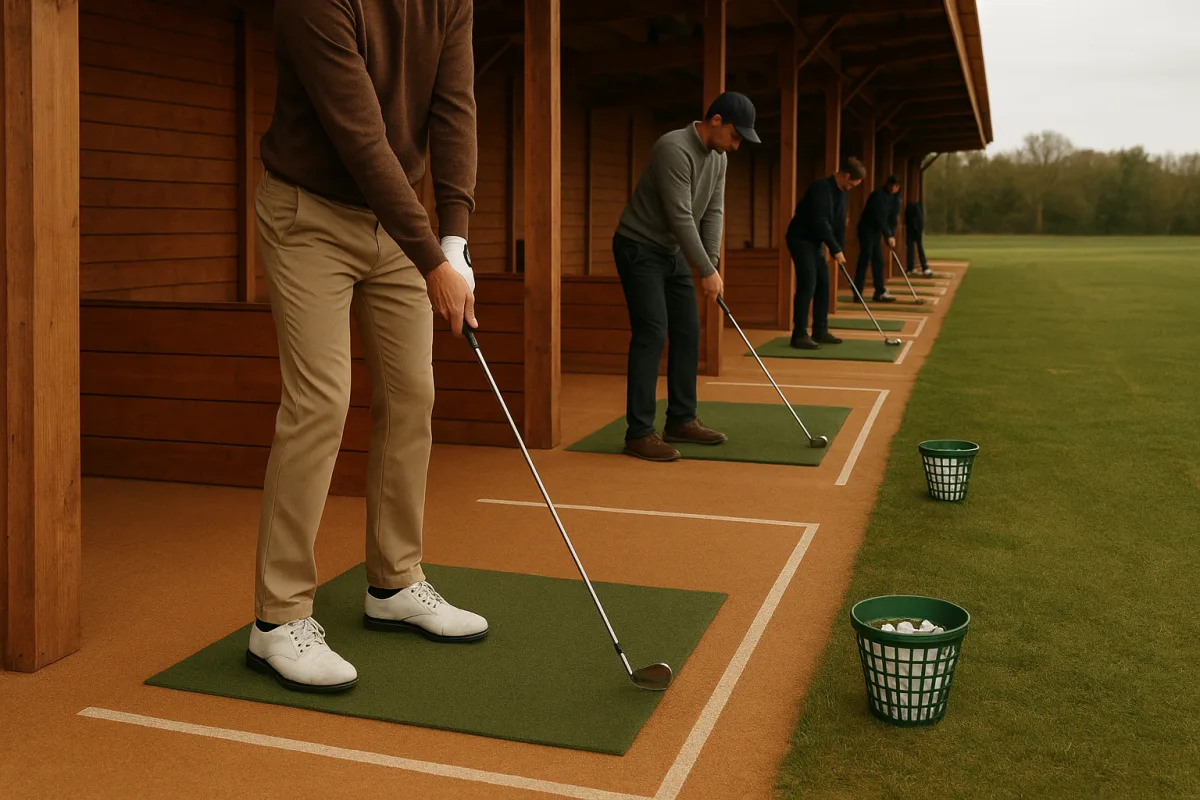
The useful way to think about range etiquette: managing shared swing space
Most range-etiquette mistakes come from treating the bay as though it exists in isolation. It does not. Every shot uses physical space, visual attention, sound, and time that other golfers are also trying to use.
That is the system worth understanding. A range is not simply a line of mats and a field full of balls. It is a shared practice environment where one person’s poor positioning can affect another player’s safety and concentration.
I am a mid-handicap golfer, so I understand the temptation to become completely absorbed in a swing thought. When the driver has been leaking right, it is easy to stare at clubface numbers or chase a different ball position.
But a launch monitor number belongs to the swing that produced it, and so does a range session. You can work on face-to-path, launch, spin or strike location without becoming the golfer whose bag blocks a walkway or whose practice routine holds up a queue.
The simplest etiquette test is this: could the person beside you make a full swing, hear their own impact, access their balls and leave their bay without needing you to move? If not, your setup needs attention.
What a bay really includes
A bay is more than the strip of mat directly under your feet. It includes the space required to address the ball, make a full backswing, finish without clipping anything, and step away safely between shots.
That matters particularly with driver. A 45-inch driver creates a far bigger moving arc than a wedge, and the follow-through can travel behind or beside the golfer, depending on handedness and how they finish.
Pecan Grove Country Club suggests approximately 10 feet between players, allowing room to swing and move freely. That is a sensible working number on an open grass line, but it is guidance rather than a formal industry-wide standard. [4]
GolfLink, Golf Safety Expert and Golf Safety UK all emphasise leaving sufficient room around golfers, without setting a universal measurement. The sensible conclusion is that the layout, markings and staff instructions beat any number you saw online. [2][3][18]
On a range with individual dividers, marked mats or partitions, use the assigned station. Do not spread into an empty bay beside you simply because you have brought an alignment stick, a launch monitor and three training aids.
On an open grass tee, create your own boundary. Pick a hitting line that is parallel to other players, leave adequate space, and do not set up so far ahead or behind that your swing occupies another golfer’s peripheral vision.
Standing behind another golfer is a common, avoidable mistake. Golf Monthly specifically includes disrupting other players among the behaviours to avoid at the range, and standing near someone’s swing path is both distracting and unnecessarily risky. [9]
The same applies to filming swings. If you are recording face-on or down-the-line video, make sure the phone and tripod remain inside your space. A tripod placed behind another player’s heels is not a harmless detail.
The quiet mechanics of not interfering
Good etiquette is not silence at all costs. Golf is not a library, and impact, conversation and the occasional frustrated mutter are part of a normal range session. The issue is avoidable disruption.
Take calls away from the bays. Keep music in headphones rather than playing it through a speaker. If you are practising with friends, speak at a volume that does not make adjacent players feel as though they joined your lesson.
Unsolicited coaching is another form of interference. Vic Hadfield Golf advises limiting unwanted advice, and that is sound guidance because range fixes are usually more complicated than they look. [1]
A player whose ball starts right may have an open face, an out-to-in path, a heel strike, poor alignment, or simply a target line they have misread. The one tip that fixed somebody else’s slice will not fix every slice.
Even apparently useful comments about equipment can be misleading. Telling someone to buy a stiffer shaft because a shot ballooned is not analysis. Loft, delivered loft, strike, spin loft, ball choice and swing speed all influence flight.
The courteous move is to let them practise unless they ask. If they do ask, keep the response proportionate: suggest a visible observation, not a diagnosis dressed up as certainty.
Practice time is part of the shared space
There is no standard rule saying each golfer gets a fixed number of minutes in a bay. That matters because golfers sometimes invent hard limits, then use them to police other players without knowing the facility’s policy.
Dobson Ranch Golf Club recommends a driving-range session of roughly 45 to 60 minutes, with about 50 to 70 quality shots. The important word is quality, not the idea that every player must leave after exactly an hour. [5]
Fifty intentional shots can be plenty. A session might include ten wedge shots for contact, 15 mid-irons with a target and start-line goal, 15 drivers with a specific fairway target, then ten shots checking whether the pattern held.
That is more useful than firing 120 balls with no target, no reset and no plan. It is also easier on the people waiting for space when the range fills up after work or before a weekend tee time.
Golf.com and Vic Hadfield Golf both frame awareness of other users as a core part of range etiquette. If golfers are waiting behind you, or every bay is occupied, that is the moment to skip the extra experimental bucket. [1][6]
Do not confuse consideration with rushing. There is no benefit in trying to hit a driver every 15 seconds because somebody has arrived. Finish the drill you are doing, collect your belongings and clear the bay efficiently.
The right adjustment is usually better planning. Buy an appropriate bucket, decide what you are practising before you start, and avoid turning the final ten balls into a slow-motion equipment fitting session when others need access.
Why range pricing and policies affect etiquette
The cost of a bucket changes how golfers behave, even if it should not change the basic safety rules. The research brief reports buckets ranging from about $5 to more than $15, with some facilities offering passes or packages. [14][17]
A golfer who has paid for a large bucket may feel entitled to occupy a mat until every ball is gone. That is understandable, but it does not override a facility’s instructions or the need to share a congested range.
Some venues make their expectations more explicit. Sunset Hills Golf Club limits members to three buckets per day, a policy that controls demand rather than assigning a formal per-bay time limit. [15]
Pole Creek Golf Club uses hourly fees and closes weekly for maintenance, illustrating another model: practice access can be managed by booked time and operating conditions rather than by unlimited, open-ended use. [16]
These policies are not universal. Before assuming you can stay as long as you like, check the posted rules, booking terms and closing times. The facility has to manage staffing, ball collection, mowing, mats and turf recovery.
That turf piece is easy to overlook. On grass tees, repeatedly striking the same patch creates divots quickly. If the range asks players to use a particular strip, rotate stations or hit from mats, follow that direction.
Divot patterns are not just cosmetic. They affect the surface the next golfer practises from and the maintenance work required to reopen the teeing area. The range’s grass is shared practice infrastructure.
Keep the ball, bag and club problem simple
There is no formal universal rulebook for where every golf bag or spare club must sit. Still, the principle is straightforward: keep your equipment inside your space and out of routes other players need to use.
Place the bag where it cannot be kicked during your swing and where it will not force somebody to step around it. On many bays, that means behind and slightly to the side, not directly on the boundary line.
Avoid laying a collection of clubs across the mat. Bring the club you are using and perhaps the next one, then return the rest to the bag. This reduces clutter and makes it less likely that a club becomes someone else’s trip hazard.
Ball position is primarily a performance issue, but it can become an etiquette issue when a player repeatedly resets, moves across a shared line, or creates a sprawling drill station. Golf Chilled and Golf Launch Lab both stress that ball position changes by club. [7][8]
Using one identical ball position for driver, iron and wedge is a common practice error. So is standing too close or too far from the ball, then trying to solve the resulting strike problem by adding more gadgets. [7][8]
Keep the setup manageable. An alignment stick can be useful, but it should lie within your bay, not point into a neighbour’s area. A headcover or towel should not become a marker that makes adjacent space unusable.
Most important, do not retrieve balls from the range. Golf safety guidance consistently treats active range areas as off-limits, and range staff, machinery and other golfers may be operating downrange. [2][3][18]
Do not aim at ball pickers, collection vehicles or distant golfers, even as a joke. Wait for the range to be clear if a facility pauses hitting for collection, and follow staff instructions immediately.
Indoor, outdoor and seasonal differences
The shared-space principle remains the same, but the details change by venue. Indoor simulators often have booked slots, limits on the number of players, quieter expectations and more restrictions around food, drinks and equipment. [10]
An indoor simulator is particularly unforgiving of clutter. A loose drink near electronics, a club swung outside the designated hitting zone, or a player stepping into another person’s camera or radar area can stop the session entirely.
Outdoor ranges create different risks. There may be no partitions, targets may encourage golfers to aim across another player’s visual field, and weather can make surfaces slippery or crowding more likely under covered bays.
Summer etiquette includes practical self-management. Bring water, sun protection and enough time to avoid rushing at peak periods, as Palm Beach National advises golfers preparing for a range visit. [11]
Winter changes the equation again. Covered or heated facilities may be busy, daylight can be limited, and grass tees may close in favour of mats. Local Golf Ranges notes that winter practice often means adapting to covered and heated range conditions. [12]
Cold air also affects ball flight and feel, so do not turn a shorter carry number into a dramatic equipment conclusion. It may be temperature, ball condition or clothing restricting the swing, not proof that your driver suddenly needs replacing.
That is the same practical mindset that makes range etiquette work. Observe the conditions, follow the local system, practise with a purpose, and leave enough space for everyone else to do the same.
Frequently Asked Questions
What is the best way to practice driving range etiquette?
The best approach is to treat the driving range as a shared space rather than a private area. Stay within your assigned bay, give neighbors enough room to swing and move freely, avoid crossing in front of active hitters, keep noise to a reasonable level, and follow any facility-specific rules. Also, avoid unsolicited advice and retrieve only your own balls in designated areas.
How much space should I leave between players at the driving range?
A practical guideline is to leave about 10 feet between players to allow enough room for a full swing and movement, especially on open grass lines. However, this is not a universal standard; the layout, markings, and staff instructions at the facility should take priority over any fixed measurement.
What are common driving range etiquette mistakes to avoid?
Common mistakes include standing too close to or behind another player’s swing path, retrieving balls from the range, aiming shots at range staff or equipment, giving unsolicited swing advice, blocking walkways or other players’ access to balls, and overcomplicating practice with excessive equipment that spills into neighboring bays.
How long should a typical driving range session last?
A productive session generally lasts 45 to 60 minutes, during which a golfer hits about 50 to 70 purposeful shots. When the range is busy, it is courteous to shorten your session and leave promptly after finishing to allow others to practice.
Is it okay to give unsolicited advice at the driving range?
No, unsolicited coaching is discouraged because swing fixes are often complex and individual. It is better to let others practice undisturbed unless they specifically ask for advice. If asked, keep comments simple and observational rather than offering definitive diagnoses or equipment recommendations.
How we researched this
This article was assembled from 18 cited references.
Nothing here is based on hands-on testing. Where a figure or finding appears, it belongs to the source cited beside it, and the writing says so rather than implying otherwise. Every source is listed below so you can check it.
Sources
- Driving Range Etiquette | Vic Hadfield Golf
- Golf Driving Range Safety Golflink.com
- Golf Expert Witness | CPR35 Reports - Safety on Golf Driving Ranges
- Driving Range Etiquette for Beginners (September 2026) Guide
- How Long Should a Driving Range Session Be in Mesa? | Dobson Ranch Golf Club | Dobson Ranch Golf Club
- Driving-range etiquette? Yep, it's a thing. Follow these 11 rules when you practice | GOLF.com
- Golf Ball Position: Correct Placement for Every Club
- Golf Ball Position Chart: Where to Place the Ball for Every Club | GolfLaunchLab
- 7 Things You Should Never Do At The Driving Range | Golf Monthly
- Indoor Golf Simulator vs Outdoor Range | Cero Golf UAE
- What to Bring to a Driving Range | Palm Beach Gardens | Palm Beach National | Palm Beach National
- Heated & Covered Driving Ranges Near You — Winter Practice | Local Golf Ranges
- Gesundheit & Technik: Golf Club Wiesensee e.V.
- Rates - The Golf Center at Palm Desert
- RATES & FEES | Sunset Hills Site
- 2026 Rates & Fees – Pole Creek Golf Club
- Rates
- Do driving ranges require Risk Assessments? - Golf Safety
Related Articles

Common Golf Etiquette Mistakes Every Golfer Should Avoid
Learn common golf etiquette mistakes and how to maintain pace, repair marks, and respect course rules for a better game experience.

Bushnell Rangefinders Review: A1 Slope, Tour Hybrid, Pro X3 Plus Link
Explore Bushnell's latest rangefinders on Lets Play Thru: A1 Slope, Tour Hybrid, and Pro X3 Plus Link. From compact design to club selection technology, find the perfect rangefinder for your golf game.

Green Eagle Terra Electric Golf Cart Review: Stability, Versatility, Affordability
Explore the Green Eagle Terra electric golf cart in this Lets Play Thru review. Discover its stability, versatility, and affordability for a game-changing on-course experience.

Wilson Staff Dina Power vs. Dina Power Max: Ultimate Iron Review
Explore the Wilson Staff Dina Power and Dina Power Max game improvement irons in this review. Discover the differences, performance, and which model suits your game best. Exciting insights await!