
Golf Course Selection by Skill Level
Learn how to choose the right golf course by skill level using course ratings, slope, yardage, and layout to improve your play experience.
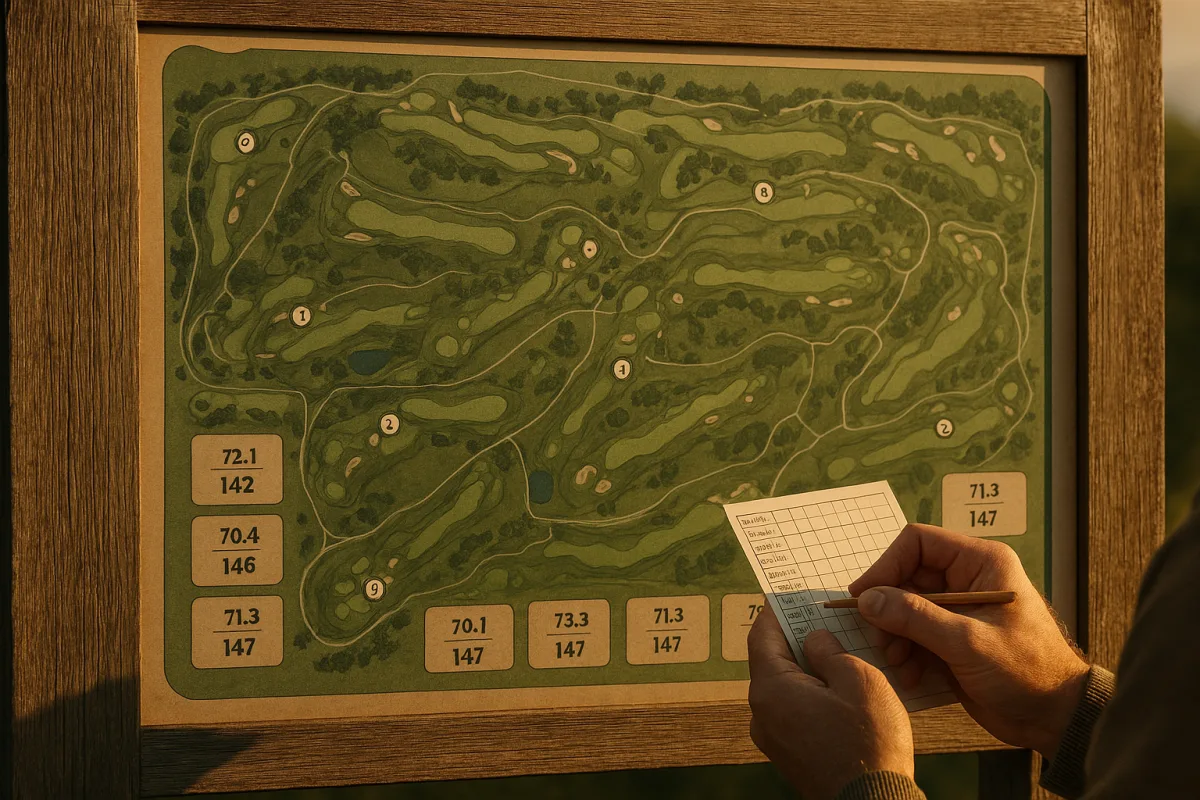
The numbers on the scorecard: Course Rating and Slope Rating
The scorecard’s tee chart is where this starts. Next to each color of tee, you may see a yardage, a Course Rating, and a Slope Rating, three numbers that describe different parts of the challenge.
Course Rating estimates what a scratch golfer, a player with a 0.0 Handicap Index, should score under normal conditions from that specific tee. Typical Course Ratings sit around 70 to 75, and the number can be above or below par. [2]
That last point catches many players. A par-72 course with a 71.0 Course Rating is not necessarily “easy,” and a par-70 course rated 72.5 is not automatically brutal for every golfer.
Par describes the score standard assigned to the holes. Course Rating describes expected scoring for scratch players from a particular set of tees. Those are connected, but they answer different questions. [2]
Slope Rating is the number aimed closer to the round most mid-handicap golfers actually play. It measures how much more difficult a course is expected to be for a bogey golfer than for a scratch golfer. [2]
The Slope scale runs from 55 to 155, and an average U.S. course is around 120. A slope near 113 is often treated as a baseline, while numbers well above it suggest the course becomes notably more punishing as your game gets less precise. [2]
A 125-Slope course is not five percent harder in any clean, universal sense. It is a relative measurement within the handicap system, built around the gap between scratch and bogey scoring, not a launch-monitor-style prediction of your score.
That makes Slope particularly relevant if your misses are large enough to find rough, bunkers, water, trees, or awkward recovery angles. A scratch golfer may recover from those places; a 15-handicap often records the damage before reaching the green.
What the ratings are actually measuring
Course Rating begins with the scratch golfer. The rating process looks at effective playing length and obstacles, including the distance the course plays, forced carries, bunkering, rough, water, trees, green targets, and recovery difficulty. [2]
Effective length is larger than the scorecard yardage. Uphill holes, soft turf, prevailing wind, elevation, doglegs, and layup zones can make a 6,100-yard course play longer than its listed total suggests.
Slope takes those same features and asks a different question: how much harder do they become for the bogey golfer? A pond that is irrelevant to a player carrying a tee shot 250 yards can be a forced layup for someone carrying it 175.
This is why two courses of similar yardage can suit completely different players. One may have broad landing areas, shallow bunkers, and greens that accept a running shot. The other may ask you to carry hazards and stop long approaches on small, quick surfaces.
Caddy Scout identifies narrow fairways, thick rough, strategically placed hazards, fast greens, and subtle green contours as common features of difficult courses. Those features compound each other when the approach shot starts from a poor lie. [5]
For a mid-handicap player, the issue is not whether the course can produce a big number. Every course can do that. The better fit is one where a normal tee shot and a normal approach still leave a playable route to bogey.
Why yardage still decides whether the tee works
Ratings tell you about the course’s expected difficulty. Yardage tells you whether you have enough club to play its holes as designed. You need both, because a moderate-Slope course can still be exhausting from tees that are too long.
Intermediate players are commonly matched with courses or tee sets between 5,500 and 6,500 yards, usually on a par-70 to par-72 layout. Beginners and high-handicap players often fit better from 4,500 to 5,500 yards. [3]
Low-handicap and professional players commonly play from 6,500 to 7,500 yards on par-72 courses. That does not mean a 6,700-yard course is reserved for elite golfers, but it does tell you what kind of approach distances the design may demand. [3]
Look at the par 4s before you focus on the total. If several par 4s leave you 180 to 220 yards after a decent drive, the tee may turn every ordinary hole into a low-percentage long approach.
The USGA’s par guidelines allow a men’s par 4 from 240 to 490 yards and a women’s par 4 from 200 to 420 yards. That is an enormous range, which is why “it is only a par 4” tells you almost nothing. [3]
Men’s par 3s can run up to 260 yards, while women’s par 3s can run up to 220 yards. Men’s par 5s range from 450 to 710 yards, and women’s from 370 to 600 yards. [3]
A 470-yard par 5 may be a reachable hole for one group and a three-shot hole for another. A 215-yard par 3 might be a long iron for one player, a hybrid for another, and a hole where a player should aim short and accept a longer first putt.
We would use your reliable carry distance, not your best drive of the summer. If your ordinary tee ball travels 210 yards and you need 230-yard second shots into multiple par 4s, move forward one tee.
The layout can outweigh the headline rating
A course’s architecture determines where a miss goes and what it costs. Ratings summarize that challenge, but the course map and hole descriptions tell you whether the trouble attacks your particular weakness.
Beginner-friendly courses tend to offer wider fairways, lighter rough, fewer hazards, and larger, slower greens. Advanced layouts often narrow landing areas, deepen rough, place hazards at strategic distances, and use smaller, faster greens with more subtle movement. [5][13]
For a player who fights a slice, a right-side pond 190 yards from the tee is more important than the course’s total yardage. For a player who hits it straight but struggles with speed control, severe greens may be the real problem.
Hazards do not need to be everywhere to make a course demanding. A bunker placed exactly where your normal drive lands can force a different club, a different line, or a tee shot that asks for more curve than you own.
The same applies around the green. A large green is not automatically easy if it has steep tiers, but larger and slower greens generally leave more room for imperfect approaches and reduce the cost of a putt struck slightly too hard. [5][13]
Golfadvising lists ignoring layout and hazards, underestimating green difficulty, focusing only on yardage, and overestimating ability among the common course-selection mistakes. [4] Those mistakes tend to show up as lost balls, repeated forced carries, and a scorecard full of doubles.
How a mid-handicap player should use the system
Begin with your Handicap Index, but do not treat it as a complete scouting report. A 14-handicap built on good driving and weak putting may struggle on a different course than a 14-handicap who chips well but sprays tee shots.
Then find the tee yardage, Course Rating, and Slope Rating. A moderate length paired with a high Slope can signal narrow landing zones, penal rough, water, or greens that punish misses more than the yardage suggests. [2][5]
Next, identify the holes that can produce your worst scores. Check forced carries, water beside your typical shot shape, bunker placement around your normal landing distance, and par 3s that require a club you rarely strike well.
Do not chase a higher Slope merely because you want a test. Challenge is productive when it gives you decisions and recoverable misses. It becomes expensive when every bad swing is a reload, a penalty stroke, or a shot you cannot physically carry.
Published guidance does not provide clean Course Rating and Slope bands for beginners, intermediates, and advanced golfers. Some guidance even associates low-handicap players with lower ratings and slopes, despite many strong players seeking higher-rated championship layouts. [1][2]
That conflict is a reason not to use one number as a label. Higher Course Rating means a tougher expected score for scratch golfers, while higher Slope means a larger difficulty gap for bogey golfers. Neither number tells your whole story.
We would pick a tee where you can reach most par 4s with a mid-iron through hybrid after a typical drive, reach par 5s in three shots without forcing hero carries, and keep a bad tee shot in play often enough to finish the hole.
Cost can change which challenge is worth taking
A fitting course is easier to enjoy when the cost matches the value you get from the day. In 2026, public-course green fees commonly run from $30 to $80 per round, while semi-private and resort courses often run $80 to $200. [8][12]
Premium courses can cost $300 or more, and Big Draw Golf Club lists Pebble Beach at roughly $695 to $750. Those green fees buy access to the course, not necessarily the complete day’s bill. [10]
Cart fees commonly add $15 to $40, while caddies can add $50 to $150 or more per bag. [8][12] A $70 public round with a $25 cart is a $95 round before food, range balls, tips, or any other optional spending.
Membership pricing varies even more. Public-course memberships are listed around $1,000 to $5,500 annually, while private-club initiation fees can start near $65,000 with monthly dues around $1,000. Elite clubs can exceed $250,000 in initiation alone. [11]
Higher cost does not guarantee the right level of difficulty. A famous course may offer exceptional conditioning, scenery, service, or history, but your score will still be shaped by the tee you select and the shots its design demands.
Course conditions can also change the experience, but published material does not provide reliable figures showing how seasonal weather or regional climate changes difficulty for golfers at different skill levels. Check conditions before booking, but do not pretend a number can forecast every bounce.
The best course for your game is the one that asks for shots you can attempt, leaves room for recovery, and gives you a few holes that expose the part of your game you are trying to improve. Start from the correct tee, then let the scorecard teach you whether to move.
Frequently Asked Questions
How do I choose a golf course that matches my skill level?
Start by reviewing the Course Rating and Slope Rating for the tees you are considering. Then check the yardage to ensure you can realistically reach par 4s and par 5s in a reasonable number of shots. For mid-handicap players, tees between 5,500 and 6,500 yards typically offer a good balance of challenge and playability.
What do golf course rating and slope mean for my game?
Course Rating estimates the expected score for a scratch golfer playing from a specific set of tees, reflecting the course’s difficulty for highly skilled players. Slope Rating measures how much more difficult the course is expected to be for a bogey golfer compared to a scratch golfer, indicating how hazards and course features penalize less precise play.
How does yardage affect golf course suitability for different players?
Yardage determines whether you have enough club to play the holes as designed. Intermediate players usually fit best on courses or tees between 5,500 and 6,500 yards, while beginners often benefit from tees between 4,500 and 5,500 yards. If par 4s leave you with approach shots beyond 180 to 220 yards, the course may be too long for your current skill level.
Which tee boxes are best for mid-handicap golfers?
Mid-handicap golfers generally find tees between 5,500 and 6,500 yards most suitable. These tees provide enough length to keep tee shots in play while offering enough hazard pressure to reward thoughtful course management. It is advisable to avoid back tees that turn normal approach shots into consistently long-iron or hybrid shots.
How do course hazards impact players of varying skill levels?
Hazards such as narrow fairways, thick rough, bunkers, water, and fast greens tend to penalize bogey golfers more than scratch golfers. While a scratch player may recover from challenging lies, mid- and high-handicap players often incur higher scores after missing fairways or greens. The Slope Rating reflects how these hazards increase difficulty for less precise players.
How we researched this
This article was assembled from 13 cited references.
Nothing here is based on hands-on testing. Where a figure or finding appears, it belongs to the source cited beside it, and the writing says so rather than implying otherwise. Every source is listed below so you can check it.
Sources
- Golf Player Ratings: How Skill Levels Are Determined | ShunGolf
- SCGA.org | Course Ratings FAQs | SCGA
- What Is The Length Of A Golf Course | Golf Life Wiki
- Your Guide To Am Golf Course: Tips & Info - Golfadvising
- Course Difficulty Grading, What Makes a Golf Course Hard? | Caddy Scout | Caddy Scout
- How To Choose A Golf Course For Your Skill Level Guide
- How to Choose Golf Course Architecture for Your Skill Level | Golf Articles
- Golf Courses Cost Breakdown - Average Prices & Estimates | AreaCosts
- How Much It Costs To Play Bethpage Black
- Bucket-List Golf Green Fees, 2026, Big Draw Golf Club
- Golf Course Membership Average Cost 2026
- How Much are Golf Fees
- Golf Course FAQs | Golfbreaks
Related Articles
How to Choose the Right Golf Course Using Course and Slope
Learn how to choose the right golf course by understanding course and slope ratings to match your skill and carry distances.
Golf Handicap System Explained
Learn how the golf handicap system works, including Handicap Index, Course Rating, and Slope Rating, to understand your scoring potential.
Average Golf Score for Amateurs: What to Expect
Discover the average golf score for amateurs and how handicap and course difficulty affect your performance.
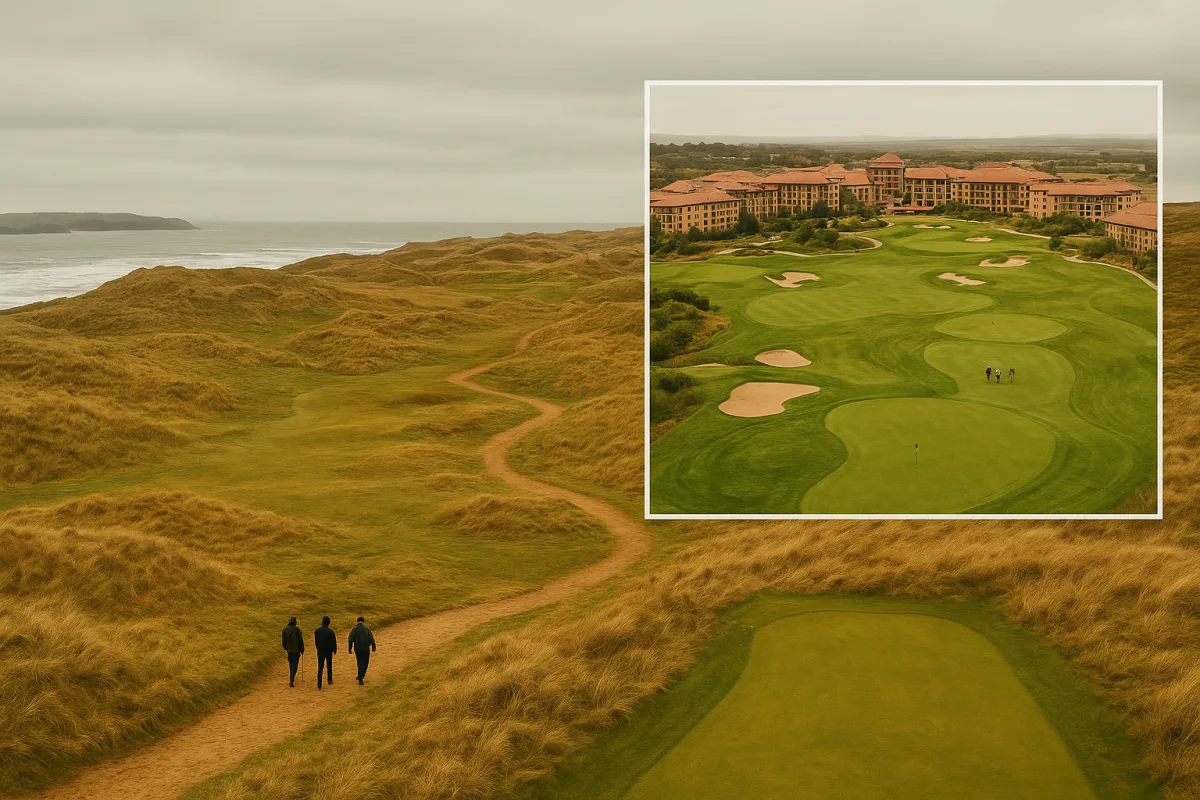
How to Choose a Golf Course for Vacation
Learn how to choose a golf course for vacation with insights on course quality, destination types, and group playability for your ideal golf trip.