
What to Do If You Hit a Spectator in Golf: Safety & Rules
Learn what to do if you hit a spectator in golf, including safety steps, rules, and how to get help after an accidental strike.
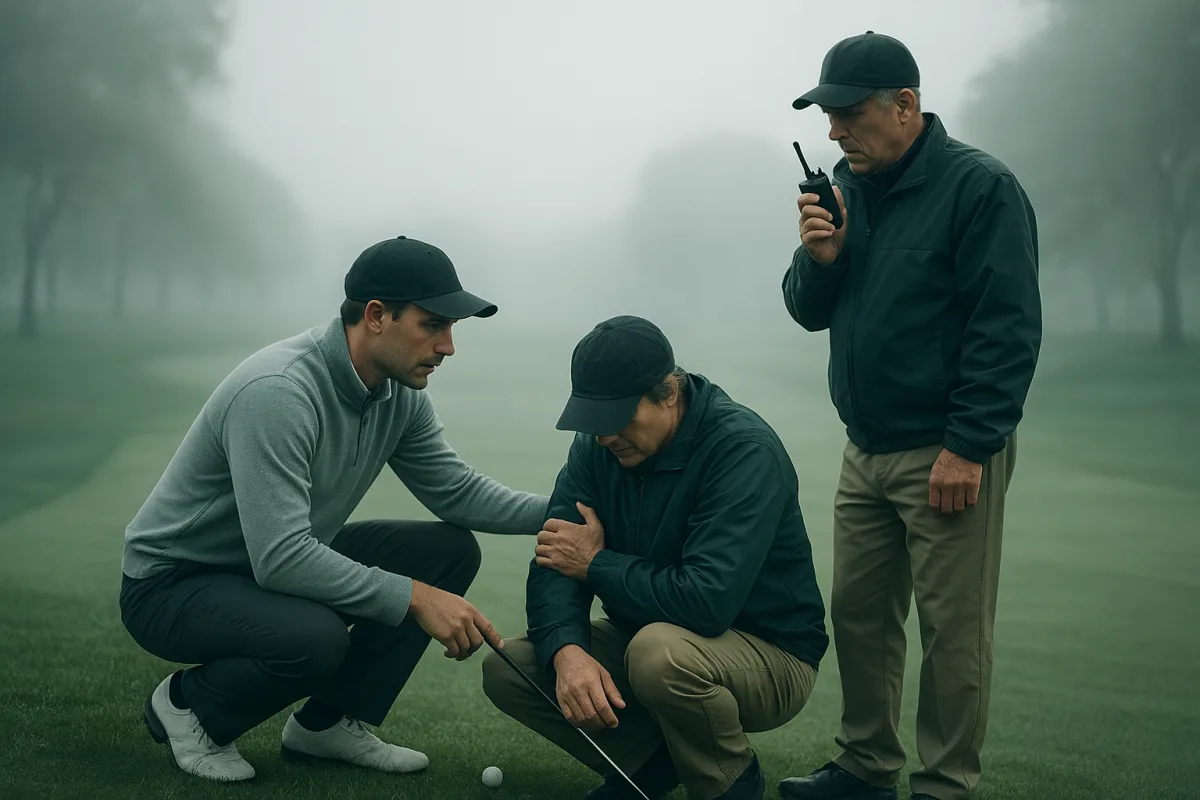
GOLF
SPECTATOR RULES
- All spectator")[12]
The response chain after a ball hits someone
A ball disappears into the right rough, then you hear a shout from beyond the trees. Stop. The important thing now is not finding your ball, recording a score, or guessing whether the person is hurt.
The safest response is a sequence: warn, stop, reach the person, assess the injury, call for help, and report the incident. Golf’s written rules do not create a universal post-impact procedure, so your actions fill that gap.
That sequence begins before impact. “Fore!” is the established warning call for an errant shot headed toward people, and the American Junior Golf Association includes it in its player safety expectations. [2]
Yell it loudly and early, not after the ball lands. A warning gives someone time to cover their head, turn away, or move, even when the ball is difficult to see against cloud, trees, or late-afternoon light.
Do not substitute “watch out,” a quiet apology, or a hand wave for “Fore!” The point is a short, recognized word that spectators, caddies, volunteers, and other players can identify immediately from a distance.
Stop play before you worry about the score
Once a ball has struck a spectator, halt your group’s play. Do not hit a provisional, inspect the lie, or continue toward the green while somebody may be injured nearby.
Stopping play does two things. It prevents a second ball from entering the area, and it makes clear that someone is taking responsibility for getting help rather than assuming another group, marshal, or spectator will handle it.
If you are playing a casual weekend round, tell your partners what happened and walk over together if the scene is safe. One person can stay alert for other golfers and direct them to hold their shots.
At a tournament, alert the nearest marshal, official, scorer, volunteer, or clubhouse staff member at once. LegalClarity identifies failure to stop play, report the incident, and assist the injured person as common mistakes after a spectator strike. [3]
You do not need to diagnose the injury before calling for help. Give the official the hole number, the location, what happened, and whether the person is conscious and responding.
This is where a tournament’s safety system takes over. Gallery ropes, marshals, medical teams, evacuation routes, and conduct rules are designed to control crowds and respond to hazards, although the major associations do not publish one formal procedure specifically for a ball-struck spectator. [4][5][6][7]
The Rules outcome is separate from the human outcome
Golfers often fear an automatic penalty after hitting somebody. Under Rule 11.1b(1), there is no penalty when a ball accidentally hits a person, animal, or outside influence, and the ball is played as it lies. [1]
That ruling answers only the ball question. It does not tell you whether the spectator needs medical care, whether a tournament official should be called, or whether the course needs to adjust spectator traffic.
The rule also should not become a reason to rush away. A scorecard can wait while a person is assessed, and tournament officials can tell you when and how to resume play.
For a mid-handicap player, this separation is useful because it removes one bad instinct: trying to solve the golf ruling first. The ball usually stays where it finished. Your immediate job is the person.
If the ball is in a location where approaching it would place you in the path of another group’s shots, get help and keep the area clear. Do not create another risk by clustering people in a blind landing zone.
Check the person, then bring in medical help
Approach carefully and make sure the area is safe before you reach the injured spectator. Watch for incoming shots, carts, uneven ground, and groups behind you that may not know why play has stopped.
Check whether the person is responsive. If they are unresponsive, call 9-1-1 immediately, or direct a specific person to call while you remain with the injured spectator.
Use direct instructions. “You in the blue shirt, call 9-1-1 and tell them we are on the seventh fairway,” is far better than asking generally whether somebody can call for help.
Head, neck, and spinal injuries require particular care. Do not move an injured person unless they face immediate danger, because moving them can worsen a potential spinal injury.
A golf ball can travel above 150 mph, and a hit that initially looks minor can still require prompt medical evaluation, especially if the person was struck in the head, face, neck, chest, or eye. [3]
Provide care only within your training. Keep the person calm, discourage them from standing up quickly, and wait for trained responders if there is any concern about consciousness, balance, confusion, pain, or a head injury.
If the spectator can speak, ask simple questions: where they were hit, whether they lost consciousness, whether they have neck pain, and whether they feel dizzy or nauseated. Relay those answers to medical staff or tournament personnel.
Do not let a spectator’s desire to “walk it off” end the process. A person may be embarrassed, angry, or eager not to delay the group, but prompt evaluation is the safer response after a high-speed impact. [3]
Why “Fore!” and positioning decide so much
The main safety system in golf is prevention. A warning call, spectator distance, ropes, cart-path rules, and marshal instructions all try to give an off-line ball enough space to miss people.
Published spectator guidance commonly places viewers 25 to 50 yards from players, with several junior and school organizations specifying at least 30 yards. [8][9][[10]](https://www.mhsaa.com/sites/default/files/Golf-Boys/2026/Golf-Spectator-Rules-8.5x11.pdf?time=1790096453911 "# MHSAA
GOLF
SPECTATOR RULES
- All spectator")[12]
Those numbers are not a magic shield against a driver, a low hook, or a flushed approach shot. They create time and space, which is what a spectator needs if a player calls “Fore!”
Some organizations also require spectators to stay on cart paths, in the rough, or in other designated areas. The restriction can feel overly cautious on a quiet junior event, but it keeps people out of the normal landing and miss zones. [9][[10]](https://www.mhsaa.com/sites/default/files/Golf-Boys/2026/Golf-Spectator-Rules-8.5x11.pdf?time=1790096453911 "# MHSAA
GOLF
SPECTATOR RULES
- All spectator")[11]
For you, the warning decision should start before the ball crosses into trouble. If a tee shot begins toward another fairway, a blind corner, a grandstand, or a group outside your normal line, call immediately.
A ball that looks harmless off the face can curve late, catch a downslope, or run much farther than expected on firm ground. The same applies to an approach that comes out hot from a flyer lie.
Wind and rain change the risk picture too. Wind can move a ball well away from its starting line, while wet conditions can alter footing, visibility, and the way spectators gather around shelter or grandstands. [7]
Course design adds another variable. Doglegs hide landing areas, elevated tees launch shots toward people below, and neighboring fairways put spectators near balls struck by players they are not following. [7]
Who handles what at an event
The player’s role is immediate: warn people, stop play, assist, and report the incident. The player is closest to the shot and may be the first person to recognize where the ball has gone.
Tournament personnel handle the wider response. Marshals can stop nearby groups, call medical staff, keep crowds back, identify witnesses, and direct play around the incident.
The USGA, PGA Championship, and Open Championship spectator policies emphasize conduct rules, mobile-device limits, alcohol and smoking restrictions, and compliance with marshal instructions. [4][5][6]
Those policies help build a controlled environment, but they do not replace your responsibility after your own shot hits someone. They also do not create a single, published golfer checklist that applies at every event.
After an incident, organizers may investigate the location and conditions, then add netting, reposition spectators, or change crowd control on that hole. Those measures have been used after safety incidents involving weather, course design, and grandstand proximity. [7]
For a club event, report the incident even if the person appears fine and declines help. The club may need an account from you, your playing partners, the marshal, and the injured spectator.
Write down basic facts while they are fresh: hole number, approximate time, where the person stood, the shot you hit, weather conditions, who heard the warning, and which official responded. Do not speculate about blame.
Liability is about conduct, not a scorecard ruling
Spectators generally accept some inherent risk when they attend golf, a legal concept often called assumption of risk. That can limit liability for injuries caused by the ordinary dangers of the game. [3]
It is not a blanket pass for careless behavior. A negligence claim may arise when a player or organizer fails to use reasonable safety measures, such as giving a warning or managing crowds appropriately. [3]
Whether negligence exists depends on the facts: the shot, the player’s view, whether a warning was possible, the spectator’s position, the event’s setup, and the response afterward. There is no simple distance or injury severity that decides every case.
Tournament organizers typically carry liability insurance for spectator injuries, and professional players often carry personal liability insurance. Publicly available material does not provide typical claim values, settlement amounts, or a standard financial cost for these incidents. [3]
For the ordinary golfer, the lesson is not to argue liability beside the fairway. Warn early, stop play, get help, report accurately, and let officials or the course handle what follows.
Make the next shot safer
Before hitting from a crowded tee or toward an adjacent hole, look farther ahead than your target line. Check the right and left miss zones, especially if your usual pattern is a push, pull, slice, or hook.
A mid-handicap miss is rarely random. If your driver often starts right and fades farther right, treat the next fairway over as part of your danger area before you tee off.
We would skip the temptation to wait and see whether the ball starts offline. If people are within reach of your common miss, calling “Fore!” early costs nothing and may give them the second they need.
Follow ropes and marshal directions as closely as you expect spectators to follow them. The response chain works best when players, spectators, and officials each protect the space around the shot.
Frequently Asked Questions
What should I do immediately if I hit a spectator with a golf ball?
Yell “Fore!” as soon as you see a shot heading toward people to warn them. If a spectator is hit, stop play immediately and go directly to the person to assess their condition. Do not continue play or try to find your ball until the situation is addressed.
Is there a penalty if a golf ball hits a spectator?
No, under the Rules of Golf, there is no penalty if a ball accidentally hits a person. The ball is played as it lies, but this rule does not affect the need to assist the injured spectator or report the incident.
How do I check and assist a spectator injured by a golf ball?
Approach the injured person carefully, ensuring the area is safe from other shots or hazards. Check if they are responsive, and if they are unresponsive, call 9-1-1 immediately or instruct someone specific to do so. Avoid moving anyone with suspected head, neck, or spinal injuries unless there is an immediate danger.
When should I call for medical help after hitting a spectator in golf?
Call for medical help immediately if the person is unresponsive or shows signs of serious injury, especially involving the head, neck, or spine. It is better to seek prompt professional evaluation even if injuries seem minor due to the high speed of golf balls.
How can I prevent hitting spectators while playing golf?
Keep spectators at a safe distance, roughly 25 to 50 yards from play, and follow ropes and marshal instructions. Give extra space on blind shots, doglegs, elevated tees, and windy days, and always yell “Fore!” loudly and early to warn people of errant shots.
How we researched this
This article was assembled from 12 cited references.
Nothing here is based on hands-on testing. Where a figure or finding appears, it belongs to the source cited beside it, and the writing says so rather than implying otherwise. Every source is listed below so you can check it.
Sources
- Accidental Deflections | Golf Rules | Sport Rules
- Spectator Code of Conduct
- What Happens If You Hit Someone With a Golf Ball? - LegalClarity
- USGA Championships Spectator Conduct Policy
- Spectator Guide | PGA Championship
- The Open Unveils New Fan Code Of Conduct After Controversial US Open Spectator Behavior
- What is spectator and venue safety in Golf?
- Spectator Guidelines - NFJG
- Conduct & Spectators | TMSGA
- [# MHSAA
GOLF
SPECTATOR RULES
- All spectator](https://www.mhsaa.com/sites/default/files/Golf-Boys/2026/Golf-Spectator-Rules-8.5x11.pdf?time=1790096453911)
- Spectator Rules | JGA of Broward County
- Spectator Guidelines
Related Articles
Hitting a Wrong Ball in Golf: Rules and Penalties Explained
Learn what to do if you hit a wrong ball in golf, the penalties involved, and how to correct your mistake in stroke and match play.
Driving Range Etiquette
Learn driving range etiquette to practice safely and respectfully with tips on space, session length, and avoiding common mistakes.
Golf Ball in Hazard Rules: What to Do When It Happens
Learn golf ball in hazard rules, how to identify penalty areas, and your relief options to make smart decisions on the course.

Common Golf Etiquette Mistakes Every Golfer Should Avoid
Learn common golf etiquette mistakes and how to maintain pace, repair marks, and respect course rules for a better game experience.