
Golf Ball in Hazard Rules: What to Do When It Happens
Learn golf ball in hazard rules, how to identify penalty areas, and your relief options to make smart decisions on the course.
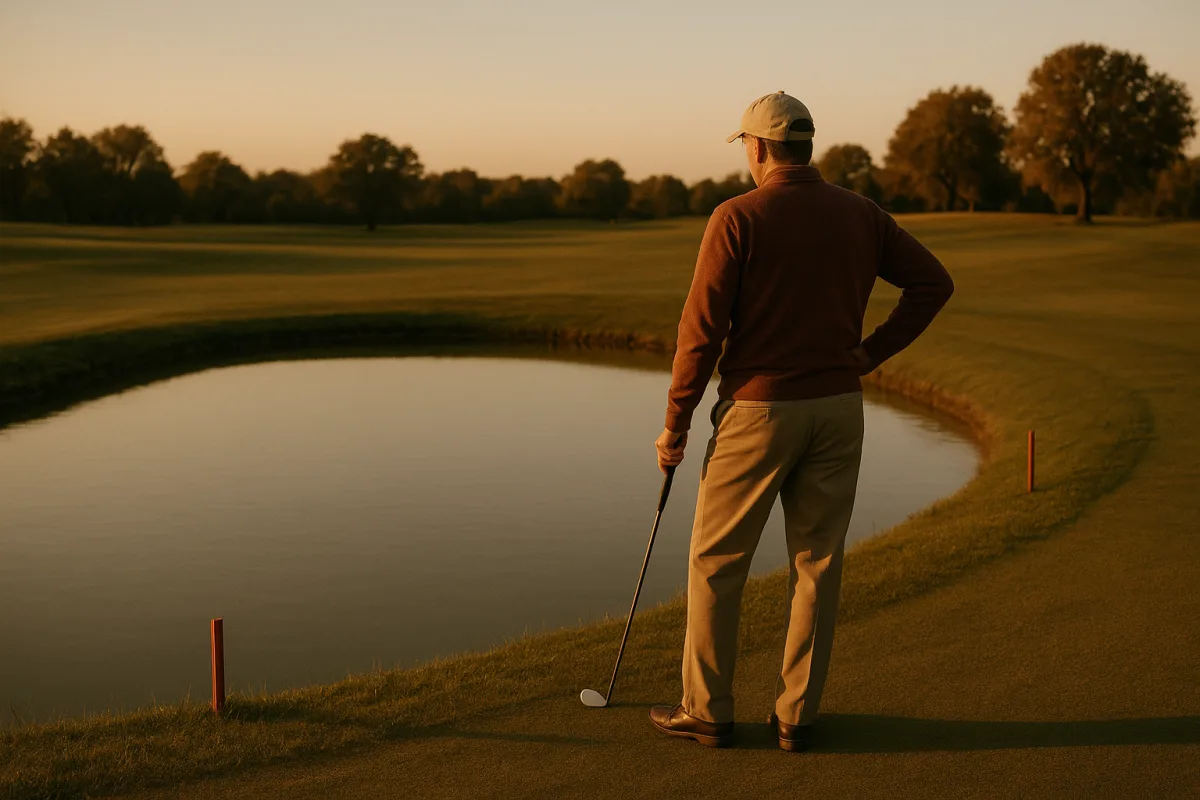
Start by deciding whether the ball is actually in a penalty area
Golf’s current term is “penalty area,” not “hazard.” The wording changed in the 2019 Rules update, and using the modern term matters because it covers more than water. A penalty area may contain water, long grass, rocks, trees or bare ground. [1]
Before reaching for another ball, work out whether it is known or virtually certain that your ball came to rest in the penalty area. If you watched it enter, that is straightforward. If it disappeared over a bank, look for evidence before assuming. [1]
A ball that may simply be lost in rough outside the penalty area is a different problem. You cannot take penalty-area relief just because water or scrub sits nearby. If the evidence does not establish that it entered the marked area, stroke-and-distance may be your only Rules option. [1]
This is worth slowing down for. Mid-handicaps, myself included, can turn one bad tee shot into a larger number by deciding what happened from fifty yards away, then dropping from the place that makes the next shot easiest.
Read the stakes and painted lines before choosing relief
Yellow stakes or lines mean a yellow penalty area. Red stakes or lines mean a red penalty area. Lines define the boundary when both stakes and lines are present, and the boundary extends vertically upward and downward. [1]
For either colour, you can always play the original ball as it lies if you find it and can make a sensible stroke. You can remove loose impediments and ground your club in a penalty area, provided you do not improve the conditions affecting the stroke or test the condition of the area. [1]
That last point is an update many golfers still miss because the old “hazard” rules were more restrictive. The sensible practical rule is not to scrape a practice swing into sand, press down grass, or use the club to test mud or water depth. [1]
If the ball is sitting on firm ground beside a creek, playing it may be better than automatically taking relief. But assess the shot honestly. A ball below your feet on wet grass with a branch behind it is not magically recoverable because it is technically playable.
If you can play it, treat the next shot as a recovery shot
A penalty area does not force you to take relief. If you have enough room to make a normal swing and the lie gives you a predictable strike, playing on can save a stroke. The Rules allow it, and the decision is entirely strategic. [1]
Do not confuse “I can reach it” with “this is the percentage play.” A long carry over water from a muddy lie is often a low-percentage shot, even if the number on the rangefinder says you have the distance.
Knowing your own carry distance matters more than the total distance printed on a launch monitor. A 7-iron that occasionally carries 155 yards is not necessarily a reliable 155-yard water carry when the ball is wet, your feet are uneven and contact is compromised.
When there is trouble short, I would use the conservative carry number, not the career-best one. Most claimed distance gains are within ordinary swing-to-swing noise anyway. The practical answer is fitting and knowing your real on-course windows, not buying a club to solve a forced carry.
Your first relief option is always stroke and distance
For a red or yellow penalty area, you may take stroke-and-distance relief for one penalty stroke. Play another ball from where you made the previous stroke. [1]
From the tee, that normally means replaying from the teeing area. From the fairway or rough, return to the spot of the previous stroke and drop a ball in the prescribed relief area. This can be the best choice if your first shot was poor anyway. [1]
It is not always the quickest option, but it can be the cleanest one. If your tee shot barely cleared trees before finding a yellow penalty area, replaying with a different target line or club may beat trying to manufacture a drop behind the water.
Announce what you are doing to playing partners, particularly in casual golf where people can lose track of stroke count. “I’m replaying from the tee, lying three” prevents the familiar scoring dispute on the next green.
Yellow penalty area: use back-on-the-line relief
A yellow penalty area gives you two standard relief choices after deciding not to play the original ball: stroke and distance, or back-on-the-line relief. Both cost one stroke. [1]
For back-on-the-line relief, identify where the ball last crossed the edge of the penalty area. Draw an imaginary line from the hole through that crossing point, then choose a spot anywhere behind the penalty area on that line. [1]
There is no fixed distance limit behind the penalty area. You might drop ten yards behind it or a hundred yards behind it, so long as the chosen spot remains on that line. The ball must then be dropped in the correct relief area. [1]
The key word is “behind.” Do not create a line from the tee, from the middle of the pond, or from where you found the ball. The line is hole, crossing point, chosen dropping point, in that order. [1]
For many approach shots into a pond in front of a green, this option leaves you a long way back. That is why knowing the stake colour before the round matters. A yellow-marked pond does not offer lateral relief just because a red drop would be more convenient.
Red penalty area: decide whether lateral relief is better
A red penalty area gives you the yellow-area options, plus lateral relief for one penalty stroke. [1] This is the option most golfers want after a ball enters a creek running alongside a fairway or a pond beside a green.
Find the point where the ball last crossed the red boundary. From that point, measure two club-lengths, using the longest club in your bag other than a putter, and establish the relief area no nearer the hole. [1]
The relief area is a two-club-length radius, not a two-club-length strip pointing directly away from the water. Within that area, select the spot that gives you the best legal lie, stance and route back toward the target. [1]
Use a driver for measuring if it is your longest club, even if you plan to hit a wedge next. Do not use two driver-lengths from where the ball disappeared under water unless that was genuinely the point where it crossed the red line.
A common error is to walk to the far side of a pond and drop there because it produces a better angle. That is not lateral relief. Your reference point is where the ball last crossed into the penalty area, not where it might have finished. [1]
Drop the ball correctly, then check where it finished
Once you have selected your reference point and relief option, drop the ball from knee height so that it falls straight down without touching your body or equipment first. The ball must come to rest inside the relief area. [1]
If it rolls outside the relief area, drop again. If the second drop also comes to rest outside, place the ball on the spot where it first touched the ground on that second drop. [1]
This sounds fussy until a scorecard matters. Taking a neat-looking side drop a few yards closer to the green can be an avoidable penalty, and it is particularly easy to get wrong when everyone in the group is trying to move quickly.
Use a tee, a leaf or a club laid on the ground to mark the crossing point before walking off to measure. It takes seconds and gives your group a visible reference instead of relying on competing guesses.
Do not use a provisional to solve the wrong problem
A provisional ball is appropriate when your original may be lost outside a penalty area or may be out of bounds. You must clearly announce that you are playing a provisional before making the stroke. [6]
If the only realistic outcome is that the ball is in a penalty area, a provisional is not the answer. Proceed under the penalty-area relief rule after establishing the relevant crossing point. [1][6]
There can be overlap. A tee shot that might be in a red penalty area but might also be lost in thick rough outside it can justify a provisional, because the original may be lost outside the area. State the reason clearly. [6]
Avoid vague language such as “I’ll hit another one.” Say “I’m playing a provisional in case the first is lost outside the penalty area.” That protects the status of the ball and makes the next steps much easier for everyone. [6]
Treat bunkers as a separate rules problem
A bunker is not a penalty area, even though golfers often call both hazards. If your ball is in a greenside bunker, do not apply the red and yellow penalty-area options described above. The Rules and relief choices are different. [1]
For a playable bunker shot, concentrate on turf, or rather sand, interaction. Chris Brook’s bunker guidance recommends a square setup, a weaker grip and a natural wrist hinge to help the club enter and move through the sand consistently. [11]
That is a technique recommendation, not a guarantee. Wet compacted sand, fluffy sand and a plugged lie can require different amounts of bounce and speed, so one bunker fix will not solve every bunker shot.
If the ball is unplayable in a bunker, understand that taking relief outside the bunker carries a greater penalty than dropping back in it. Do not casually rake a ball into a better lie or assume that a bunker exit is covered by penalty-area relief. [1]
Check local rules before relying on any familiar routine
The Rules are globally standardised, whether you are on a links course, parkland course or travelling abroad. Course setup changes the strategic question, but not the basic Rules of Golf. [1][9]
Local rules can still matter. Mill Creek Golf Course, for example, publishes local provisions covering embedded-ball relief and specifies where that relief does not apply. [2] Other clubs use preferred-lie procedures during wet or winter conditions. [4]
A local rule may also provide an alternative to stroke-and-distance for a ball lost or out of bounds, usually with an additional penalty. That is not the same as penalty-area relief, and it is only available when the course has adopted it. [4]
Read the scorecard, first-tee noticeboard or club app. Also ask the professional shop if a temporary local rule is in effect after heavy rain, construction work or seasonal maintenance. A correct drop on one course can be wrong on another.
Use the penalty encounter to improve the next tee shot
After the hole, make a quick note of what created the problem. Was the carry longer than your reliable number, did you aim at the flag instead of the safe side, or did a poor strike turn a safe club into trouble?
GOLF.com’s course-management guidance emphasises planning for the result you are most likely to produce, rather than simply attacking the ideal target. [10] On a hole with water right, that may mean aiming farther left even when the flag is tucked right.
A rangefinder can help with front carries and lay-up numbers, but it cannot tell you whether your current swing will produce your best strike. Use the distance, wind, lie and your normal carry pattern together.
If a penalty area catches the same miss repeatedly, adjust the strategy before changing equipment. A different shaft flex or loft may help only after a proper fitting identifies a repeatable delivery issue. It will not fix every slice, and neither will one swing tip.
Frequently Asked Questions
What are my options if my golf ball lands in a hazard?
If your ball is in a penalty area (formerly called a hazard), you may play it as it lies if possible. Otherwise, you have relief options that each cost one penalty stroke: stroke-and-distance relief by replaying from the previous spot, back-on-the-line relief (for yellow penalty areas), or lateral relief within two club-lengths of the entry point (for red penalty areas). Always mark the point where the ball last crossed the penalty area boundary to determine your drop location.
How do I take relief from a red penalty area in golf?
For a red penalty area, after deciding not to play the ball as it lies, you can take stroke-and-distance relief or lateral relief. Lateral relief allows you to drop the ball within two club-lengths of the point where the ball last crossed the penalty area boundary, but not closer to the hole. Both options incur a one-stroke penalty.
Can I play my ball as it lies in a golf hazard?
Yes, you may play the ball as it lies in a penalty area if you can make a sensible stroke. You are allowed to remove loose impediments and ground your club in the penalty area, provided you do not improve the conditions affecting your stroke or test the condition of the area.
What is the difference between red and yellow penalty areas?
Yellow penalty areas allow stroke-and-distance relief and back-on-the-line relief, while red penalty areas provide these options plus lateral relief within two club-lengths of the entry point. The boundaries are marked by yellow or red stakes or lines, which define the vertical and horizontal limits of the penalty area.
When should I take stroke-and-distance relief after hitting into a hazard?
Stroke-and-distance relief is always available as an option after hitting into a penalty area. It involves playing another ball from where you made your previous stroke and incurs a one-stroke penalty. This option is often chosen if your original shot was poor or if other relief options are impractical.
How we researched this
This article was assembled from 11 cited references.
Nothing here is based on hands-on testing. Where a figure or finding appears, it belongs to the source cited beside it, and the writing says so rather than implying otherwise. Every source is listed below so you can check it.
Sources
- The Course
- Local Rules : Mill Creek Golf Course
- A Fellow Golfer Shifted A Movable Obstruction That Was Out Of Bounds So They Could Stand To Play Their Ball. Was That A Penalty?
- Local Rules | pggolf
- Hazard in Golf: Meaning, History, and What It Means Today - Golf With Brio Golf
- What Does Provisional Mean in Golf? (Complete Weekend Golfer Guide)
- Grounding Your Club in a Hazard - My Golf Instructor
- How To Escape Common Course Hazards
- Playing Links vs. Parkland Courses: What’s the Difference? - The Golf PA
- 5 tips for better course management to easily shoot lower scores | GOLF.com
- Green Side Bunker Shots: Square Setup, Weak Grip & Distance Control | Chris Brook
Related Articles

Hitting a Wrong Ball in Golf: Rules and Penalties Explained
Learn what to do if you hit a wrong ball in golf, the penalties involved, and how to correct your mistake in stroke and match play.

Common Golf Etiquette Mistakes Every Golfer Should Avoid
Learn common golf etiquette mistakes and how to maintain pace, repair marks, and respect course rules for a better game experience.
Best Golf Ball for Control: Srixon Z-Star Diamond vs Pro V1
Compare the best golf ball for control: Srixon Z-Star Diamond vs Titleist Pro V1 for wedge spin, feel, and short-game performance.
Golf Tournament Rules: What You Need to Know
Learn the essential golf tournament rules including local rules, pace of play, and the role of the tournament committee.