
Practice Putting at Home: Effective Drills and Setup Tips
Learn how to practice putting at home with drills, setup tips, and routines to improve your stroke and distance control indoors.
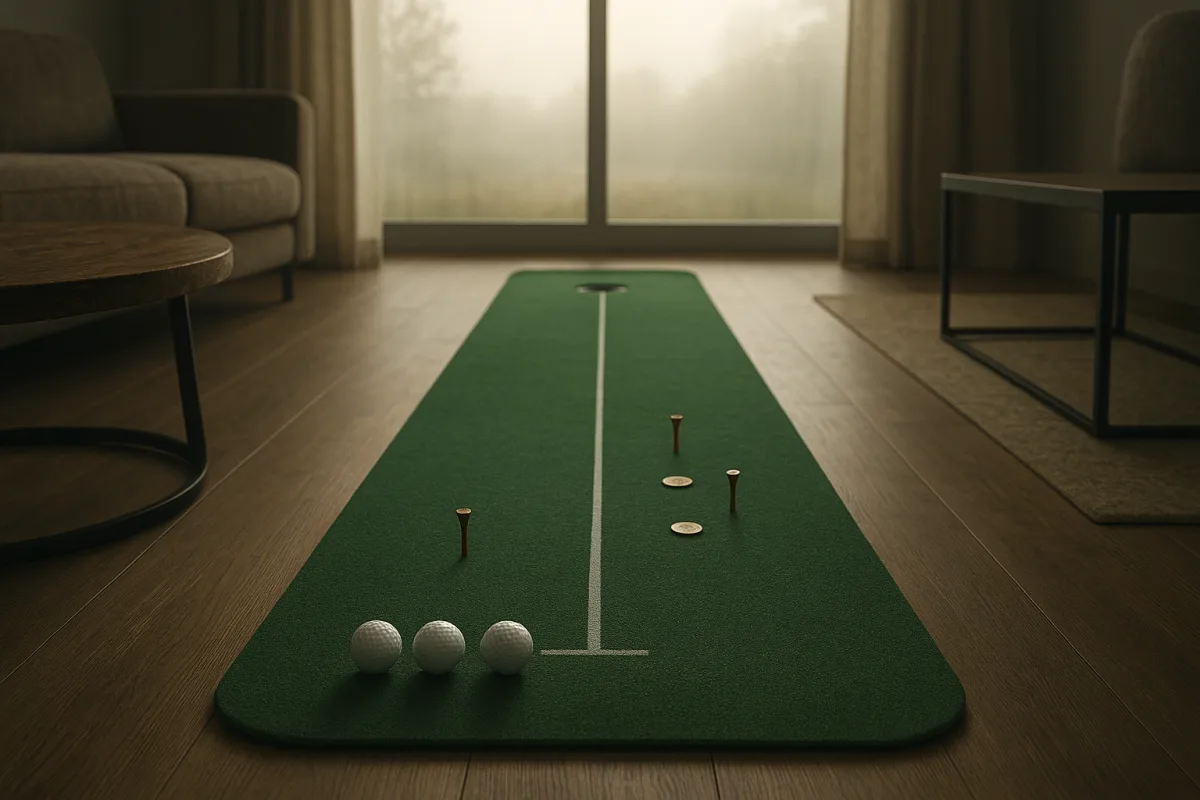
First problem: you do not have enough room
The ideal home mat is often quoted at 10 to 12 feet long and about four feet wide, with a non-crease polyester surface and EVA foam base intended to make the roll more green-like. [4][5] That is a sensible target if you have a spare room, office or garage lane.
Most of us do not. A six- to eight-foot mat is still enough to practice face control and start line, and it can support useful pace work for putts that would be 12 to 20 feet outdoors. You are not reproducing the whole putt, but you can rehearse a repeatable strike.
Do not force a 40-foot ladder drill into a hallway. The Ladder Drill is useful because it trains pace control through distinct distance targets, not because your carpet happens to be 40 feet long. [3] Scale the distances to your available lane and keep the task honest.
A practical small-space setup needs a flat section of floor, one cup-sized target, a few coins or tees, and consistent lighting. An actual hole is nice, but a coin, tape mark or small target gives better information than simply rolling putts toward the far end of the rug. [2][7]
Surface quality matters more than many home setups acknowledge. Indoor putting guidance flags lighting, mat consistency, temperature and humidity as factors affecting practice conditions, while an uneven or creased mat can make you diagnose a bad roll as a bad stroke. [10][11][12]
Keep the lighting steady and avoid moving the mat between carpet, tile and uneven floorboards every session. There is limited direct evidence that indoor air quality changes putting performance specifically, so I would not overthink it, but consistent room conditions are easier to learn from than a changing setup. [10][12]
Next problem: the putter does not start the ball where you think
Before worrying about speed, give yourself immediate feedback on whether the ball starts on line. The Gate Drill does that simply: set two tees just wider than the ball on your intended line, then roll putts through the gate without clipping either side. [1][2]
Place the gate a short distance ahead of the ball, not at the end of the mat. If the ball catches a tee, do not just hit another one. Reset your aim, posture and face position, then make the next putt a fresh attempt.
This is where an alignment mirror can earn its keep. The SKLZ Putting Mirror is listed at about $22 and suits the golfer who wants visual feedback on setup and alignment without turning a home practice corner into a simulator studio. [15]
A mirror is not a cure for every miss. It can show whether your eyes, shoulders and putter appear consistently positioned, but it cannot tell you why your face arrived open or closed on a particular stroke. Use it for setup checks, then remove it for some putts.
The Coin Drill offers an even cheaper option. Use a coin as a precise start target or reference point and try to roll the ball over it on the intended line, which makes vague “that looked straight” practice more measurable. [1][2]
I would keep this block short, perhaps five minutes. A putting stroke can become overly mechanical when every roll is constrained by a gate, mirror or rail, and Golf Smart Academy specifically warns against overreliance on training aids and excessive feedback. [14]
Then you discover that straight putts can still finish miles past
A home mat can make you look like a good putter if every ball rolls at one speed toward the same cup. On the course, the useful question is usually whether your next putt is manageable, so distance control needs its own practice block. [3][7]
Use the Towel Drill for pace. Place a folded towel beyond your target and try to finish the ball between the hole and towel, or stop it just before the towel when working on defensive speed. Pyramid Golf includes towel-based practice among its drills that need no putting green. [2]
The point is not to make every putt. It is to give a poor pace a visible result. A ball that reaches the target but races into the towel has taught you more than a made putt that happened to fall into an oversized practice cup.
For a longer target, use the Ladder Drill. Set several tape marks or coins at progressively farther points, then roll one ball to each location without repeating a distance until you have completed the sequence. GOLF.com recommends ladder-style drills specifically for distance control. [3]
If your available roll is seven feet, make a ladder at two, three, four, five, six and seven feet. Then reverse it. On a longer mat, use the same idea at wider intervals, but avoid pretending that a 10-foot synthetic surface perfectly replicates a 30-foot, sloping outdoor green.
The Three-Foot Increment Drill gives structure to that progression. Work through putts at three-foot steps, treating one to six feet as short range, six to 12 as medium range, and 12 to 20 as longer range. [8][9] Those categories keep practice from becoming all three-footers.
Short putts matter, but overemphasising them is a common home-practice mistake. [7][13] If all you do is make 30 putts from three feet, you may improve confidence from three feet while doing almost nothing for the 25-footer that determines whether you avoid a three-putt.
Then repetition becomes too easy
The best home practice has a little uncertainty. GOLFiX Journal argues that games and variable practice transfer better than mindless repetition, while Chiputt identifies repetitive drills without variation and a lack of pressure as common obstacles to improvement. [7][13]
Try a simple scorecard: make three putts from three feet, two from six feet and one from nine feet, with a set number of attempts at each station. If you miss the target, restart that station rather than immediately grinding the same putt.
That adds consequence without pretending your hallway is the final green on a Saturday medal. Pressure at home is necessarily artificial, but a required score, a restart rule or a limited number of balls makes each stroke less disposable. [13]
Rotate among a start-line drill, a speed drill and a scoring game in one session. The suggestion of 10 to 20 minutes daily, four or five times weekly, is a useful baseline, with reports of improvement over roughly a month, but it is not a universal prescription. [7]
Some golfers may retain their stroke mechanics with only five minutes, and the research brief does not establish one optimal routine for every amateur. The sensible test is whether your practice produces clearer feedback and fewer avoidable misses on the course, not whether you have hit a fashionable number of putts.
Use feel drills carefully, not as a magic fix
Eyes-Closed Putting is one way to shift attention from mechanics toward strike and pace. It is commonly recommended among home drills, alongside gates, towels and coin targets, but the evidence for direct on-course transfer is less settled than for straightforward start-line and distance-control tasks. [1][2]
Use it after you have checked your setup, not instead of checking it. Roll five balls with your eyes closed after address, then open them and compare finish distances. If the drill makes you tense or inconsistent, drop it. A tip that helps one golfer find feel will not fix every putting problem.
The same applies to any claim that a particular drill “fixes” a push, pull or yip. A launch monitor number belongs to the swing that produced it, and a putting drill result belongs to the stroke, surface and task that produced it. Home data is useful, but it is not a diagnosis by itself.
Choose equipment by the feedback you actually need
A basic mat and a few tees cover a surprising amount. If your issue is aim and setup, the approximately $22 SKLZ Putting Mirror is the low-cost choice, and it suits players who need a repeatable reference for alignment rather than another moving part. [15]
If you want a target that rewards correct pace, the PuttOUT Premium Pressure Putt Trainer costs about $50 and suits golfers working on the speed that would hold a real putt rather than simply collecting balls in a cup. [19] It is a target, not a substitute for reading slope outdoors.
For a more substantial surface, the Wellputt High Speed 10ft Putting Mat is listed below $200 and suits the player with enough clear floor for a dedicated 10-foot pace and line station. [20] Check the local price and currency before buying, since retailer listings and markets differ.
The Exputt RG Putting Simulator is priced around $470 and suits golfers who want simulated putting tasks and digital feedback without entering commercial simulator pricing. [21] That is a meaningful jump from a mat, so decide whether its feedback addresses a real practice gap.
At the top end, PuttView systems are cited around $12,000 plus subscription costs and suit dedicated simulator installations, coaching environments or golfers with unusually large budgets. [17][18] That price is for the technology, not necessarily the room, flooring, installation or ongoing service around it.
I have not used these products, and the evidence does not conclusively show that advanced simulators improve real-world putting more than well-designed traditional drills. [17] Most distance and improvement claims in golf sit closer to the noise than the marketing suggests, so fitting your practice setup to your actual miss is better than buying the most elaborate feedback system.
A 20-minute home session that covers the likely gaps
Start with five minutes of Gate Drill or Coin Drill work at three to six feet. Use one ball at a time, reset between attempts and note whether misses begin left or right. This is your face-control and start-line block. [1][2]
Spend the next seven minutes on pace. Use the Towel Drill for a stop zone, then run a short Ladder Drill through several marks on the mat. Alternate ascending and descending distances so you are not simply calibrating to one repeated stroke. [2][3]
Use five minutes for a pressure game: a set score across three, six and nine-foot stations, scaled to your available space. Include at least one medium or longer putt category, because a home routine built only around short makes leaves speed control behind. [7][8][9]
Finish with three minutes of eyes-closed rolls or normal putting without aids. That final block checks whether the movement still feels usable after the gates, coins and targets are removed. If it does not, reduce the aid time next session rather than adding another gadget. [14]
Frequently Asked Questions
How can I practice putting at home with limited space?
If you have limited space, use a shorter mat of six to eight feet instead of the ideal 10 to 12 feet. Focus on drills that emphasize face control and start line, such as the Gate Drill, and scale distances to fit your available lane. A flat floor section, a cup-sized target or coins, and consistent lighting help create a practical small-space setup.
What are effective putting drills to do at home?
Effective drills include the Gate Drill to improve ball start line, the Ladder Drill for distance control, and coin or tee drills for alignment and stroke path. Varying drills that target stroke path, face control, and pace—such as the Towel Drill and Three-Foot Increment Drill—help develop a repeatable and reliable putting stroke.
How long should I practice putting at home each session?
Practice sessions of 10 to 20 minutes, four to five times per week, are recommended. It’s important to vary distances, targets, and add consequences or pressure rather than simply repeating identical putts, as varied practice transfers better to on-course performance.
What equipment do I need to practice putting indoors?
At minimum, you need a flat surface, a putting mat (ideally 6 to 12 feet long and about 4 feet wide), a target such as a cup or coin, and tees or coins for alignment gates. An inexpensive alignment mirror (around $22) can provide valuable feedback on setup and stroke alignment without requiring expensive simulators.
How do I improve my putting alignment and speed at home?
Use the Gate Drill by placing two tees just wider than the ball on your intended line to ensure the ball starts on the correct path. For speed control, practice putts at varied distances scaled to your mat length, focusing on consistent stroke length and feel. Feedback tools like alignment mirrors help identify setup errors that affect alignment and speed.
How we researched this
This article was assembled from 21 cited references.
Nothing here is based on hands-on testing. Where a figure or finding appears, it belongs to the source cited beside it, and the writing says so rather than implying otherwise. Every source is listed below so you can check it.
Sources
- Putting Drills You Can Practice at Home | Improve Your... | Bulle Rock Golf
- Putting Practice at Home: 5 Effective Putting Drills That Don't Require a Putting Green – Pyramid Golf
- 5 great drills to improve your distance control when putting | GOLF.com
- Home Golf Putting Mat | Buy Putting Mat Golf | Net World Sports
- Indoor Putting Green Guide: How to Choose the Best One – PuttGreen
- Best Putting Mats 2026
- Practice Putting at Home: Drills That Lower Scores | Chiputt
- Golf Practice at Home: Simple Routines That Fit Real Life
- How to Practice Golf at Home — The Complete Setup Guide for 2026 – Home Golf Lab
- Golf Simulator Putting Practice in Michigan: How to Build a Better Sho
- Indoor Putting Green: Setups for Every Room (2026 Guide)
- Indoor Putting Practice at Home UK 2026 | The Golf Hacks
- Putting practice games that actually transfer to the course · GOLFiX Journal
- Putting Aid Feedback: Why Less Can Be More | Golf Smart Academy
- SKLZ Putting Mirror - Alignment Golf Training Mirrors
- Home Golf Simulator Putting: Best Mats in 2026. Divotloft
- Best Putting Simulator 2026: Exputt vs PuttView Compared
- PuttView Indoor Putting Green - Golf Simulator Videos
- PuttOUT Premium Pressure Putt Trainer — The House of Golf
- Wellputt High Speed 10ft Putting mat
- Exputt RG Putting Simulator - EX500D | GolfBox
Related Articles
Practice Golf Swing with a Friend: Safe, Effective Tips
Learn how to practice golf swing with a friend safely and effectively using structured drills, feedback roles, and focused sessions.
Best Golf Drills for Short Game: Improve Chipping & Control
Discover the best golf drills for short game to improve chipping accuracy, distance control, and course strategy with practical landing spot methods.
Prepare Mentally for Golf Tournament: Focus and Routine Tips
Learn how to prepare mentally for golf tournament with focus routines, breathing exercises, and warm-up strategies for better performance.
Improve Golf Swing Tempo: Tips and Drills for Success
Learn how to improve golf swing tempo with practical tips, drills, and training aids to enhance your rhythm and consistency on the course.