
Golf Tournament Rules: What You Need to Know
Learn the essential golf tournament rules including local rules, pace of play, and the role of the tournament committee.
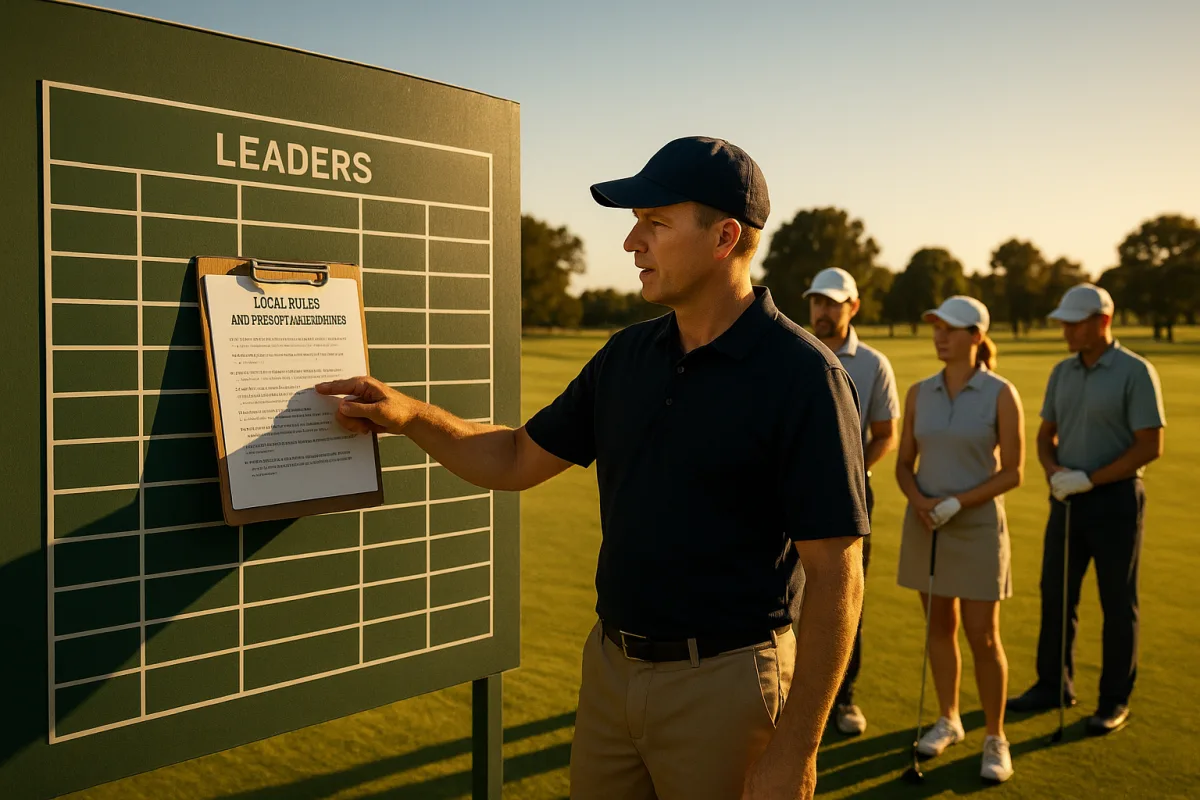
The tournament committee is the rule system you actually play under
When golfers say, “What are the tournament rules?”, they often mean the Rules of Golf. That is only part of the answer. The rules book is the common standard, while the tournament committee turns that standard into a competition.
The R&A and the USGA jointly publish the Rules of Golf used worldwide. [3] Those Rules cover basics such as playing the ball as it lies, penalties, relief and scorecard responsibilities. A tournament adds another layer: Terms of Competition and Local Rules.
Think of the rules book as the equipment specification, and the committee sheet as the build sheet for a particular club. A 10.5-degree driver head may be legal, but its actual launch depends on the shaft, strike location and golfer swinging it. Similarly, a Rule may be universal, but how it operates depends on the course setup and competition conditions.
The committee is normally the group appointed by the club, regional association or tour to run the event. It may include tournament staff, referees, starters and scoring officials. In a professional event, that structure is usually more formal. In a local amateur event, it may be the competition chair and volunteers.
Its job is not to make up golf rules at random. It uses the authority built into the Rules to define the format, establish starting times, mark penalty areas, identify ground under repair, set pace procedures and publish conduct expectations.
That means the first tournament document matters more than many players realise. The scorecard might identify a dropping zone. A notice board might introduce preferred lies after heavy rain. An email may state whether caddies are allowed, whether rangefinders are permitted, or what happens after a pace warning.
GOLF.com’s explanation of Local Rules makes the key point: a Local Rule is only in effect when the committee has adopted and communicated it. [11] Do not assume your regular Saturday-game custom applies in a qualifier just because it was used last month.
Terms of Competition: the event’s operating instructions
Terms of Competition are the administrative rules of the tournament. They answer questions that the main Rules of Golf intentionally leave to the people running the event.
A committee can specify whether the competition is stroke play, match play, Stableford or another authorized format. It can set handicap eligibility, entry deadlines, tee assignments, practice-round access, tie-breaking methods and what happens if weather interrupts play.
The Southwestern Amateur Golf Tournament’s published Conditions of Competition are an example of this sort of document. They establish event-specific requirements beyond merely handing competitors a standard rule book. [9] That is normal, not an extra layer of bureaucracy.
A tournament might also state the deadline for returning a scorecard, whether scores must be entered electronically as well as signed, and who is responsible if an app and paper card do not match. The official scorecard is not just a record of birdies and doubles. It is a competition document.
In stroke play, getting that card right is critical. Returning a score lower than actually taken on a hole, generally because a penalty was omitted, can mean disqualification. The harshness makes sense once you see the system: the field is relying on each player’s certified score.
The committee also determines entry and withdrawal procedures. The Greater Cincinnati Golf Association’s tournament policies show how regional amateur organizers can publish their own eligibility, conduct and administrative requirements. [10] There is no single all-amateur dress, caddie or withdrawal rule that applies everywhere.
That variability is worth remembering if you play both club events and larger amateur tournaments. A club may allow a spouse to caddie, while another event may restrict caddies, require them to register, or prohibit motorized transport for them. Read the event sheet rather than relying on memory.
Local Rules: how the course is made playable and fair
Local Rules are the practical part of committee work. They adapt a general Rules framework to features of a particular golf course, season or weather pattern.
A classic example is abnormal course conditions. Rule 16.1 provides free relief from an abnormal course condition such as ground under repair or temporary water. The player finds the nearest point of complete relief, then drops within one club-length of that point, not nearer the hole. [7][8]
“Nearest” does not mean “nicest.” It means the physically nearest point that gives complete relief from the interference. If that point leaves an awkward stance behind a tree, that is still the nearest point. A player may choose a different available option only if the Rules provide one, or may sometimes play the ball as it lies.
Free relief is also not always compulsory. A player can commonly choose to play a ball from ground under repair if the committee has not made that area a No Play Zone. Relief becomes mandatory when the committee has designated the area a No Play Zone, and there are separate obligations where temporary water interferes. [7][8]
This is where tournament paperwork changes the decision. A roped-off patch may look like ground under repair, but a golfer should know whether it is merely marked GUR, a No Play Zone, or simply an area the superintendent wants protected. Each designation can produce a different obligation.
Wet-weather Local Rules often cause confusion because players call them “winter rules.” A committee may adopt a Model Local Rule allowing a ball to be lifted, cleaned and placed in closely mown areas when conditions justify it. That permission is not automatic after rain.
Likewise, seasonal setup can alter what golfers encounter without changing the fundamental Rules. A course may overseed Bermuda grass with ryegrass in cooler months, producing a different lie and turf interaction. The committee still needs to communicate any relief or course-condition rule that affects play.
The sensible pre-round routine is simple. Read the sheet, look at the first tee notice, and ask the starter whether there are amendments. It is less glamorous than comparing driver ball speed, but it prevents penalties that no amount of launch-monitor work will recover.
Pace of play: the 40-second number is not a four-hour rule
Rule 5.6b(1) says players should make a stroke in no more than 40 seconds, and they are encouraged to play more quickly when possible. [3] That figure is often repeated as though it creates a universal maximum round duration. It does not.
The official Rules do not set a maximum round time. A fourball can take very different amounts of time depending on course length, rough, wind, field size, course traffic and whether groups are searching for balls. A six-hour round may be unacceptable, but the Rules do not contain a fixed six-hour cutoff.
Instead, the committee publishes its own pace policy. It may use checkpoint times, define an out-of-position group, issue warnings, put a group on the clock and apply penalties after bad times. Those details must come from the event’s stated policy, not from bar-room folklore.
This resembles launch-monitor numbers. A golfer seeing 2,800 rpm with a driver should not assume 2,800 rpm is universally right, because it belongs to that swing speed, delivery and strike. The 40-second figure works the same way. It is a standard reference, not a complete pace policy.
Players can help themselves by being ready while others play, choosing a provisional ball promptly when a shot may be lost or out of bounds, and watching where playing partners’ shots finish. Those are competition habits, not merely etiquette, because they affect whether the group falls behind.
If a group is put on the clock, do not assume the slowest-looking golfer is the only person exposed. Committees can assess each player’s time. Ask an official how the policy is being applied if there is uncertainty, rather than debating it while the clock runs.
Conduct rules can carry real penalties
Rule 1.2b allows a committee to create and enforce a Code of Conduct. Penalties can range from a one-stroke penalty to disqualification, depending on what the committee has adopted. [3]
That authority covers behaviour beyond the mechanics of playing a shot. A code may address club throwing, abusive language, damage to the course, mistreatment of staff, repeated misconduct or dangerous behaviour. The exact penalty ladder should be published in the Terms of Competition.
Golf Monthly reported that the 2026 U.S. Open used a two-stroke penalty for club throwing under its conduct framework. [1] The useful lesson is not that every local tournament automatically imposes two strokes. It is that conduct penalties are committee-specific and can be decisive.
Professional events generally run stricter dress and caddie standards than amateur events. PGA Tour-style competition involves detailed player and caddie expectations, while an amateur tournament may have anything from a basic collared-shirt requirement to a more formal dress policy, depending on the organizer.
A player should not treat dress and caddie rules as cosmetic. Turning up in prohibited clothing, bringing an ineligible caddie or ignoring a conduct instruction can create a problem before the first ball is struck. Tournament golf starts at check-in, not on the first tee.
Equipment rules: check conformity, ignore proposed changes for now
Rule 4 limits a player to 14 clubs during a round and requires clubs and balls to conform to the Equipment Rules. [2][6] Carrying more than 14 clubs is not a harmless packing mistake. It can produce a two-stroke penalty, subject to the Rules’ maximum penalty limits.
For tournament players, the practical equipment check is usually straightforward. Count clubs before the round, make sure the driver is not damaged or altered in a non-conforming way, and use a ball on the current Conforming Golf Ball List where the competition requires it. [2][3]
At the technical end, a conforming golf ball has a minimum diameter of 1.680 inches, a maximum weight of 1.620 ounces and an initial-velocity limit of 250 feet per second under the test standard. [4][5] Those figures matter to manufacturers and governing bodies more than to most golfers choosing between two retail balls.
Current club limits include a maximum club length of 46 inches and a driver-face Characteristic Time limit of 257 microseconds. [2][6] Characteristic Time is a test of face flexibility, not a launch-monitor reading. It does not tell you how fast your own ball will leave the face.
There are proposals under review for elite or professional play, including a 317-yard test-distance limit for balls, a reduction in permitted driver-face flexibility toward 239 microseconds, and possible club-length changes. These are not mandatory rules for amateurs at present.
That distinction matters because equipment-rule headlines can sound more immediate than they are. Most claimed distance gains between current retail drivers are within the noise unless the strike pattern, loft, shaft and ball are controlled. Fitting beats buying, and rules compliance is a separate question from performance.
Professional tours may also impose conditions that ordinary amateur events do not. The PGA Tour’s One Ball Condition, for example, requires a player to use the same brand and model of ball throughout a round. That is not a default requirement for every club competition.
When to call for a ruling
The safest tournament habit is to stop guessing when a ruling could change the score. If a ball may be in a penalty area, in ground under repair, lost, obstructed or played from a wrong place, involve a referee or committee official where one is available.
If an official is not immediately available in stroke play, the Rules provide procedures for playing two balls in certain doubtful situations and reporting the facts to the committee before returning the scorecard. That option is far better than quietly choosing the lie that looks most favourable.
Tournament rules are not designed to catch players out. They are there to make every score comparable. The committee’s published conditions are the bridge between a universal rule book and the actual course, weather and field in front of you.
Frequently Asked Questions
What are the key golf tournament rules players must know?
Players should understand the baseline Rules of Golf published by the R&A and USGA, including how to play the ball as it lies, penalties, relief options, and scorecard responsibilities. Additionally, they must read the tournament’s Terms of Competition and Local Rules, which specify event-specific details like scoring procedures, pace of play policies, caddie access, and equipment conditions. Knowing when and how to seek rulings from officials is also important to avoid costly mistakes.
How do local rules affect golf tournament play?
Local Rules adapt the general Rules of Golf to the specific course, weather, or conditions on the day of the event. They can define areas of ground under repair, penalty zones, or preferred lies, and must be adopted and communicated by the tournament committee to be in effect. Players should not assume that local rules from previous events or casual rounds apply unless explicitly stated for the current tournament.
What is the role of the tournament committee in golf rules?
The tournament committee applies the Rules of Golf to the specific competition by setting the format, starting times, marking penalty areas, establishing pace of play procedures, and publishing conduct expectations. It is responsible for issuing the Terms of Competition and Local Rules that govern how the event is played, and for resolving disputes or questions during play. The committee’s authority ensures that the universal rules are tailored fairly to the course and conditions.
How do pace of play rules work in golf tournaments?
The Rules of Golf provide a guideline of 40 seconds to play a stroke but do not set a maximum round time. Pace of play enforcement and penalties depend on the tournament committee’s published policies. Players should be aware of the committee’s specific pace rules and consequences, as these can vary between events.
What are Terms of Competition in golf tournaments?
Terms of Competition are the administrative rules established by the tournament committee that govern the event’s format, eligibility, tee assignments, practice access, tie-breaking methods, and procedures for weather interruptions. They also cover scorecard submission requirements, caddie regulations, and withdrawal policies. These terms supplement the Rules of Golf to provide a complete framework for the competition.
How we researched this
This article was assembled from 11 cited references.
Nothing here is based on hands-on testing. Where a figure or finding appears, it belongs to the source cited beside it, and the writing says so rather than implying otherwise. Every source is listed below so you can check it.
Sources
- Has The Major Code Of Conduct Policy Worked?
- What is player's equipment (rule 4) in Golf?
- United States Golf Association
- Golf Ball Size, Weight, Dimples & Velocity Limits | item.guide
- Golfball Größe & Gewicht 2026: Alle Normen erklärt - Golf Mag
- Golf Clubs, Balls, and Equipment Rules Explained | Sport Rules
- Ground Under Repair Rules in Golf Golflink.com
- Rules Review: What is casual water and how do I play around it? | How To Play Golf | Golf Digest
- CONDITIONS OF COMPETITION – Southwestern Amateur Golf Tournament
- Tournament Policies
- Local Rules: How do you know when they're in effect? | GOLF.com
Related Articles

Prepare Mentally for Golf Tournament: Focus and Routine Tips
Learn how to prepare mentally for golf tournament with focus routines, breathing exercises, and warm-up strategies for better performance.

Common Golf Etiquette Mistakes Every Golfer Should Avoid
Learn common golf etiquette mistakes and how to maintain pace, repair marks, and respect course rules for a better game experience.

Handle Pressure in Golf Tournaments: Mental Game Strategies
Learn how to handle pressure in golf tournaments with routines, breathing, and course strategy to improve your mental game under stress.

Hitting a Wrong Ball in Golf: Rules and Penalties Explained
Learn what to do if you hit a wrong ball in golf, the penalties involved, and how to correct your mistake in stroke and match play.